
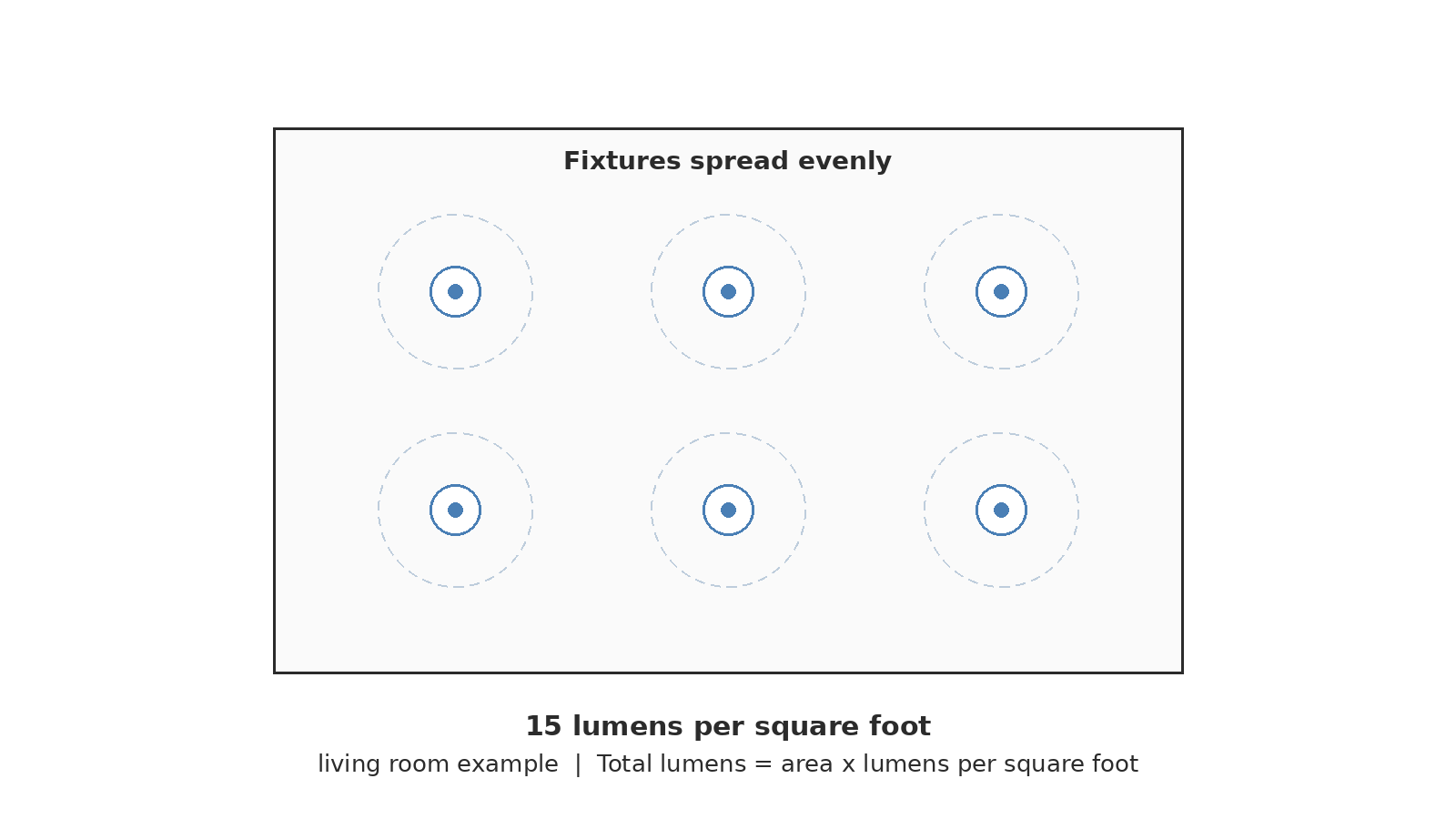
A dim room is usually a math problem, not a bulb problem. One ceiling light cannot cover a kitchen, and a bright bedroom bulb still leaves corners dark. If you are wondering how to calculate how many lumens for a room, this tool does the math from two measurements and the room type. Measure the length and width of the room in feet, pick the room type, and pick the bulb brightness from the bulb label. The tool returns total lumens and how many bulbs that means, so you buy the right count the first time.
Table of Contents
Quick Answer
Multiply room area in square feet by the lumens per square foot for the room type. Living rooms and bedrooms need 10 to 20 lumens per square foot, kitchens need 30 to 40, and bathrooms need 70 to 80. A 12 by 12 foot living room is 144 square feet, so at 15 lumens per square foot it needs 2,160 lumens, about three 800 lumen bulbs split across fixtures.
How to Use the Tool
- Measure the room length and width in feet, wall to wall, and note both numbers. Switch the units box to meters if your tape reads metric.
- Pick the room type from the list, since each room type uses its own lumens per square foot.
- Pick the bulb brightness from the bulb label, or use 800 lumens for a standard bulb.
- Press Calculate and read the total lumens first.
- Read the bulb count next, and split those bulbs across fixtures instead of using one bright bulb.
- Add task lighting over counters, desks, and mirrors, then recheck the room at night before buying more.
How the Result Works
The tool turns room size and room type into a lumen total and a bulb count with one formula. It uses a published lumens-per-square-foot figure for the room type, so the same room size gives a different answer for a bedroom and a bathroom. Every result shows the figure used, so you can check the math by hand.
How to Calculate How Many Lumens for a Room: The Formula
Lumens measure light coming out of a bulb. Foot-candles measure light landing on one square foot of surface. One foot-candle equals one lumen per square foot, so the two numbers convert directly. Total lumens equals room length times room width times lumens per square foot for the room type. Bulbs needed equals total lumens divided by lumens per bulb, rounded up, since a partial bulb cannot light a room. For an L-shaped room, split the floor into rectangles, work out each rectangle separately, and add the totals together. Measure each rectangle wall to wall and use the same room-type figure for all of them.
Lumens per square foot by room type
The table below shows the typical range for each room type and the single figure the tool uses, which is the midpoint of the range. Bathroom and kitchen figures run high because grooming and food preparation need clear, shadow-free light. Bedroom and living room figures run low because those rooms suit softer ambient light with lamps for reading.
| Room type | Typical range | Calculator uses | 12x12 room total |
|---|---|---|---|
| Living room | 10 to 20 | 15 | 2,160 lumens |
| Bedroom | 10 to 20 | 15 | 2,160 lumens |
| Dining room | 20 to 30 | 25 | 3,600 lumens |
| Kitchen | 30 to 40 | 35 | 5,040 lumens |
| Home office | 30 to 50 | 40 | 5,760 lumens |
| Bathroom | 70 to 80 | 75 | 10,800 lumens |
| Hallway | 5 to 10 | 8 | 1,152 lumens |
What changes the result
Ceiling height and wall color move the number most after room size. Ceilings over 10 feet push light further before it lands, and dark walls absorb light instead of bouncing it back, so add about 20 percent more lumens in either case. The checkbox in the tool adds that 20 percent for you. Layered lighting splits the total across sources: ambient light from the ceiling, task light where you work, and accent light for glow.
Bedroom accent layers such as fairy lights bedroom ideas add atmosphere without adding much to the total. Task areas need their own light on top of the room total, and battery operated under cabinet lighting covers kitchen counters without wiring. Color temperature changes how light feels, not how many lumens are needed, and the best Kelvin for living room guide covers warm versus cool choices.
Daylight and dimmers change how the total feels in use. The tool total covers evening use, when windows add nothing, so a sunny room still needs the full total after dark. A dimmer lets one bulb total serve both bright evenings and soft late nights, since you can turn the same bulbs down instead of buying two sets. If the room has one switch and no dimmer, split the bulbs across two switches or lamps so you can light half the room on quiet evenings.
Lumens versus watts
Watts measure power use, not brightness. An old 60 watt incandescent bulb made about 800 lumens, while a modern LED makes the same 800 lumens with about 9 watts. Shop by the lumens number on the label, not the watt number. Bulb packaging in the US carries a Lighting Facts label that lists lumens first, so the number is easy to find without reading the fine print. Common equivalents are 450 lumens for about a 40 watt bulb, 800 lumens for about a 60 watt bulb, 1100 lumens for about a 75 watt bulb, and 1600 lumens for about a 100 watt bulb.
Common Mistakes
- Shopping by watts instead of lumens, then wondering why two "60 watt" bulbs look nothing alike. One may be 800 lumens and the other 450, since wattage no longer tracks brightness for LEDs.
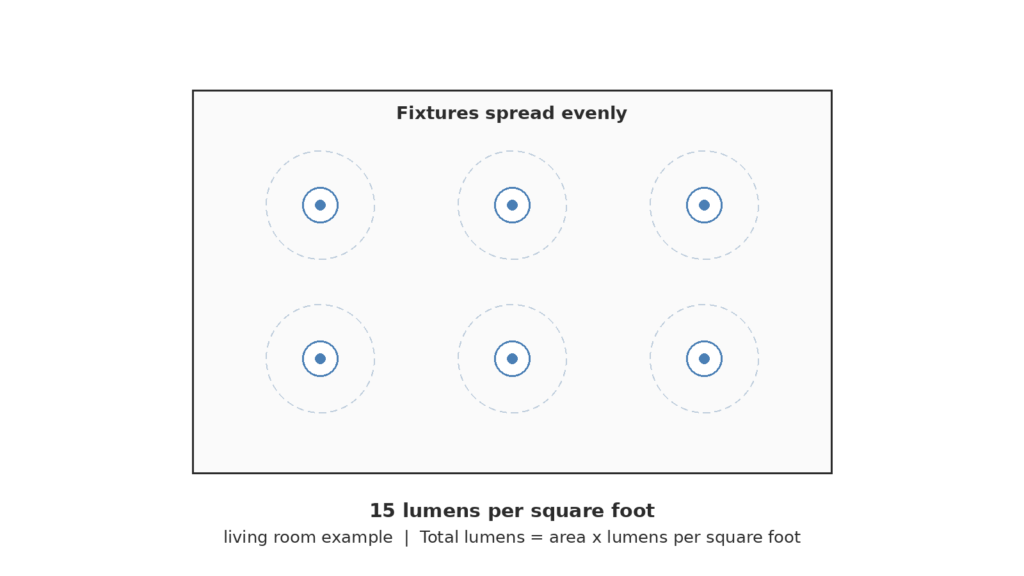
- Putting all the lumens in one ceiling fixture, which leaves corners dark while the center is glaring. Split the total across two or three sources at different heights instead.
- Forgetting the room-type figure when the room serves two purposes, like a dining room that doubles as an office. Work to the higher figure so the brighter use gets enough light.
- Skipping task lighting because the room total looks high enough on paper. General light spreads everywhere and task light concentrates where you need it, and one cannot replace the other.
- Relying on daylight figures for a room you use at night. Test the room after dark, then add portable layers like plug-in pendant lights before buying a second round of bulbs.
FAQs
How many lumens is a 60 watt bulb?
A traditional 60 watt incandescent bulb makes about 800 lumens. A modern LED bulb makes the same 800 lumens with about 9 watts, so compare bulbs by the lumens number on the label, not the watt number.
How bright is 1000 lumens?
1000 lumens is a little brighter than a classic 60 watt bulb. In a 12 by 12 foot bedroom needing 2,160 lumens, 1000 lumens covers about half the room, so it works as one of two light sources rather than the only light.
Is 1000 lumens bright?
For a small bedroom or hallway, 1000 lumens is fine. For a kitchen or bathroom, it is not: a 10 by 12 foot kitchen needs 4,200 lumens, so 1000 lumens covers less than a quarter of the requirement.
How many lumens for bathroom?
Bathrooms need 70 to 80 lumens per square foot, and this tool uses 75. An 8 by 10 foot bathroom is 80 square feet, so it needs 6,000 lumens split across ceiling light and mirror light.
How many lumens for bedroom?
Bedrooms need 10 to 20 lumens per square foot, and this tool uses 15. A 12 by 12 foot bedroom is 144 square feet, so it needs 2,160 lumens, about three 800 lumen bulbs split across a ceiling light and lamps.
How many lumens to light a room?
Multiply the room area in square feet by the lumens per square foot for the room type. Living rooms and bedrooms need about 15, kitchens about 35, and bathrooms about 75. The tool does this math and converts the total into a bulb count.
How many lumens for living room and kitchen?
Living rooms need 10 to 20 lumens per square foot and kitchens need 30 to 40. The tool uses 15 for living rooms and 35 for kitchens, so a 12 by 12 foot living room needs 2,160 lumens and a 10 by 12 foot kitchen needs 4,200 lumens.
Key Takeaways
- Total lumens equals room length times room width times lumens per square foot for the room type.
- Living rooms and bedrooms need about 15 lumens per square foot, kitchens about 35, and bathrooms about 75.
- Bulbs needed equals total lumens divided by lumens per bulb, rounded up.
- Split the total across two or three fixtures instead of putting it all in one ceiling light.
- Add about 20 percent more lumens for dark walls or ceilings over 10 feet.
- Shop by lumens on the Lighting Facts label, not by watts.
- Task lighting over counters, desks, and mirrors sits on top of the room total, not inside it.
Conclusion
A well-lit room starts with one number: total lumens. Measure the room, pick the room type, and let the tool do the math. Buy the right bulb count the first time, spread the bulbs across fixtures, and add task light where you work. For rooms with no outlets to plug into, see how to light a dark room with no outlets.