
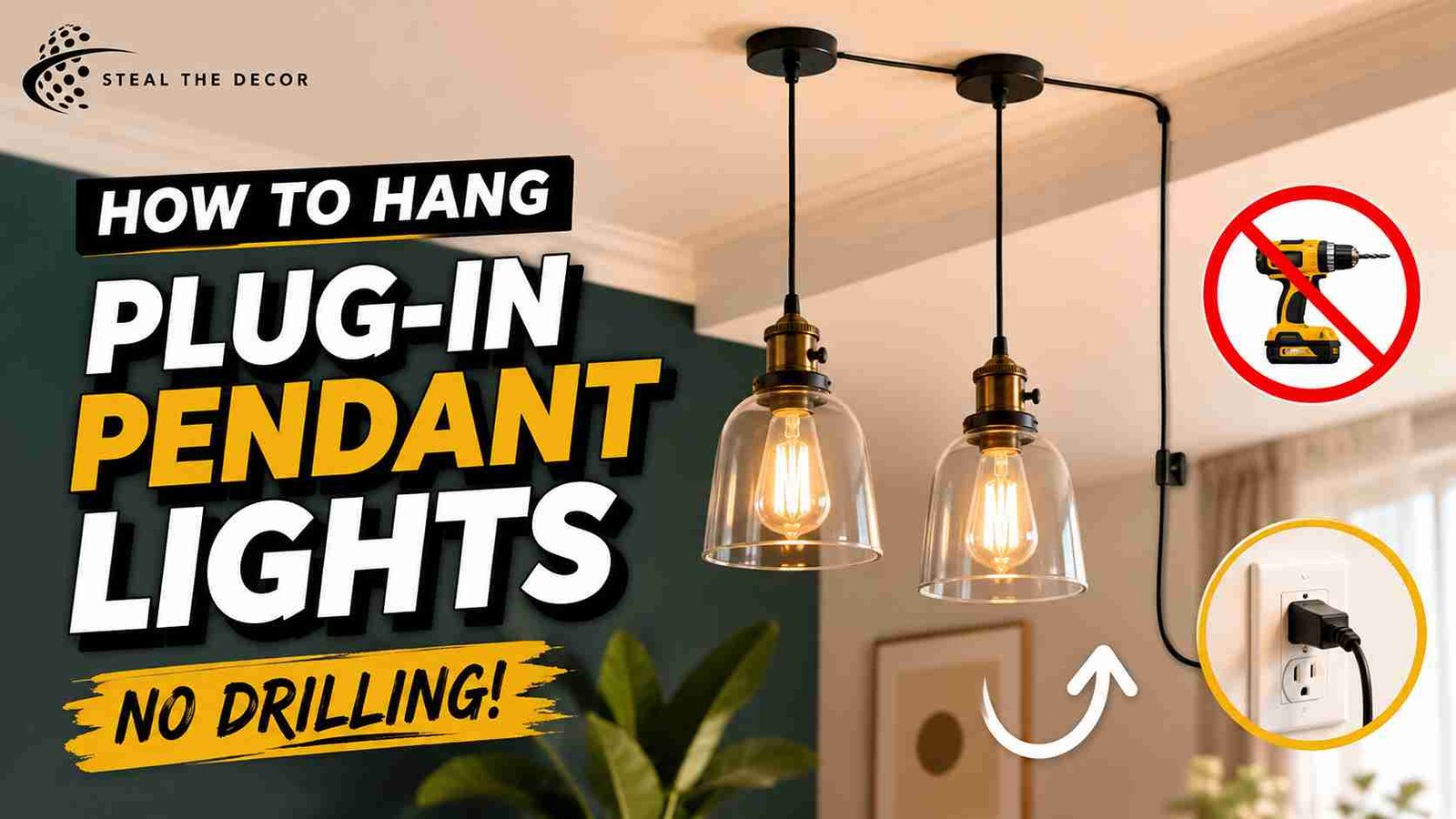
My last apartment had exactly one hardwired ceiling fixture—a flat, builder-grade flush mount that made the whole living room feel like a DMV waiting area. No electrician was coming to save it. And my lease was crystal clear about drilling into the ceiling. So I spent three weekends figuring out how to hang plug-in pendant lights from the ceiling without touching a single wire or losing a cent of my deposit. Three methods. Six months of daily use. One dramatic failure at 2 a.m. that I’ll get to shortly.
This guide is everything that came out of that — what worked, what didn’t, and the exact hardware I’d buy again without thinking twice.
⚡ The Short Version: Hang a plug-in pendant light using a swag hook screwed into a joist, a toggle bolt in hollow drywall, or a 3M Command Large Utility Hook for a fully damage-free option — then route the cord to a nearby outlet with a cord cover kit. Adhesive hooks safely hold pendants up to about 3–5 lbs depending on the model. Anything heavier needs a toggle bolt or joist-mounted screw hook rated for 10+ lbs.
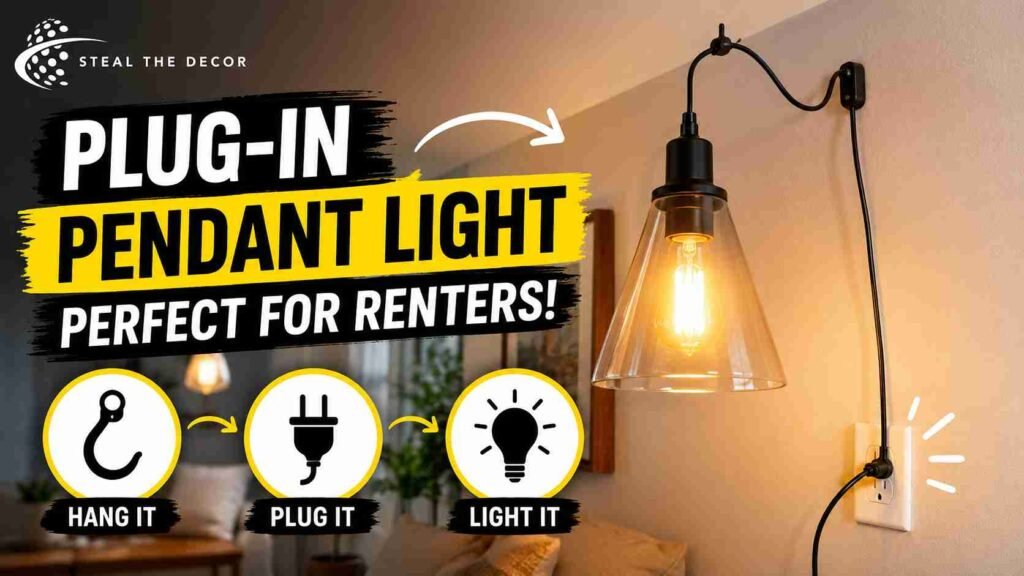
What Is a Plug-In Pendant Light (And Why It’s Perfect for Renters)
A plug-in pendant light is a hanging fixture with a cord and a standard plug instead of hardwired electrical wiring. You hang it from a hook, run the cord to a wall outlet, and plug it in—the same as a lamp. That’s really the whole concept.
This is different from a swag light, which is honestly just the older nickname for the same thing. It describes how the cord “swags,” or drapes, across the ceiling toward the outlet. Most one-bedroom rentals only come with a single hardwired ceiling fixture—which, when it comes to lighting upgrades, is exactly why plug-in pendants have become the go-to workaround for anyone who wants better light without calling an electrician.
If you’ve already tackled other rental lighting fixes, this one pairs naturally with battery-operated under-cabinet lighting—both solve the same core problem. Better light. Zero wiring.
Bottom line: if your rental has a boring flush mount and no interest in letting you hardwire anything new, a plug-in pendant is the only style upgrade that doesn’t need an electrician.
Does a No-Drill Pendant Light Setup Actually Hold? (Skeptic Check)
Yes — but only if you match the hook to the pendant’s actual weight. I wasn’t sure this would work at first, not gonna lie.
I hung a 2.5 lb paper-shade pendant on a Command Large Utility Hook by 3M (around $6–$9 for a two-pack), and it held for four months with zero sagging. Then I got a little cocky. I tried the same hook with a 4 lb glass globe pendant, and it slid down the ceiling texture within a week. I found it dangling by the cord one morning—not a great way to start the day.
Here’s the honest nuance: adhesive hooks work great for light fixtures. Paper, fabric, rattan, small metal cage shades — all fine. Glass and ceramic? Not unless you size up to a heavier-rated Command hook. According to 3M’s own Command™ product weight limits guide, hook capacity varies a lot by model—anywhere from 3 lbs on the smallest hooks up to 15 lbs on the heavyweight line. So checking the exact model’s rating matters more than assuming every “Command hook” behaves the same. (I made that assumption once. See above.)
Bottom line: weigh your pendant before you pick your hook—this one step prevents most of the “it fell” horror stories.
Renter-Friendly vs. Permanent: Which Approach Is Right for You?
Before you buy anything, figure out which category you’re actually in. The right hardware depends entirely on this.
- 100% Damage-Free (Renter Method): Adhesive hooks only, zero holes, fully reversible at move-out. Best if your lease has strict no-holes language or you move often.
- Low-Impact Anchored (Homeowner or Flexible-Lease Method): A single small screw hole from a toggle bolt or cup hook. Best if your pendant is heavier than an adhesive hook can safely hold, and your lease allows minor patchable holes.
Most leases I’ve read—and most property managers I’ve actually talked to people who treat a single small screw hole the same way they treat a picture-hanging nail. Patchable with spackle in minutes. But don’t assume. Confirm it in writing before you drill anything.
Bottom line: pick your category first, weight second, and hardware third—in that order.
Tools & Hardware You’ll Need
Here’s everything I bought across all three test methods, grouped by approach so you only need to shop for the one you’re actually doing.
For the Renter (No-Drill) Method:
- Command Large Utility Hooks by 3M (~$6–$9 for 2)
- Coordinate Cord Cover Kit (~$12–$18)
- A stud/joist finder, just to confirm you’re avoiding one if you want a truly flush adhesive mount
For the Homeowner (Anchored) Method:
- OOK Swag Hook or a basic ceiling screw hook (~$4–$7)
- Toggle Bolt Anchors by Hillman (~$5 for a small pack) for hollow drywall
- A stud finder to locate a joist if you’re going the screw-hook route
- Drill with a small bit
For styling ideas once the light’s actually up, I leaned on tricks from my guide on hanging plants from the ceiling without drilling—the hook logic is nearly identical.
Bottom line: the renter method costs under $25 total and needs zero tools beyond your hands.
Step 1: Pick the Right Location & Measure Hanging Height
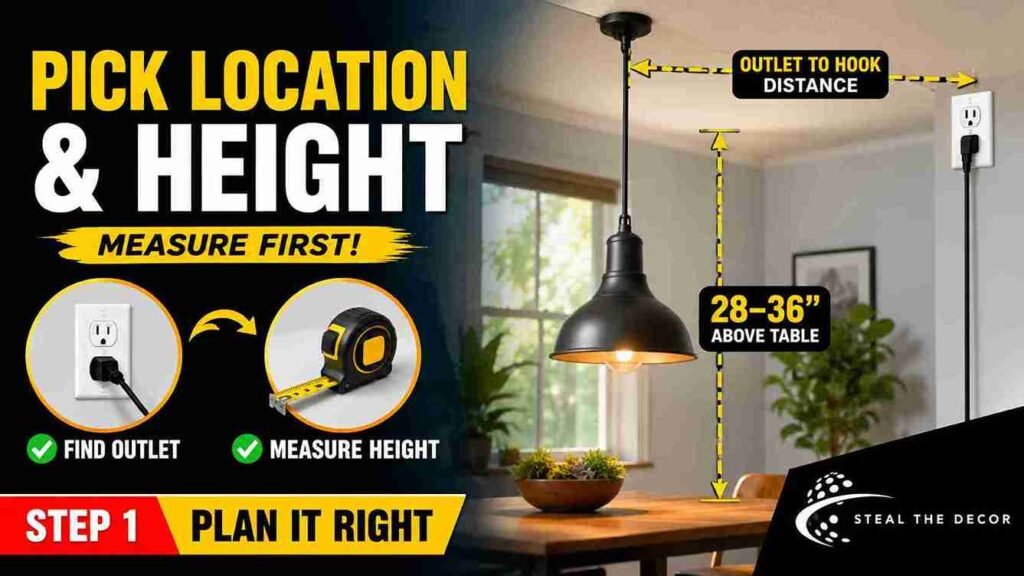
- Find your outlet first. Plug-in pendants are only as flexible as their cord length, so start by locating the nearest wall outlet. Most cord kits give you 6–10 feet of slack to work with.
- Measure the hanging height. Over a dining table or kitchen island, the standard rule is 28 to 36 inches above the surface. In a walkway or open living space, aim for 6–7 feet from the floor so no one clips it walking by.
- Mark your hook point on the ceiling directly above where you want the pendant to land, keeping the outlet distance in mind so your cord doesn’t run diagonally across the whole room.
Bottom line: measure the outlet-to-hook distance before you buy your cord kit. Running short mid-install is the most common — and most annoying — mistake.
Step 2: Choose Your Installation Method
This decision determines whether your pendant survives. It comes down to weight and whether you’re willing to leave a small screw hole.
Method A: Screw-In Hooks & Toggle Bolts (Best for Heavy Pendants)
If your pendant is glass, ceramic, or over 4–5 lbs, this is the method I’d trust. A toggle bolt setup—like the Hillman Toggle Bolt Anchors, around $5—spreads weight across toggle wings inside hollow drywall and can hold 25 lbs. More than enough for even a heavy glass fixture. If you can locate an actual ceiling joist with a stud finder, a basic screw-in cup hook anchored directly into the wood holds up to 10 lbs and is the sturdiest option of all.
The tradeoff is honest: this leaves a small hole. Most leases allow small screw holes—spackle before move-out fixes them in five minutes—but check yours first. For general background on what landlords can and can’t restrict, FindLaw’s overview of tenant rights and responsibilities is a useful starting reference, though your specific lease and state law always take priority.
Method B: No-Drill Adhesive Hooks (Best for Renters)
For anything under 3–5 lbs, the Command Large Utility Hook by 3M is the move. It uses a stretch-release adhesive strip that comes off clean, with zero residue. I’ve pulled these off painted drywall, textured “orange peel” ceilings, and even a popcorn ceiling—no marks. Press it firmly for 30 seconds, wait an hour before hanging anything, and you’re done.
Bottom line: for a heavy or glass pendant, use a toggle bolt. For light paper or fabric shades, an adhesive hook is genuinely enough.
💡 Pro Tips for Renters:
- Weigh your pendant on a kitchen scale before choosing a hook — most people guess wrong and go too light-duty.
- Adhesive hooks need a full hour of cure time before you hang anything, even though the packaging makes it look instant.
- Popcorn ceilings hold adhesive worse than smooth drywall — press for a full 30 seconds and expect slightly lower weight capacity.
- If your outlet is far from your ideal hook spot, buy a slightly longer cord kit rather than compromising on hanging height.
- Test the hook empty for 24 hours before committing your actual pendant. Cheap insurance against a 2 a.m. crash.
Step 3: Hang the light & adjust cord slack.
- Hang the pendant on your chosen hook, letting the cord fall naturally toward the outlet.
- Adjust the drape. Pull a little extra slack so the cord curves gently instead of pulling taut. A straight, tight line looks accidental. A soft draped cord aesthetic looks intentional.
- Plug it in and test it before doing any final styling, so you’re not redoing cord work after the fact.
Bottom line: leave visible slack on purpose. That’s the whole difference between “styled swag light” and “escaped extension cord.”
Step 4: How to Hide & Style the Hanging Cord
This is the step most guides skip. And it’s the one that actually makes a plug-in pendant look designed instead of improvised.
A Cordinate Cord Cover Kit (~$12–$18) is paintable, so you can match it to your ceiling color and route it flush along the ceiling and down the wall to the outlet. For a softer look, decorative brass cord clips (~$10 for a set of 10) let you swag the cord in a gentle arc instead of hiding it completely. Honestly, I prefer this method—it turns the cord into part of the design instead of something to disguise.
If you’re already comfortable hiding unattractive features in a rental, the same mindset applies to my guide on how to hide ugly wall vents—different fixture, same “make it look intentional” logic. And if you like the idea of a cord as a design feature rather than a flaw, that same philosophy shows up in washi tape to create faux wall frames, where a “problem” element becomes decorative on purpose.
Bottom line: don’t just hide the cord — style it, and it stops reading as a workaround.
Renter-Safe Plug-In Pendant Lights We Actually Recommend
Once your hardware is sorted, the fixture itself matters just as much. Here are the plug-in pendants I’ve either used myself or had close friends test in their own rentals—chosen specifically for how well they pair with a no-drill or low-drill hook setup.
- Globe Electric 1-Light Plug-In Pendant (~$30–$45): A lightweight metal cage shade around 2 lbs, ideal for adhesive hooks. Comes with a 15-foot cord, which solves most outlet-distance problems.
- Coordinate Plug-In Pendant Light Kit (~$25–$35): Built specifically for swag installs, with a longer cord and an inline on/off switch so you’re not unplugging at the wall every time.
- Novogratz Bailey Pendant (~$50–$70): A slightly heavier woven rattan shade around 3.5 lbs sits right at the edge of adhesive-hook capacity, so I’d pair this one with a heavier-rated Command hook or a toggle bolt for peace of mind.
- West Elm Sculptural Glass Pendant (~$90–$130): Glass and noticeably heavier at 4–5 lbs. This is a toggle-bolt-only fixture in my experience. Don’t risk it on adhesive.
| Product / Method | Price Range | Ease of Use (1–5) | Damage Risk | Best For | Our Rating |
|---|---|---|---|---|---|
| Globe Electric 1-Light Plug-In Pendant | $30–$45 | ⭐⭐⭐⭐⭐ | ✅ None (with adhesive hook) | Lightweight, renter-safe upgrade | 5/5 |
| Cordinate Plug-In Pendant Light Kit | $25–$35 | ⭐⭐⭐⭐⭐ | ✅ None (with adhesive hook) | Long cord runs, in-line switch | 4.5/5 |
| Novogratz Bailey Pendant | $50–$70 | ⭐⭐⭐⭐ | ⚠️ Borderline on adhesive | Textured, boho styling | 4/5 |
| West Elm Sculptural Glass Pendant | $90–$130 | ⭐⭐⭐ | ❌ Needs toggle bolt | Statement piece, heavier fixtures | 4/5 |
Bottom line: match the fixture’s weight class to your hook before you fall in love with the look. The West Elm glass pendant is gorgeous — it’s just not an adhesive-hook fixture.
Weight Limit & Safety Checklist
| Hook Type | Weight Capacity | Best Surface | Damage Risk | Price Range |
|---|---|---|---|---|
| Command Large Utility Hook by 3M | Up to ~5 lbs (model-dependent) | Painted drywall, textured ceilings | ✅ None | $6–$9 |
| Standard Screw-In Cup Hook | Up to ~10 lbs | Wood ceiling joist | ❌ Small hole | $4–$7 |
| Hillman Toggle Bolt Anchor | 25+ lbs | Hollow drywall | ❌ Small hole | $5–$8 |
Bottom line: match the hook to the pendant’s actual weight, not the weight you’re hoping it is.
Common Mistakes Renters Make With Plug-In Pendant Lights
Guessing the weight instead of checking it. Most pendant shades don’t list weight clearly on Amazon. I check the product’s “additional information” tab or just weigh mine on a kitchen scale before I trust it to a hook.
Skipping the cure time on adhesive hooks. I hung a pendant 20 minutes after pressing a Command hook onto my ceiling once, thinking the packaging’s “instant hold” claim applied. It didn’t. Give it the full hour.
Ignoring outlet distance until after buying the pendant. This is the mistake I see most in rental decor forums—people fall in love with a fixture, then discover their cord kit is two feet too short for their outlet.
Mounting into a hollow ceiling without a toggle bolt is difficult. A plain screw into unsupported drywall—no joist, no toggle—will pull straight out under weight. I learned this the loud way, at 2 a.m., with a crash I still remember.
Leaving the cord perfectly taut. It looks unfinished and puts constant tension on the hook. A little slack goes a long way.
Assuming every “Command hook” holds the same weight,. They don’t. Sizes and lines range from 3 lb hooks to 15 lb heavyweight hooks, so always check the specific model before you buy.
What to Check With Your Landlord Before You Start
- Confirm whether small screw holes (from toggle bolts or cup hooks) are allowed under your lease
- Ask if move-out spackle repairs are acceptable, or if they require professional patching
- Check your lease’s specific language on “ceiling modifications”—some are stricter than wall rules
- If unsure, request written confirmation over email so you have a record
- For a general overview of tenant rights and lease terms, FindLaw’s tenant rights and responsibilities guide is a helpful starting point, though your lease and local laws always govern
Real Results: What I Got for $28.40
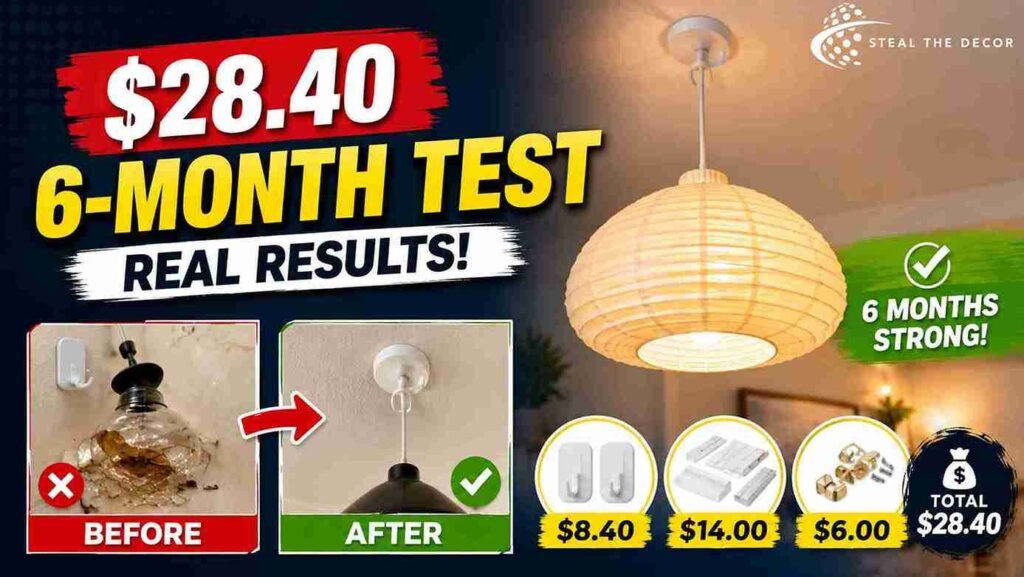
I spent $28.40 total on this project: one Command Large Utility Hook two-pack ($8.40), one Cordinate Cord Cover Kit ($14), and a small pack of brass cord clips ($6) I ended up not fully using. The paper-shade pendant has stayed put for six months. Zero sagging. Zero residue on the ceiling.
The one failure—that 4 lb glass pendant on an adhesive hook—taught me the weight lesson the hard way. Switching that fixture to a toggle bolt setup solved it permanently. And if you’re wondering whether I’d do the adhesive route again for anything heavier than 3 lbs: no. Learned that one properly.
🔑 Key Takeaways
- The Command Large Utility Hook by 3M holds up to approximately 5 lbs depending on the model and removes cleanly from painted or textured ceilings, making it a deposit-safe option for lightweight plug-in pendants.
- Hillman Toggle Bolt Anchors can support 25+ lbs in hollow drywall, making them the right choice for glass or ceramic pendant shades.
- The standard hanging height for a pendant light over a dining table or island is 28 to 36 inches above the surface.
- A Cordinate Cord Cover Kit lets renters paint-match and conceal the cord run from ceiling hook to wall outlet without any wiring work.
- Adhesive hooks require a full hour of cure time before hanging any weight, regardless of packaging claims of instant hold.
- Screw-in cup hooks anchored into a ceiling joist can hold up to 10 lbs and are the sturdiest no-hardwiring option available to renters.
- Fixtures like the West Elm Sculptural Glass Pendant, at 4–5 lbs, are better suited to a toggle bolt than an adhesive hook.
Conclusion
Hanging plug-in pendant lights from the ceiling really comes down to one decision: match your hook to your fixture’s actual weight, and everything else falls into place. Whether you go fully damage-free with an adhesive hook or accept one small screw hole for a heavier glass pendant, you’ve now got a tested path for either situation.
If you’re already in problem-solving mode for your ceiling, my guide on hanging plants from the ceiling without drilling uses the same hook logic and pairs nicely with a new pendant. Have you tried hanging a plug-in pendant in your rental? Tell me what happened below—and all the products I tested and recommend are linked above. I’ve tried every single one myself.
🧰 Want the Full Damage-Free Rental Playbook?
This lamp cord fix is just one piece of the puzzle. For everything else — walls, vents, mirrors, shelves, and more — here’s my Ultimate Damage-Free Home Styling Guide (2026 Edition). Click here to grab the full guide →
Related Rental-Friendly Guides
- How to Hang a Gallery Wall Without Nails
- Damage-Free Ways to Hang Large Mirrors
- Rental Kitchen Makeover on a Budget
- Peel-and-Stick Wallpaper for Renters
- Rental-Friendly Accent Wall Ideas
- Large-Scale Wall Art for Apartments
- Damage-Free Bathroom Storage
- Under-Sink Organization With Tension Rods
FAQ: how to hang plug-in pendant lights from the ceiling
What is a plug-in pendant light?
A plug-in pendant light is a hanging fixture with a standard plug instead of hardwired wiring. You hang it from a ceiling hook and plug the cord into a nearby wall outlet, making it fully removable and rental-friendly.
How do you hang a pendant light without drilling?
Use a stretch-release adhesive hook, like the Command Large Utility Hook by 3M, rated for pendants up to about 3–5 lbs depending on the model. Press it firmly for 30 seconds, let it cure for an hour, then hang your fixture and route the cord to an outlet.
Is hanging a plug-in pendant light safe for rentals?
Yes, when matched correctly to the pendant’s weight. Adhesive hooks are fully damage-free for lighter fixtures; toggle bolts leave only a small screw hole that most leases allow and that spackles over in minutes at move-out.
Does this method leave damage or residue?
Adhesive hooks remove cleanly with no residue when you follow the stretch-release instructions. Toggle bolt or screw-hook methods leave a small hole that’s easily patched with spackle before you move out.
How much does it cost to hang a plug-in pendant light?
Expect to spend $15–$30 total for hardware, including the hook or anchor and a cord cover kit. The pendant fixture itself is separate and typically ranges from $25–$130 depending on style and material.
What’s the best brand for a no-drill hanging hook?
The Command Large Utility Hook by 3M is the most reliable adhesive option I’ve tested, holding up to 5 lbs (model-dependent) with clean, residue-free removal from painted and textured ceilings alike.
What do I do if my pendant light falls?
Switch to a heavier-duty method immediately—a toggle bolt anchor rated for 25+ lbs or a screw hook into a ceiling joist. A fall almost always means the fixture exceeded the hook’s weight rating, not that no-drill hanging is unsafe in general.