
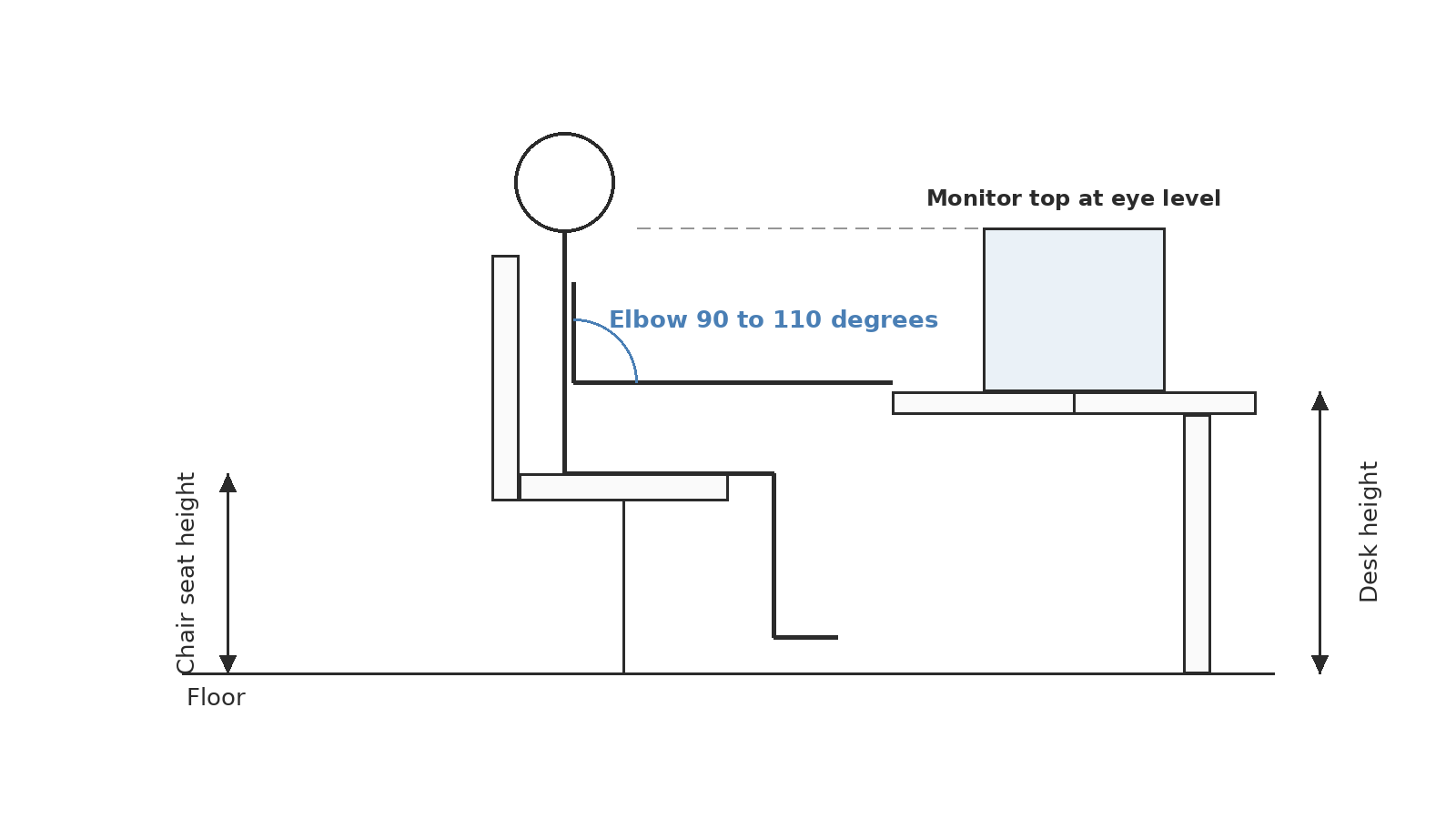
A desk at the wrong height makes itself known fast. Shoulders creep up, wrists bend, and the lower back complains by lunch. The fix is rarely a new desk. It is a number: the height where your forearms rest level and your elbows sit at 90 to 110 degrees. This ergonomic desk height calculator finds that number from your height, for sitting and standing, plus matching chair and monitor heights. Measure your height wearing the shoes you work in, then enter it below. If your desk lives in a closet nook, closet office ideas shows how others fit a workspace into that space.
Table of Contents
Quick Answer
For most adults, a sitting desk belongs at 24 to 30 inches and a standing desk at 38 to 46 inches, with the surface at elbow height and forearms level. A standard fixed desk is 29 inches tall, which suits people around 6 feet tall. Enter your height in the tool above for your own range, then fine-tune by elbow height over your first week.
How to Use the Ergonomic Desk Height Calculator
- Put on the shoes you wear while working, then enter your height in inches, or switch the units box to centimeters.
- Pick Sitting and standing, Sitting only, or Standing only, depending on the desk you are setting.
- Press Calculate and read your desk height range first.
- Set the chair seat height shown, so thighs stay level and feet rest flat on the floor.
- Set the top of the monitor to the monitor height shown, at or just below eye level.
- Fine-tune by elbow height over the first week in half-inch steps, and recheck after changing shoes or chairs.
How the Result Works
The tool turns one input, your height, into a full workstation setup. It uses published height formulas for the desk ranges, then derives chair and monitor figures from the desk height with two plain rules. Every number is a starting range, not a single exact setting, because two people at the same height can need desks an inch apart. The elbow check at the end of this section settles any case where the formula feels wrong.
The sitting formula
Sitting desk height comes from two linear formulas published by Omni Calculator. The minimum is 0.4739 times your height minus 6.678, and the maximum is 0.5538 times your height minus 9.427, with height in inches. Both results round to the nearest half inch. For a 5 foot 7 inch person (67 inches), the math gives 25 to 27.5 inches, which matches the published example for that height. The formulas assume average body proportions and height measured in shoes, so they give a range to start from rather than one fixed number.
The standing formula
Standing desk height tracks elbow height. Elbow height while standing runs about 0.62 times body height, so the tool shows 0.62 times your height, plus or minus 1 inch for tuning, rounded to the nearest half inch. For a 5 foot 7 inch person, that gives 40.5 to 42.5 inches, inside the published 40.5 to 43.5 inch example for that height. Standing ranges run higher than sitting ranges by roughly the height of a chair seat, which is why a desk that only adjusts a few inches cannot serve both positions.
Chair and monitor figures
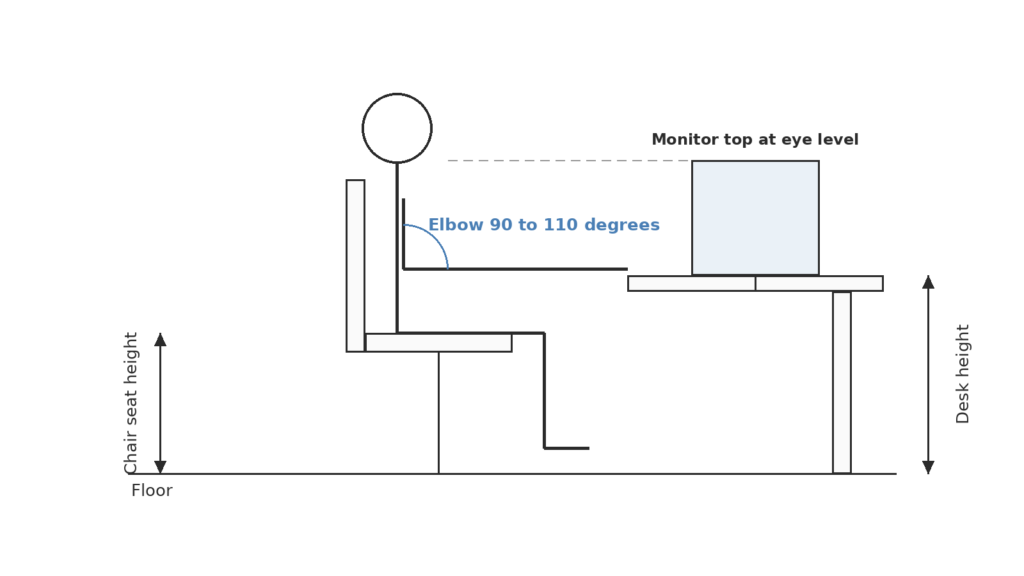
Chair seat height runs about 9 inches below sitting desk height, which keeps thighs level and feet flat on the floor. For the 5 foot 7 inch example, that gives a chair seat of 16 to 18.5 inches. Monitor top height runs about 21 inches above desk height, which puts the top of the screen at or just below eye level when you look straight ahead.
For the same example, that gives a sitting monitor top of 46 to 48.5 inches and a standing monitor top of 61.5 to 63.5 inches. Pair the chair number with a chair that actually adjusts to it: see these ergonomic office chairs for what adjustment range to check. A laptop screen sits far below eye level on its own, so a laptop stand for desk raises it toward the monitor height shown.
What changes the result
Three inputs move the result most: height, shoes, and position. An inch of shoe sole moves every figure by about half an inch sitting and about six-tenths of an inch standing. Switching from sitting to standing adds roughly 14 to 16 inches for most adults. Body proportions matter too: a long torso with short legs needs a higher sitting desk than the formula suggests, which is why the elbow check has the final say.
Fine-tune with the elbow check
Height formulas use averages, so the elbow check settles the final setting. Standing, bend your elbows to 90 degrees as if typing, measure from the floor to the bottom of your elbows, and subtract about 1 inch for keyboard thickness. Sitting, measure from the seat to the bottom of your elbows and add the seat height. When the elbow check disagrees with the height formula, trust the elbow check, since it measures your actual proportions. Three things shift the best setting most: the shoes you work in, keyboard thickness, and monitor size, so recheck after any of those change.
Shared desks and children
A desk shared by people of different heights needs the full adjustable range, not one person’s number. Adjustable sitting desks commonly cover 22 to 33 inches, and standing desks commonly cover 35 to 47 inches, so check the desk’s travel spec before buying. For a child’s desk, an adjustable model grows with the child instead of needing replacement every year or two. When only one fixed desk serves two people, set it for the taller person and give the shorter person a footrest and a lower chair setting.
Desk Height Chart
Use the chart when you want a number without running the tool. All heights are in inches, and all ranges round to the nearest half inch.
| Your height | Sitting desk | Standing desk | Chair seat |
|---|---|---|---|
| 5 ft 0 in | 22 to 24 | 36 to 38 | 13 to 15 |
| 5 ft 2 in | 22.5 to 25 | 37.5 to 39.5 | 13.5 to 16 |
| 5 ft 4 in | 23.5 to 26 | 38.5 to 40.5 | 14.5 to 17 |
| 5 ft 6 in | 24.5 to 27 | 40 to 42 | 15.5 to 18 |
| 5 ft 8 in | 25.5 to 28 | 41 to 43 | 16.5 to 19 |
| 5 ft 10 in | 26.5 to 29.5 | 42.5 to 44.5 | 17.5 to 20.5 |
| 6 ft 0 in | 27.5 to 30.5 | 43.5 to 45.5 | 18.5 to 21.5 |
| 6 ft 2 in | 28.5 to 31.5 | 45 to 47 | 19.5 to 22.5 |
| 6 ft 4 in | 29.5 to 32.5 | 46 to 48 | 20.5 to 23.5 |
Standard fixed desks are 29 inches tall, which suits people around 6 feet tall. Everyone else needs an adjustable desk, a different chair height, or a footrest to close the gap.
Common Mistakes
- Setting the desk to the standard 29 inches regardless of height. Fix: use the tool range for your height; 29 inches suits people around 6 feet tall, and shorter users need a lower surface or a footrest.
- Raising the chair to reach a high desk. Fix: fix height at the desk, not the chair; feet must rest flat on the floor, or add a footrest under them.
- Setting monitor height by the desk instead of eye level. Fix: the top of the screen belongs at or just below eye level, about 21 inches above the desk; raise a laptop on a stand instead of tilting your head down.
- Copying a chart number and never tuning it. Fix: adjust in half-inch steps over the first week until forearms sit level and shoulders stay down, then leave it alone.
- Stopping at the desk number. Fix: chair, monitor, keyboard, and cables all shift comfort, so finish the setup; desk cable management ideas keep cords from pulling a monitor arm out of place.
FAQs
What is standard desk height?
The standard fixed desk height is 29 inches. Adjustable sitting desks commonly cover 22 to 33 inches, so one fixed height cannot fit everyone. If your desk does not adjust, match it with chair height and a footrest instead. People around 6 feet tall fit a 29 inch desk best.
How tall is a desk?
Most fixed desks run 28 to 30 inches tall, and the common standard is 29 inches. Measure from the floor to the top of the desk surface. Adjustable desks move far beyond that range, from about 22 inches sitting to about 47 inches standing. Your ideal height depends on your body, not on the standard.
How high is a desk?
For most adults, a sitting desk runs 24 to 30 inches high and a standing desk runs 38 to 46 inches high. Those are typical ranges, not personal settings. Enter your height in the tool above for your own range, then check it against elbow height. Two people at the same height can still need desks an inch apart.
How high should a desk be?
A desk should sit at elbow height, with forearms level and elbows at 90 to 110 degrees. That rule holds sitting and standing. Use the tool above for a height-based range, then confirm it with the elbow check: floor to elbow minus about 1 inch standing, or seat to elbow plus seat height sitting.
How tall should a desk be?
A sitting desk should hold your forearms level at elbow height, 24 to 30 inches for most adults. A standing desk should do the same while you stand, 38 to 46 inches. Run your height through the tool above, set the desk to the middle of the range, and tune it in half-inch steps over the first week.
What is the average height of a desk?
The average fixed desk is 29 inches tall. That average suits people around 6 feet tall and runs high for shorter users. Standing desks typically run 38 to 46 inches, while adjustable desks cover wider ranges in both positions. Treat any average as a starting point, then set the desk to your own elbow height.
How high should standing desk be?
A standing desk should sit at elbow height minus about 1 inch for keyboard thickness. For most adults that lands between 38 and 46 inches. Measure floor to elbow with elbows at 90 degrees, subtract about 1 inch, and set the desk there. Then set the monitor top at eye level and tune in half-inch steps over the first week.
Key Takeaways
- Sitting desk height for most adults runs 24 to 30 inches; standing runs 38 to 46 inches.
- The desk surface belongs at elbow height with forearms level and elbows at 90 to 110 degrees.
- Standard fixed desks are 29 inches tall and suit people around 6 feet tall.
- Chair seat height runs about 9 inches below sitting desk height; monitor top runs about 21 inches above desk height.
- Measure height wearing the shoes you work in, and fine-tune in half-inch steps over the first week.
- When the elbow check disagrees with the height formula, the elbow check wins.
- For a desk that cannot move, a footrest, chair adjustment, monitor riser, or keyboard tray closes the gap.
Conclusion
One height input gives the whole workstation: desk range, chair seat, and monitor top for sitting and standing. The formulas do the rough work, and the elbow check does the fine work, since it measures your proportions instead of an average. Set the desk to the middle of your range today, then adjust half an inch at a time over the first week until forearms sit level and shoulders stay down.
If the desk itself cannot move, the gap is still fixable with a footrest, a different chair setting, or a monitor riser. For a small-space setup that stays simple, a minimalist desk setup for renters keeps the surface clear once heights are right. Recheck the setup after changing shoes, chairs, or monitors, since each one moves the best setting.