
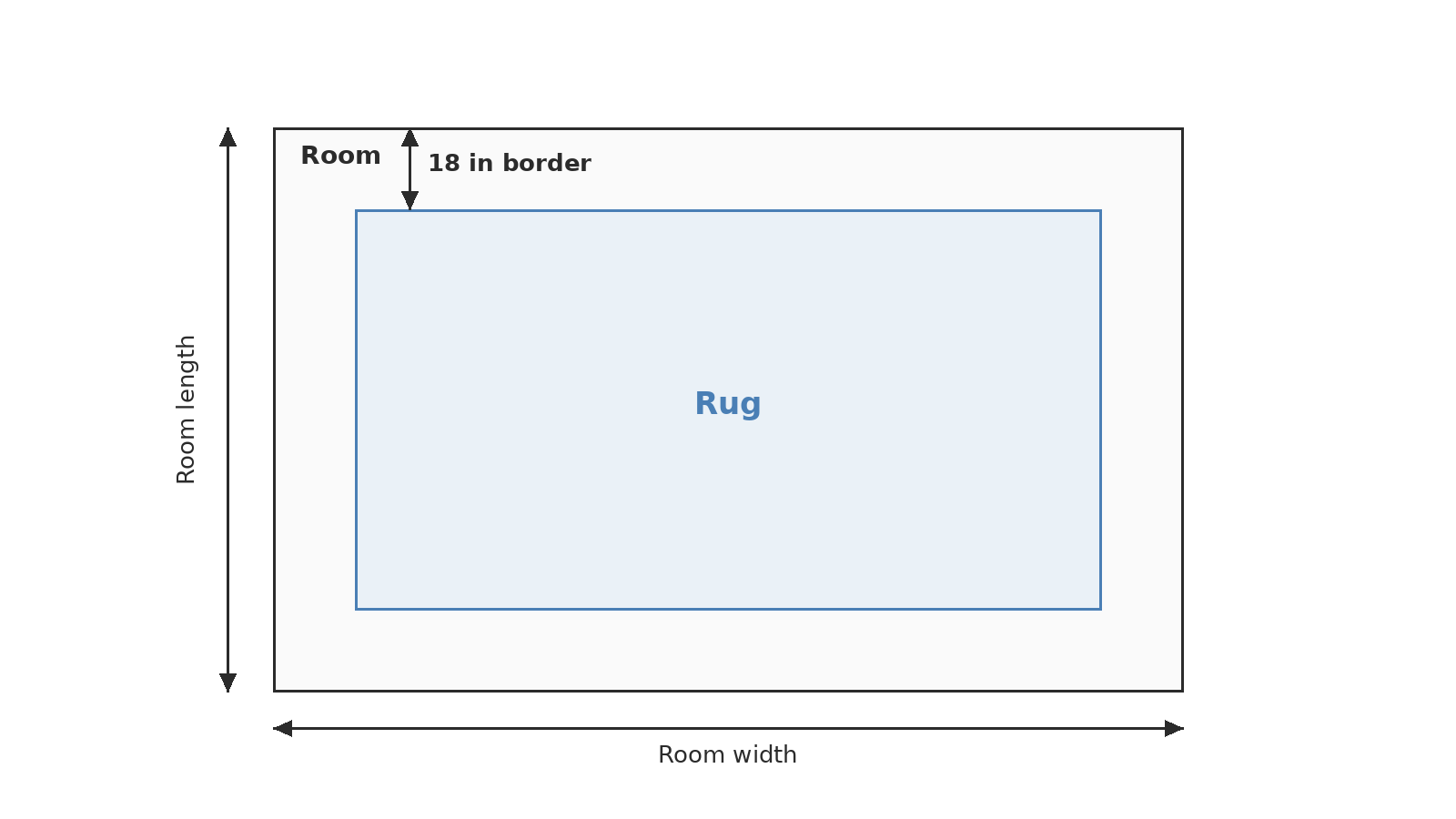
A rug that is too small floats with no furniture touching it. A rug that is too big eats the walkways and creeps under doors. The calculator below fixes both problems. Enter your room size and room type, and it returns the rug size that fits your room plus the nearest standard size you can buy. Measure the room in feet first, and the table or bed in inches for dining rooms and bedrooms.
Rug Size Calculator
Quick Answer
Measure your room and subtract 12 to 18 inches of bare floor on each side, then buy the nearest standard size at or above that number. If that size would leave less than 8 inches of bare floor at a wall, drop one size, and the calculator flags this for you. For a standard living room that usually means an 8x10 rug. For a queen bed it means an 8x10. For a dining table it means the table plus 24 inches on every side. The calculator above does this math for your exact room.
How to use the rug size calculator
- Measure the room length and width in feet, wall to wall. Switch the units box to meters if you measure in metric.
- Pick the room type: living room, bedroom, dining room, or hallway.
- Set the bare floor border. The default is 18 inches on each side; the allowed range is 8 to 24 inches. Hallways skip this step and use a fixed 6 inch margin.
- For a dining room, enter the table length and width in inches, or pick Round and enter the table diameter. For a bedroom, pick the bed size.
- Press Calculate.
- Read the custom size, the nearest standard size, and the placement note. Between sizes, buy the larger one.
How the rug size is calculated
The calculator uses one rule per room type. Every result shows the formula behind it.
| Mode | Formula | Worked example |
|---|---|---|
| Room-fit | Room minus 2 times the border | 12 by 16 ft room, 18 in border: 9 by 13 ft, nearest standard 10x14 |
| Dining | Table plus 48 in each way (24 in per side) | 72 by 36 in table: 120 by 84 in, nearest standard 8x10 |
| Bedroom | Bed width plus 36 in; bed length plus 24 in | Queen 60 by 80 in: 96 by 104 in, nearest standard 8x10 |
| Hallway | Hall minus 12 in each way (6 in per side and end) | 4 by 12 ft hall: 3 ft by 11 ft runner |
- Assumptions: rectangular rooms and rugs, an even border on all sides, whole-inch rounding. Odd shapes and very large sectionals change the result, so measure the seating zone itself in those cases.
- King bed note: a king at 76 by 80 inches needs 112 by 104 inches. The nearest standard size covering that area is a 9x12, which is also the common retail pick for a king. With the 9 foot side across the bed it leaves about 16 inches of rug at each side; turned so the 12 foot side runs across, it leaves about 34 inches.
- Between sizes, the calculator rounds up to the nearest standard size. A slightly large rug only shows a smaller border; a slightly small rug leaves furniture legs off the edge.
Standard rug sizes chart
| Size | Inches | Square feet | Typical use |
|---|---|---|---|
| 2x3 | 24 by 36 | 6 | Entry or in front of a sink |
| 3x5 | 36 by 60 | 15 | Small entry or bedside |
| 4x6 | 48 by 72 | 24 | Small bedroom or office |
| 5x7 | 60 by 84 | 35 | Small living area or home office |
| 5x8 | 60 by 96 | 40 | Small living area or small bedroom |
| 6x9 | 72 by 108 | 54 | Small dining table or smaller living room |
| 8x10 | 96 by 120 | 80 | Standard living room, queen bed, dining room |
| 9x12 | 108 by 144 | 108 | Large living room, king bed, large dining room |
| 10x14 | 120 by 168 | 140 | Open plan spaces |
| 2x6 runner | 24 by 72 | 12 | Hallway |
| 2x8 runner | 24 by 96 | 16 | Hallway |
| 2x10 runner | 24 by 120 | 20 | Hallway |
Rug sizes by room
| Room | Rule | Common pick |
|---|---|---|
| Living room | Front legs of sofa and chairs on the rug; 12 to 18 in bare floor at walls | 8x10; 9x12 large; 5x8 small seating only |
| Bedroom | Under lower two-thirds; 18 to 24 in past sides and foot | Twin, Full, and Queen 8x10; King 9x12; 5x8 as a landing strip in a small room |
| Dining room | Table plus 24 in on every side; round table: diameter plus 48 in | 72 by 36 in table: 8x10; 8 seats: 9x12 |
| Hallway | 6 in bare floor each side and end | Runner 2 to 3 ft wide |
Related guides
- area rug over carpet: layering a rug on carpeted floors without ripples.
- arrange furniture in a long narrow living room: seating zones in long rooms.
- corner furniture ideas: anchoring a corner seat with a rug.
- console table behind a sofa: where the seating zone starts when a console sits behind the sofa.
Common mistakes
- Buying too small, so the front legs sit off the rug: size up until they sit on it.
- Measuring the room but not the furniture, so dining chairs slide off the edge: run the dining mode with the real table size.
- Blocking a door swing or walkway: check doors and paths before buying.
- Sizing down between standard sizes: buy the larger size, since a slightly large rug only shows a smaller border.
- Leaving zero bare floor: keep at least 8 inches of border so the rug does not read as wall-to-wall carpet.
- Using a rectangular rug under a round table: use a round rug sized to the table diameter plus 48 inches.
Frequently asked questions
What size rug for living room?
An 8x10 rug fits most standard living rooms. It holds the front legs of the sofa and chairs while leaving 12 to 18 inches of bare floor at the walls. In a large open room, step up to a 9x12. In a small seating area with one sofa and no side chairs, a 5x8 can work.
What size rug for king size bed?
A 9x12 rug is the common pick for a king bed. Placed under the lower two-thirds of the bed, it leaves about 16 inches of rug at each side, with room to spare at the foot. If your room is tight, an 8x10 still works but leaves only about 10 inches at each side.
How big is a 5x7 rug?
A 5x7 rug measures 60 inches by 84 inches and covers 35 square feet. It fits a small living area, a home office, or the foot of a bed. It is too small for a standard sofa set, where the front legs of the seating need at least an 8x10 in most rooms.
What size rug for a room?
Subtract 12 to 18 inches of bare floor from each side of the room, then buy the nearest standard size at or above the result. For a 12 by 16 foot room with an 18 inch border, that means a 9 by 13 foot rug, and the nearest standard size is 10x14.
How big is 8x10 rug?
An 8x10 rug measures 96 inches by 120 inches and covers 80 square feet. It is the standard pick for a living room, a queen bed, and a dining table up to 72 by 36 inches. If your room is larger than 12 by 14 feet, check whether a 9x12 fits better.
What size rug for full size bed?
An 8x10 rug fits a full bed, which measures 54 by 75 inches. Place it under the lower two-thirds of the bed so you step onto rug at both sides and at the foot. In a very small bedroom, a 5x8 under the lower half of the bed works as a landing strip.
What are standard rug sizes?
Common US standard rug sizes are 2x3, 3x5, 4x6, 5x7, 5x8, 6x9, 8x10, 9x12, and 10x14 feet. Standard runner widths are 2, 2.5, and 3 feet, with lengths of 6, 8, 10, and 12 feet. Round rugs commonly come in 4, 6, and 8 foot diameters.
Key takeaways
- Room-fit size equals room length minus 2 times the border, and room width minus 2 times the border, with 18 inches as the default border.
- At least the front legs of the sofa and chairs must sit on a living room rug.
- A dining rug must extend 24 inches past every table edge, which means adding 48 inches to the table length and width.
- A bedroom rug sits under the lower two-thirds of the bed with 18 to 24 inches of rug past the sides and at the foot.
- When your size falls between two standard sizes, buy the larger one.
- A rug pad should be 1 to 2 inches smaller than the rug on all sides so it never peeks out at the edges. A pad also stops the rug from sliding, and securing loose rugs is a standard step in fall-proofing a home.
Conclusion
Picking a rug size comes down to two checks: the room check and the furniture check. The room check subtracts a 12 to 18 inch border from each side of the room. The furniture check puts the front legs of seating on the rug, adds 24 inches around a dining table, and puts 18 to 24 inches of rug past the sides and foot of a bed. Run both checks in the calculator above, take the larger answer when they disagree, and buy the nearest standard size at or above it. Measure once with a tape measure, and the rug you buy will anchor the room instead of floating in it.