
Every rental has one corner that never quite works. The rest of the room is fine, the sofa fits, the rug is right, and then there is that one square of floor where a laundry basket lives next to a plant that gave up months ago. It looks unfinished, not because the room needs more stuff, but because nothing in that corner has a job.
That is the whole point of corner furniture ideas that help in a rental. A corner does not need a collection of small decorations. It needs one freestanding piece that fixes what the room is missing, whether that is a seat, a place to store blankets, a light, or somewhere to set a cup down.
This guide sticks to living rooms and bedrooms, and to pieces you can carry in, place, and carry out again at move-out. Nothing here needs drilling or building in. Measure first, pick one piece, and let the rest of the room stay as it is.
Affiliate disclosure: This post contains affiliate links. If you buy through them, we may earn a small commission at no extra cost to you. As an Amazon Associate, I earn from qualifying purchases.
Quick Answer: Choose one freestanding piece for the corner based on what the room is missing: a seat, closed storage, light, or a landing spot. Measure along both walls before you buy, keep a clear walkway past the piece, and leave breathing room around it.

Start With the Corner You Have, Not the Piece You Want
Shopping first is how a corner ends up worse than empty. A chair that looked compact in a shop can block a door swing at home, and a cabinet that fit the wall on the left can stick out past the wall on the right. Start with the corner itself. Take a measuring tape and write down the length along both walls and the depth you can use before the piece starts eating the walkway.
Then note the things that limit the choice: door swings, heaters, outlets, and natural light. A bright corner near a window suits a plant and a reading chair.
Now give the corner one job, and only one. A dead corner becomes useful the moment it has a purpose: a place to sit and read, a place to store things out of sight, a place for a lamp to stand, or a place to land a book and a cup.
An awkward corner is one with a door, a heater, or an odd angle that limits what fits. An unused corner is simply empty, with no traffic passing through it.
A rug can help mark the corner’s territory, but only if the rug already belongs in the room. If your floor is carpeted and you want a defined seating spot, read about area rug over carpet before layering anything, since a rug that slides will undo the tidy corner you just made.

Living Room Corner Furniture Ideas
Most living room corners fail in the same way: they sit beside the main seating area doing nothing, while the seating area itself is short of a seat, a light, or storage. Each of the living room corner ideas below fills one of those gaps. Whatever the corner looks like now, empty, awkward, or full of odds and ends, the test stays the same: one piece, one job, measured on both walls.
A corner sofa or corner chaise for seating
A corner sofa, sometimes sold as an L-shaped sofa, is the most direct way to turn a corner into seating. It uses both walls at once, so a room that could only fit a two-seat sofa against one wall can suddenly seat three or four people. It suits a corner that already faces the television or the main conversation area. Measure both walls before you buy: most compact L-shaped sofas need around 6 to 8 feet along the longer wall, plus clear floor in front of the chaise end.
An accent chair for a corner reading nook
An accent chair is the smallest piece that can still make a corner feel finished. A curved chair softens the square angle of the room, and with a side table beside it and a reading lamp behind it, the corner becomes a corner reading nook. Keep the chair compact, with open legs, so a small space still feels open. A storage ottoman beside it can hold a spare blanket and give feet a rest.
A corner TV stand angled to the seating area
A corner TV stand uses diagonal placement to solve a common layout problem: the only free wall faces away from the sofa. Angled furniture like this turns the screen toward the seating area instead of forcing the sofa to move. Measure the stand along both walls before you buy. Pick one focal point for the room and let the other wall stay calm.
A corner bench or corner window seat for extra seats
A corner bench gives a living room extra seats without the bulk of another sofa. A corner window seat version, a bench that runs into the corner beneath a window, gives the same seats plus daylight for reading. Look for a bench around 16 to 18 inches high, close to normal chair height, so it works as a real seat. A version with storage underneath also gives the corner a home for shoes or baskets.
A corner bar cart or corner cabinet for closed storage
A corner cabinet is the right answer when the corner’s job is storage, not seating. A closed cabinet hides board games, chargers, and spare throws. A corner bar cart does a lighter version of the same job for drinks and glasses.
Keep the top mostly clear. A leaning mirror beside the cabinet can bounce light into the corner. For hanging art without holes, the same no-drill approach used to hang large mirrors without drilling applies to lightweight frames too, as long as you follow the weight limits on the product itself.
Bedroom Corner Furniture Ideas
Bedroom corners have a different problem. The bed already takes the biggest wall, so the corners that remain are usually small, dark, or beside a door. Bedroom corner furniture should stay light and quiet: a chair for reading, a dressing table in good light, or storage that does not box the room in. Match the piece to the light the corner actually gets.
A bedroom accent chair and floor cushion reading corner
A bedroom accent chair in a corner gives the room a second place to be that is not the bed. Place it at a slight angle, not jammed into the point of the corner, with a small pedestal table beside it for a book and a cup. Done this way, the corner becomes a cozy corner for reading, and a floor cushion nearby gives it a second seat.
Light decides whether this corner gets used. A floor lamp behind the chair turns a dark corner into a reading spot after sunset, and an arc lamp can do the same job from further back.
A corner vanity in the brightest corner
A corner vanity, a small dressing table that fits into the angle of two walls, suits a bedroom corner with daylight. Morning light from a nearby window makes the corner useful for getting ready, and the table’s small footprint leaves the rest of the bedroom free. Keep the top clear except for daily items.
A corner storage bench at the foot of the bed or under a window
A corner storage bench at the foot of the bed or tucked under a window gives a bedroom storage that does not look like storage. Spare bedding and bags fit inside, and the top works as a seat for putting shoes on. In a small bedroom, this one piece can replace a separate storage box and a separate seat.
A corner daybed for guests in a larger bedroom
A corner daybed suits a larger bedroom that sometimes hosts a guest. Pushed into the corner, it reads as a sofa during the day and a bed at night. This only works when the corner is wide enough for the daybed plus a clear path around it. A twin daybed takes up roughly 3.5 by 6.5 feet of floor, so tape that footprint first and check the walkway before you commit.
A tall plant on a corner plant stand with a floor lamp
A tall plant is the simplest bedroom corner fix, and a corner plant stand raises it to a height where it reads as furniture, not clutter. Match the plant to the light: a bright corner suits a taller leafy plant, while a dim corner suits a plant that tolerates low light.
A floor lamp beside the plant solves the dark-corner problem. If a live plant does not fit your routine, a faux plant can fill the same corner, but it needs to look real up close. The guide to how artificial plants look real covers the details that give a faux plant away, like shiny leaves and a light pot, and how to fix them.

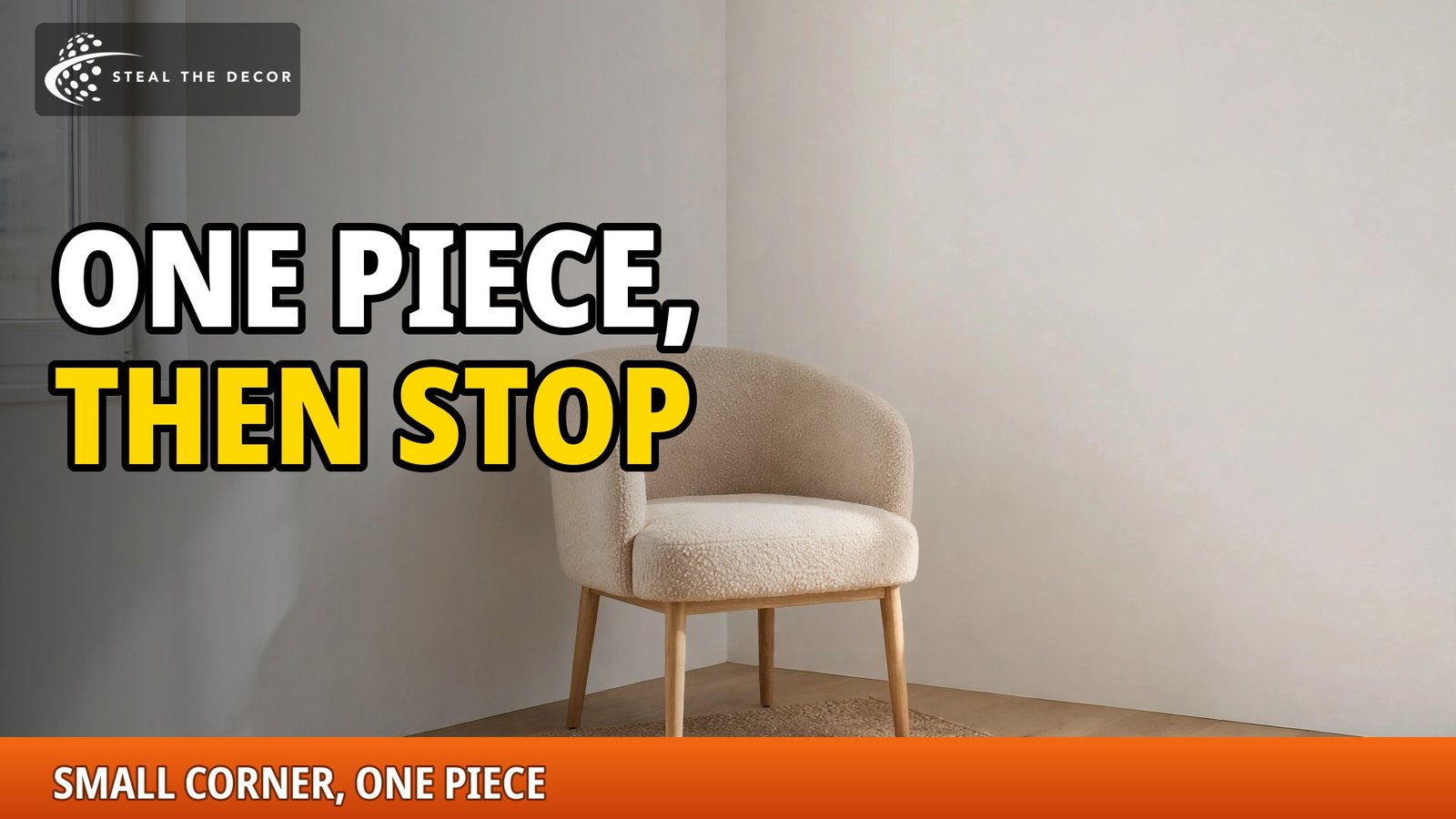
Small Corners: Pick One Piece and Stop
Small corner furniture ideas follow a stricter rule than the rest of this guide. In a tight corner, one piece is the whole design. If you are choosing for a corner less than about three feet on each wall, pick from the table below, place it, and stop.
| Piece | Footprint | Fits | Watch out for |
|---|---|---|---|
| Accent chair | Small to medium | Living room, bedroom | Needs a walkway beside it |
| Corner bench | Small to medium | Window corners | Lid must open fully |
| Corner cabinet | Small | Storage corners | Doors need swing room |
| Tall plant on a stand | Small | Bright or lit corners | Needs the right light |
| Pedestal table | Very small | Beside a chair | Only holds a few items |
Scale and proportion matter more than style in a small corner. A tall narrow piece suits a tall narrow corner, while a low wide piece suits a corner under a window. A piece too tall for its corner looks squeezed, and a piece too small looks lost.
Wall art above a low piece can finish a small corner without adding furniture. One framed print, hung at eye level and sized to the piece below it, is enough. For a renter-safe way to hang it, the method used to create a gallery wall without nails works for a single frame too, as long as the frame weight stays within the product’s stated limit.
Set Up a Corner in an Afternoon: 7 Steps
Set aside an afternoon, keep the measuring tape handy, and work through the steps in order. Nothing here needs drilling, and nothing changes the walls, so the whole setup stays rental-friendly: you are moving furniture, not fixing anything to the building.
- Clear the corner. Take everything out of the corner, including the items that drifted there. Wipe the floor and both walls so you can see the true size of the space.
- Measure both walls and tape the footprint. Measure along each wall, then mark the footprint on the floor with painter’s tape. Step back and look at it from the door.
- Check the walkway and traffic path. Walk the route people take through the room, past the taped footprint. Keep at least 24 inches clear for passing.
- Place the rug first, if the corner has one. Set the area rug so its front edge sits under the front legs of the piece.
- Set the anchor piece. Place the one main piece, angled slightly out of the corner rather than jammed into the point. Leave a small gap behind it for air and cleaning.
- Add light. Place the lamp, check it in the evening, and move it until the corner reads clearly after dark. A corner that only works in daylight is only half finished.
- Live with it for a day, then adjust. Use the corner normally for a day. Move the piece a few inches if you keep bumping it, and remove anything you did not use.
Walls, Light, and Finishing Touches
Once the furniture is placed, the corner needs very little else. Wall art above a low piece, or a leaning mirror beside a tall piece, gives the eye somewhere to land. Warm light in the evening, from a lamp with a warm bulb, makes the corner feel like part of the room. A throw blanket and one floor cushion are enough softness; more than that, and the corner starts to look like a storage spot for textiles. If the wall behind the corner feels bare, these rental-friendly accent wall ideas include removable options that suit a corner wall without paint or drilling. Keep it to one wall, and keep the furniture as the main event.

Mistakes That Make a Corner Look Worse
Most bad corners come from good intentions. Filling every corner in a room makes the room feel crowded, even if each piece is small. A room needs at least one empty corner to breathe, so leave the least visible corner alone on purpose.
Several small pieces in one corner read as clutter, while one larger piece reads as a decision. A corner with a tiny table, a tiny plant, a basket, and a stack of books looks like a holding area. The same corner with one chair and a lamp looks like a place.
Blocking the walkway is the mistake that matters most, because it affects the whole room, not just the corner. If you have to sidestep a piece to cross the room, the piece is too big for that corner, no matter how good it looks.
Finally, watch the light. A dark heavy piece in a dark corner with no lamp will disappear into shadow. Either add light, choose a lighter piece, or leave that corner empty and put the piece where the light already is.
FAQs
How do I decorate a corner in a living room?
Start by giving the corner one job, then pick one freestanding piece that does that job. Measure along both walls, keep a clear walkway, and add light if the corner is dark. One chair, cabinet, or plant with breathing room around it.
How do I furnish a corner that feels awkward?
Work around what makes it awkward. If a door swings into the corner, choose a slim piece that sits clear of the swing. If a heater sits there, keep furniture away from it and use the corner for a plant stand instead.
What should I put in a corner of a room?
Put the piece the room is missing. A living room short on seats needs a chair or a bench. A room short on storage needs a closed cabinet or a storage bench. A dark corner needs a lamp first.
What works in an empty corner of a living room?
A corner sofa or chaise works when the corner faces the main seating area. An accent chair with a side table works when you want a reading spot. A corner cabinet works when the room needs hidden storage. Pick the one that matches the corner’s light, size, and traffic.
How do I decorate a bare corner without cluttering it?
Use one anchor piece and stop. Add at most one wall item above it, such as a single framed print, and one soft item, such as a throw blanket. Step back to the doorway and check the corner from there.
What corner furniture works in a small bedroom?
A compact accent chair, a corner storage bench, a small corner vanity in a bright corner, or a tall plant on a stand all work in a small bedroom, as long as only one of them goes in the corner. Skip a daybed in a small bedroom, since it will take the corner and the walkway.
Should every corner in a room be filled?
No. A room with every corner filled feels crowded, and at least one empty corner helps the room breathe. Fill the corners you see from the entrance or use every day, and leave the least visible corner empty on purpose.
Key Takeaways
- Give each corner one job, then pick one freestanding piece that does that job well.
- Measure along both walls and tape the footprint on the floor before you buy.
- Keep at least 24 inches of clear walkway past any corner piece.
- Match the piece to the corner’s light: bright corners suit plants and reading chairs, dark corners need a lamp first.
- In a small corner, one piece is the whole design, and a second piece turns the corner into clutter.
- Leave at least one corner empty on purpose, so the furnished corners can stand out.
Conclusion
Corner decorating ideas for a living room or a bedroom come down to a simple habit: look at the corner, name its job, measure it, and pick one piece. A corner sofa for seating, a cabinet for storage, a chair for reading, or a plant for height can each turn an empty corner into a useful part of the room.
Find the corner you pass without noticing, and ask what that corner should do. What is the one piece that would make you actually use it?