
Walk into a long narrow living room and you can tell in five seconds what went wrong: the sofa sits flat against one long wall, the television hangs on the other, and between them runs a long empty strip of floor that nobody uses. The room feels like a corridor with furniture in it, not because it lacks space, but because the layout follows the walls instead of the way people live in it.
Learning how to arrange furniture in a long narrow living room starts with one change in thinking: stop treating the room as a single stretched-out space, and treat it as two shorter rooms sitting end to end, joined by one clear path. Once you do that, every other decision gets easier, from where the sofa goes to what to do with the far end.
Affiliate disclosure: This post contains affiliate links. If you buy through them, I may earn a small commission at no extra cost to you. As an Amazon Associate, I earn from qualifying purchases.
Quick Answer: Keep a walkway at least 30 inches wide, split the room into two seating zones, and give each zone its own rug and light. Float the sofa or angle the chairs instead of pushing everything against the walls, and pick one focal point.
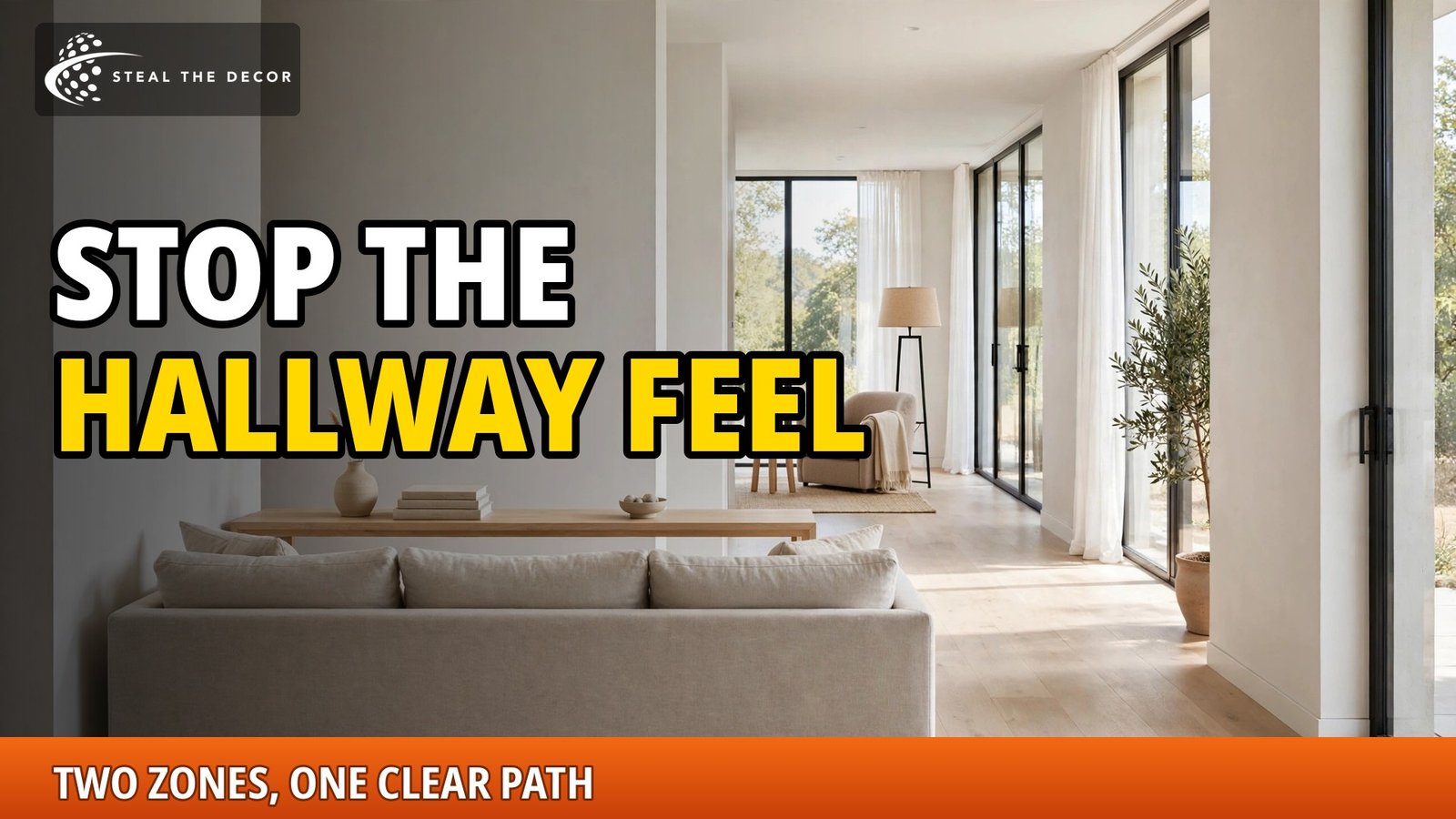
Measure First, Then Draw the Walkway
Before you move a single piece, measure the room: length, width, door swings, window positions, radiators, and outlets. Plan the layout on paper first, because a sofa that looks fine in the shop can eat the only path through the room once it is home. Sketch the outline on paper or in a free floor-plan app, and mark every door swing, since a door opening into your seating zone undoes the layout.
Next, draw the traffic path, the route people take from the door to the rest of the home. It comes before furniture, not after. A 30 inch walkway is the minimum that still feels comfortable for one person carrying something, and 36 inches is better where the room allows it. Run that path along one side of the room, not straight down the middle, where it would split both seating zones and send people walking between you and the television.
Now test the plan with tape. Painter’s tape on the floor costs almost nothing and shows the truth fast: tape the walkway, the rug outline, and the sofa footprint, then walk the route and sit in the taped chair positions. If you shuffle sideways past the coffee table, the plan is wrong, and it is far better to learn that from tape than from a bruised shin.
Pick One Focal Point and Let It Set the Layout
Every room needs one place the eye lands first. In a narrow living room, that focal point does extra work: it stops the eye from running the full length of the room and makes the space feel shorter and calmer. It might be the TV wall, a fireplace, a large window, or a conversation grouping around a coffee table. Pick one, because two focal points pulling in opposite directions make a long room feel restless.
The focal point also decides the sofa position. The main seat faces it or angles toward it, and everything else arranges around that relationship. If the television is the focus, the sofa faces it, with chairs angled in from the sides, and this guide to style a blank wall behind a TV covers renter-friendly options. If the window is the focus, the seats turn toward the light and the television becomes a secondary piece on a side wall.
A strong piece on a short end wall, like a bookshelf or leaning mirror, can change the whole feel of a narrow living room arrangement by giving the eye a reason to stop.
Three Layouts That Work in a Long Narrow Room
Most long narrow rooms suit one of three furniture layouts. Choose by your room’s doors and windows, not by a photo you liked. A layout that needs a clear short wall fails in a room where that wall holds the only door.
Layout A: Sofa on the Long Wall
Put the sofa against one long wall, place one or two accent chairs opposite at a slight angle, and keep the walkway on the far side of the chairs. A horizontal rug under the seating group, laid across the width of the room rather than along its length, widens the space visually. The simplest long narrow living room layout suits rooms where the doors sit at the ends. Its weakness is the wall-hugging feel, so pull the sofa a few inches off the wall and add a slim sofa table behind it to break the flat line.
Layout B: Float the Sofa to Split the Room
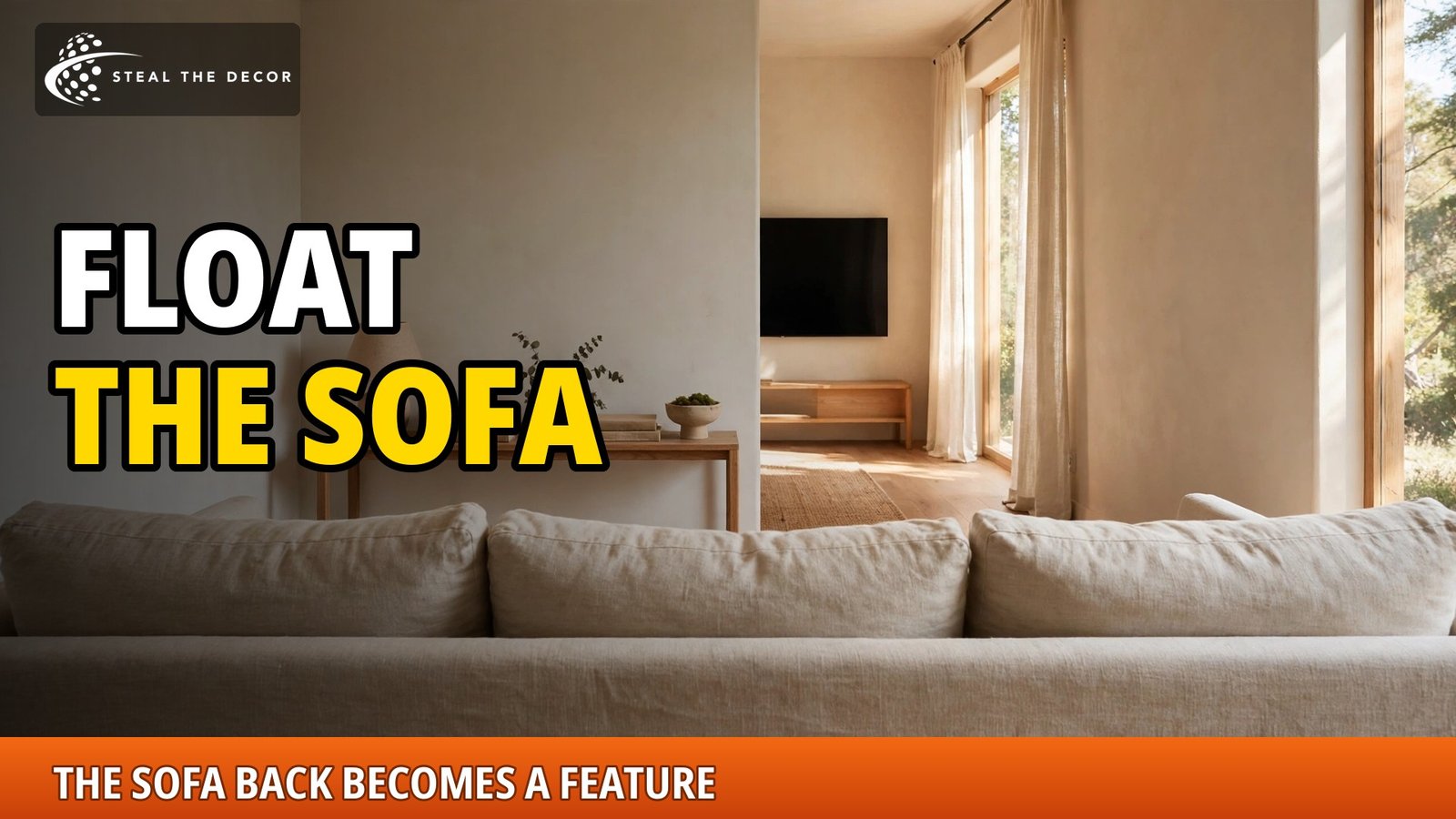
When you float the sofa across the width of the room, it acts as a soft room divider and creates two seating zones from one long space. The main zone faces the television or fireplace. The second zone, on the far side of the sofa, becomes a reading nook with a chair, floor lamp, and side table, or a small game table with two chairs. A console table behind the sofa finishes the back view, and our guide to a console table behind a sofa shows how to dress it without cluttering the walkway. This layout needs enough width for a walkway beside the floated sofa, so measure before committing.
Layout C: Face to Face for Conversation
Skip the television as the centre and place two loveseats, or a sofa and two chairs, facing each other across a narrow coffee table. This conversation area suits rooms used more for talking, reading, and music than for screen time, and it leaves clear paths on both sides of the grouping, which helps in rooms with doors on both long walls. A round coffee table works well here, since it softens the straight lines and makes passing easier in a tight gap.
| Layout | Best for | Watch out for |
|---|---|---|
| Sofa on the long wall | Simple rooms, doors at the ends | Can feel flat against the wall |
| Floated sofa, two zones | Very long rooms, two uses | Needs width for a walkway beside it |
| Face to face | Conversation-first rooms | Television becomes a side piece |
None of these layouts is precious. Try the taped version for a day, live with it, and move one piece. The right furniture layout for long narrow living room spaces is the one your household walks through without thinking about it.
Arrange It in an Afternoon: 7 Steps
If you want to know how to place furniture in a long narrow living room without a weekend project or a new budget, start here: you need an afternoon, a tape measure, and a willingness to move things twice.
- Clear the floor. Move small pieces, baskets, and anything living on the floor out of the room, since you cannot judge a layout while clutter is making the decisions.
- Tape the walkway. Mark your 30 inch walkway with painter’s tape along one side of the room, from door to door. This line is now fixed.
- Place the rugs. Lay one rug per zone, across the width of the room, with the front legs of the sofa and chairs on the rug so each zone reads as one grouping.
- Set the sofa. Place the sofa facing the focal point, on the long wall or floated to split the room, and check the walkway is still clear before moving on.
- Add the second zone. Build the far-end zone next: a chair, floor lamp, and side table for a reading nook, or a small table and two chairs for games.
- Place the lighting. Give each zone its own light source at seating height, so the far end does not sit in shadow.
- Live with it for a day. Use the room normally, then adjust: move the chair six inches, swap the side table. Small moves after real use beat a perfect plan made on paper.
One practical note for renters: furniture sliders under heavy legs protect floors and turn a two-person drag into a one-person push.

Rugs, Mirrors, and Walls That Make the Room Feel Wider
Rugs do more than warm the floor in a narrow room. They draw the borders of each zone, and where you draw those borders decides whether the room reads as one tunnel or two comfortable spaces. Lay each rug across the width of the room, not down its length: a runner pointing down the middle only repeats the tunnel shape, while a horizontal rug cuts across it and makes the eye read width instead of length. If you are layering over existing carpet, this guide to an area rug over carpet covers pads and bunching fixes.
One rug per zone is the rule that works for most long rooms. The main seating rug anchors the sofa and chairs, while the far-end rug, smaller and in a related but not identical pattern, marks the reading nook or second seating area. Two rugs in one colour family but different patterns keep the zones distinct. When people ask how to arrange a long narrow living room, the rug answer usually changes the room most for the least money.
Mirrors are the other wide-maker, used with care. A large mirror on a long wall bounces light across the room and adds visual width, especially beside a window. Avoid hanging it directly across from a window if glare hits the seating, and keep the frame light. You can hang large mirrors without drilling using adhesive or leaning methods, which suits renters.
Short walls carry the last trick. A gallery grouping on a short end wall gives the eye a destination and stops the long sightline, so keep frames in one colour family with breathing room between them. For a no-drill approach, a gallery wall without nails is a practical weekend project.
Furniture That Fits a Narrow Footprint
Scale and proportion decide more than style in a narrow room. A deep, high-backed sofa built for a wide room will swallow a narrow rental, while a low-backed sofa with slim arms leaves sightlines open. Knowing how to furnish a long living room pays off here: buy for the width of the room, not its length.
Slim furniture earns its place here: leggy furniture with visible legs and open frames lets the eye travel under it, so the floor reads as continuous. A sectional sofa can work in a long narrow room, but only at one end with the chaise tucked into a corner, not stretched along the long wall where it blocks the path. Skip deep recliners and oversized ottomans in the traffic path, since both turn a comfortable room into an obstacle course.
Storage should go up, not out. Vertical storage and open shelving along a long wall hold books and objects without stealing floor space, and a tall narrow bookshelf on a short wall shortens the room visually.
Lighting and Finishing Touches
One ceiling light in the middle of a long room leaves both ends in shadow, which is how a tunnel feels at night. Give each zone its own light: a floor lamp beside the main sofa, a smaller lamp in the reading nook, and a soft light at the far end. Hang curtains high, near the ceiling, and wide, on an extra-wide curtain rod that runs past the window frame on both sides, so the window reads larger and the wall reads wider.
Light colors on the long walls keep the space airy, while symmetry in small doses, like matching lamps either side of a sofa, gives the eye rest without forcing a mirror image. If you are learning how to decorate a long narrow living room on a rental budget, or gathering furniture ideas for long narrow living room spaces, lamps, curtains, and one rug per zone give the biggest change for the least spend.

Mistakes That Turn It Back Into a Hallway
The fastest way to lose the room is to push every piece flat against the walls. Wall-hugging furniture leaves a bare strip down the middle, and that strip is what makes the room feel like a hallway. Pull at least one piece, usually the sofa or a chair, a few inches into the room, and the whole arrangement starts to look intentional.
Two more mistakes: giving the room two competing focal points, like a television on one wall and a bold gallery on the opposite wall at full height, splits attention and makes the room feel restless. Matching furniture to the length of the room instead of its width, such as a long media console plus a long sofa plus a long bench, repeats the same line until the room feels like a corridor of long things. A narrow long living room needs crosswise lines, round shapes, and short stops for the eye.
FAQ: how to arrange furniture in a long narrow living room
Where should the sofa go in a long narrow living room?
Put the sofa on a long wall facing the focal point, or float it across the width to split the room in two. The long-wall option suits simple rooms with doors at the ends; the floated option suits very long rooms that need two uses. Either way, keep the walkway clear.
How wide should the walkway be in a narrow living room?
Aim for 30 inches at minimum, and 36 inches where the room allows. Thirty inches lets one person pass comfortably while carrying something; under 24 inches becomes a shuffle past a coffee table or chair leg. Tape the walkway before moving furniture.
Can you float a sofa in a narrow living room?
Yes, when the room is wide enough for a walkway beside the floated sofa. Floating works best in rooms at least 11 to 12 feet wide, where the sofa can sit across the width and leave a passing lane. In tighter rooms, float a chair instead for the same airy effect.
Should I use one rug or two in a long narrow living room?
Use two rugs when the room holds two zones, one rug per zone, each laid across the width. A single large rug suits one seating area plus a second use that needs no border, like a desk corner. Never run a single runner down the middle, since it repeats the tunnel shape.
Can a sectional sofa work in a long narrow living room?
Yes, if it sits at one end of the room with the chaise tucked into a corner, and the total depth stays under about 36 inches. A sectional stretched along the long wall usually blocks the walkway and deepens the tunnel feel. Separate pieces give more flexibility in most narrow rooms, so choose a sectional only when end-wall placement is genuinely possible.
Where should the TV go in a long narrow living room?
Place the television on the wall the sofa faces, at a distance that suits the screen size, and keep it as the single focal point. A long wall opposite the sofa works in most rooms; a short end wall works when seating can sit far enough back. Avoid placing it where viewers must walk between the screen and the seats.
How do I stop my long narrow living room feeling like a hallway?
Break the length into two zones with rugs and furniture, keep one clear walkway along a side, and give the eye crosswise lines and short stops: a horizontal rug, a round table, a mirror on a long wall, and a strong piece on a short end wall. Pull one piece off the wall, and light each zone separately.

Key Takeaways
- Draw the walkway first, at 30 inches minimum, along one side of the room.
- Split the room into two seating zones, each with its own rug and light, instead of one long tunnel.
- Pick one focal point, and let it decide where the sofa faces.
- Float the sofa or pull it off the wall, and use a console behind it to finish the view.
- Choose slim, leggy pieces sized to the room’s width, and let rugs, mirrors, and short-wall pieces add width.
- A living room layout for long narrow room shapes works when the household can walk it without thinking, so test the taped plan for a day.
A Room, Not a Corridor
The best furniture arrangement for long narrow living room spaces is rarely the most furniture. It is the arrangement that respects the walkway, names one focal point, and gives the far end a job. Measure once, tape the path, place the rugs across the width, and build two zones that each earn their light.
If your room still feels like a hallway after that, the fix is usually one move: pull the sofa off the wall, swap the runner for a crosswise rug, or light the far end. Which of the three layouts fits your doors and windows best, and what will you put in the far-end zone?