
Paint shopping goes wrong in one predictable way: you guess the gallons, run out mid-wall, and the second can never quite matches the first. This paint coverage calculator removes the guess. Enter the room size, the number of doors and windows, the surface condition, and the coats, and it returns the gallons of finish paint you need, plus primer if the job calls for it. Measure the walls first (length, width, and ceiling height in feet), then check the result against the formula shown below it. If your lease bans paint, peel and stick wallpaper for renters gives color without a paint can.
Table of Contents
Quick Answer
One US gallon covers about 350 to 400 square feet per coat on smooth, primed walls. Most rooms need 2 finish coats, so a 12 by 12 foot room with 8-foot ceilings needs about 2 gallons after doors and windows are deducted. Rough, textured, or unprimed walls need more paint, and primer is counted separately. Use the calculator above for your exact room.
How to Use the Paint Coverage Calculator
- Measure the room length, width, and ceiling height in feet, wall to wall and floor to ceiling. Switch the units box to meters if you measure in metric.
- Count the doors and windows you will not paint, including closet doors.
- Pick the surface condition: smooth primed walls, new drywall, or textured or rough walls.
- Pick the number of finish coats, then check the ceiling box if you are painting the ceiling and the primer box if the job needs primer, with 1 or 2 primer coats.
- Press Calculate, then read the gallons to buy. If you entered a price per gallon, the cost line shows the estimated finish paint cost.
How the Result Works
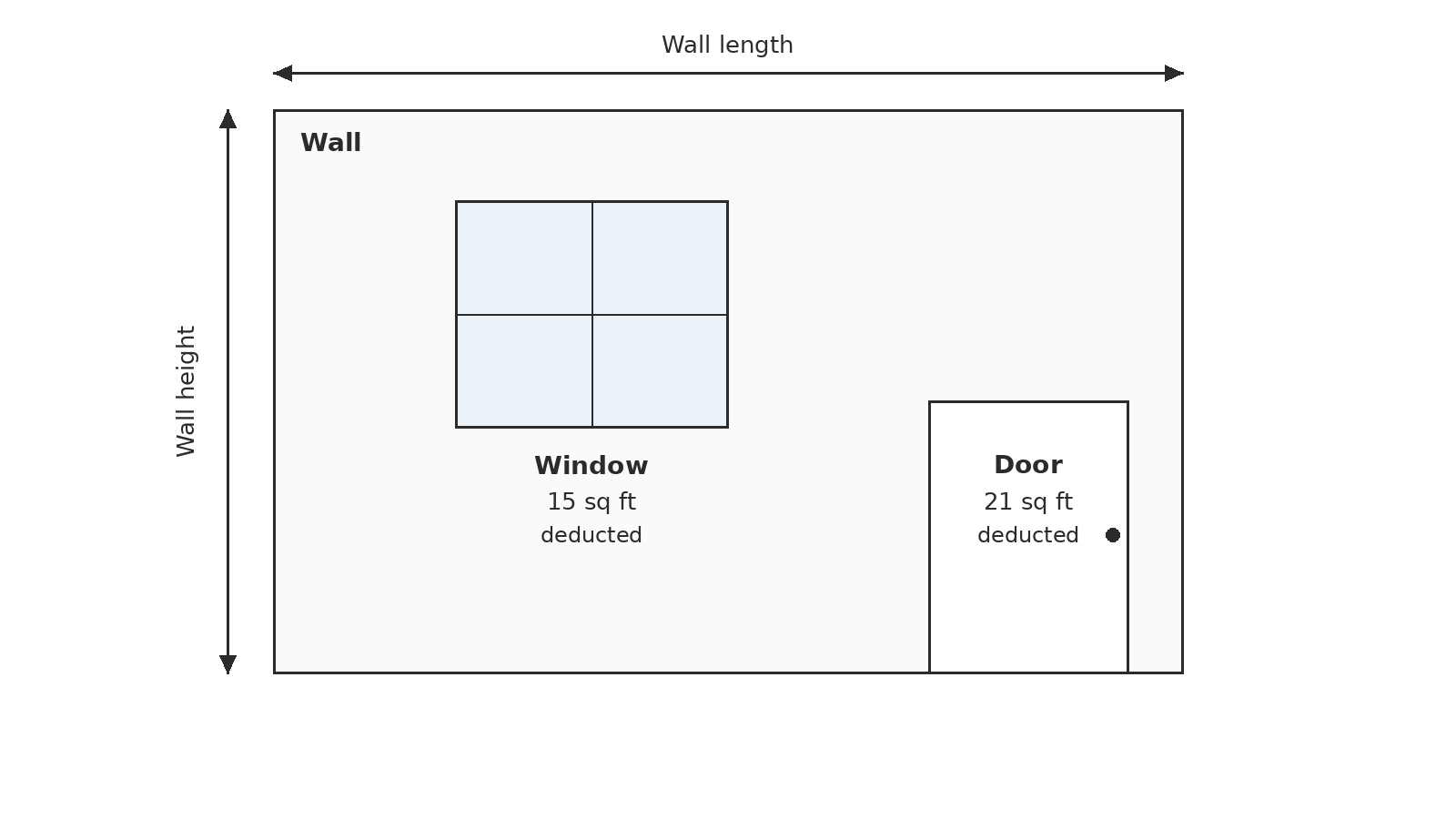
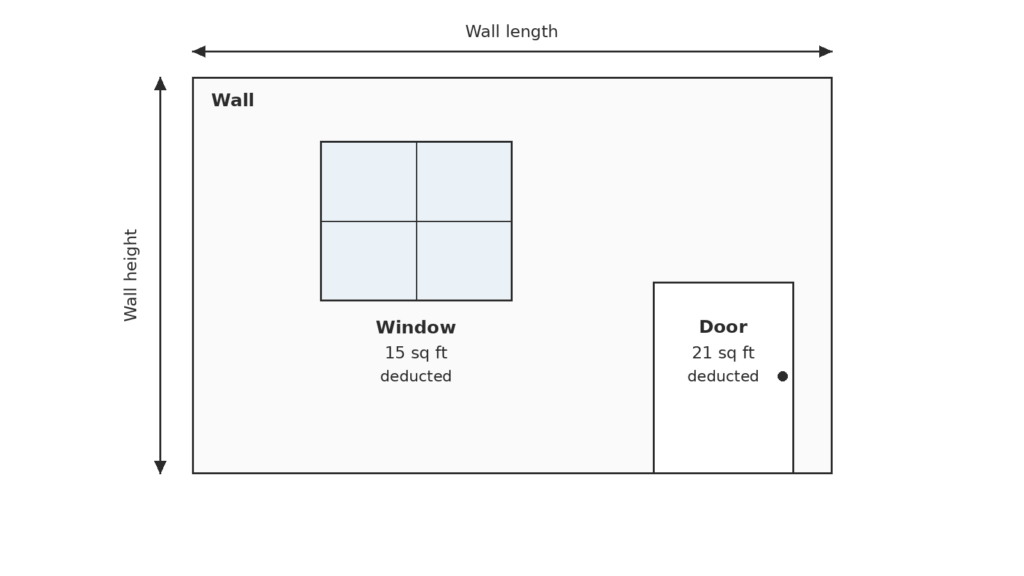
The tool uses wall area, not floor area. A 12 by 12 foot room has 144 square feet of floor, but its walls cover far more paintable surface. The default example shows the math: the perimeter is 48 feet, times an 8-foot ceiling gives 384 square feet of wall. One door (21 square feet) and two windows (30 square feet) deduct 51 square feet, leaving 333 square feet. At 2 coats and 350 square feet per gallon, 333 times 2 divided by 350 equals 1.90 gallons, so you buy 2 gallons.
Assumptions the tool uses:
- Standard door deduction: 21 square feet per door.
- Standard window deduction: 15 square feet per window.
- Coverage per gallon per coat: 350 for smooth primed walls, 300 for new drywall, 250 for textured or rough walls.
- Primer coverage: 300 square feet per gallon over the same total area, 1 coat by default or 2 coats for bare drywall, stains, or dark-to-light changes.
- Buy gallons: exact gallons rounded up to whole gallons.
- Cost line: buy gallons times the price you entered, finish paint only.
What changes the result most is ceiling height, then the number of openings, then the surface condition, then the coats. A ceiling adds the full floor area to the job. Primer adds a separate gallon count on top of finish paint. For exterior walls, use the textured or rough coverage choice, since rough siding drinks more paint, and buy paint rated for exterior use. This tool covers walls and ceilings, not furniture; paint laminate furniture without sanding needs a different product and prep. Before painting over old wallpaper, read how to remove wallpaper without damaging paint so the surface is ready.
Paint Coverage and Room Sizes
Coverage figures below are typical manufacturer ranges, not exact promises. When you are unsure, pick the rougher surface in the tool so you do not run short.
| Surface | Coverage per gallon per coat |
|---|---|
| Smooth, primed walls | 350 to 400 sq ft |
| New drywall | 250 to 300 sq ft |
| Textured or rough walls | 200 to 300 sq ft |
| Primer | About 300 sq ft |
Common rooms at 2 coats, 350 coverage, 8-foot ceilings, with 1 door and 2 windows deducted:
| Room | Paintable walls | Exact gallons | Gallons to buy |
|---|---|---|---|
| 10 by 10 bedroom | 269 sq ft | 1.54 | 2 |
| 10 by 12 bedroom | 301 sq ft | 1.72 | 2 |
| 12 by 12 bedroom | 333 sq ft | 1.90 | 2 |
| 12 by 15 room | 381 sq ft | 2.18 | 3 |
| 14 by 16 room | 429 sq ft | 2.45 | 3 |
| 16 by 20 living room | 525 sq ft | 3.00 | 3 |
The tool uses the same math as this table. Change the surface or the coats in the tool for any other case.
Common Mistakes
- Using floor area instead of wall area. A 12 by 12 room has 144 square feet of floor but 333 square feet of paintable wall. Measure the perimeter times the height.
- Skipping the door and window deduction. One door and two windows remove 51 square feet. Ignoring them buys a gallon you may not need.
- Planning 1 coat for a color change. Two coats is the standard for any color change or fresh surface. One coat only works for the same or a very similar color over a clean, primed surface.
- Skipping primer on bare drywall, stains, or dark-to-light changes. Primer is a separate gallon count, and paint alone will not hide stains or seal bare drywall evenly.
- Buying the exact decimal instead of rounding up. The round-up covers cutting in at edges, roller absorption, and touch-ups later.
Renters: check the lease before painting, since most leases require landlord permission for paint. The guide to decorate a rental without damage covers renter-safe options and the permission question. In homes built before 1978, old paint may contain lead, so follow these lead-safe painting steps before you sand or scrape.
FAQs
How many coats of primer do I need?
Most rooms need 1 coat of primer. Add a second coat on bare drywall, over stains or water marks, or when changing from a dark color to a light one. Primer is counted separately from finish paint, so it does not replace a finish coat. If the walls are already painted and in good shape, 1 coat is enough.
How many gallons of paint do I need?
It depends on your wall area, openings, coats, and surface. Measure the walls as perimeter times height, subtract 21 square feet per door and 15 per window, then divide by coverage and multiply by coats. As a reference, a 12 by 12 room with 8-foot ceilings needs about 2 gallons for 2 coats. The calculator above runs your exact numbers.
How many square feet will a gallon of paint cover?
One gallon covers about 350 to 400 square feet per coat on smooth, primed walls. On rough, textured, or unprimed walls, expect about 200 to 300 square feet per gallon. Primer covers about 300 square feet per gallon. Brands print their own figure on the can, and that figure wins over any general range.
How long between coats of paint?
Wait about 4 hours between coats of latex paint, and about 24 hours between coats of oil-based paint. Primer usually needs about 1 to 2 hours before painting over it. Heat, humidity, and airflow change these times, so always follow the recoat time printed on the can. Recoating too soon can pull up the first coat.
How much paint for a bedroom?
A 10 by 12 bedroom with 8-foot ceilings has about 301 square feet of paintable wall after 1 door and 2 windows. At 2 coats and 350 square feet per gallon, that is about 1.72 gallons exact, so buy 2 gallons. Add primer separately if the walls are bare drywall or stained.
How much paint do I need to paint a room?
Measure the room length, width, and ceiling height in feet. Multiply the perimeter by the height for wall area, subtract 21 square feet per door and 15 per window, divide by coverage, and multiply by coats. The calculator above does this math, adds ceiling and primer if checked, and rounds up to whole gallons.
How many coats of paint do I need?
Two finish coats is the standard for most rooms. One coat only works when repainting the same or a very similar color over a clean, primed surface. A third coat helps with dramatic color changes, weak hide, or rough surfaces that drink the first coat. Count primer separately: it is a base coat, not a finish coat.
Key Takeaways
- One gallon covers about 350 to 400 square feet per coat on smooth, primed walls.
- Wall area is perimeter times height, minus 21 square feet per door and 15 square feet per window.
- Two finish coats is the standard; budget primer separately at about 300 square feet per gallon.
- A 12 by 12 room with 8-foot ceilings needs about 2 gallons for 2 coats.
- Always round up to whole gallons for cutting in and touch-ups.
- Check landlord permission before painting a rental, and follow the label on the can for recoat times.
Conclusion
Paint math is simple once the inputs are right: measure the walls, subtract the openings, pick the coverage for the surface, plan 2 coats plus primer where needed, and round up. The most common error is measuring the floor instead of the walls, and the second is skipping primer on bare or stained surfaces. Both are easy to avoid with the calculator above, since every assumption is shown next to the result.
If a full room feels like a big first job, start with one wall: rental-friendly accent wall ideas shows how a single painted wall changes a room without repainting everything. Run your room through the tool before buying, keep the leftover paint for touch-ups, and check the cost line if the budget matters.