
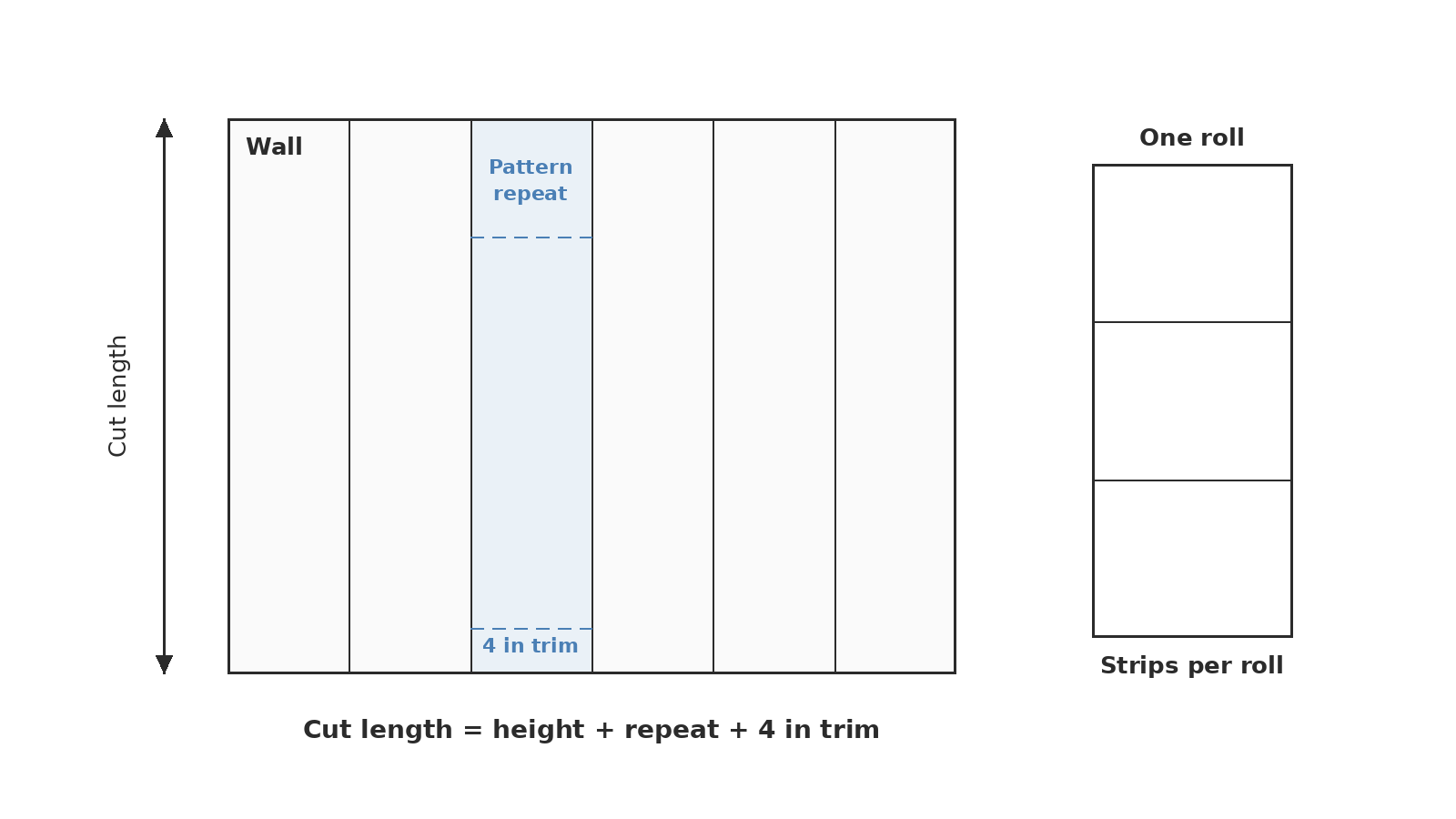
Running out of wallpaper halfway up a wall is a miserable place to stop. The pattern run ends, the batch changes, and the new rolls never quite match. Ordering too much wastes money and leaves rolls in a closet for years. This wallpaper calculator gives you the roll count before you order, from the walls you plan to cover, the pattern repeat on the label, and the roll size you are buying. Measure each wall at its widest point and its tallest height first. If you rent, read how to decorate a rental without damage first, so the paper you pick fits your lease and your move-out plan.
Table of Contents
Quick Answer
Count strips, not square feet. Divide total wall width by roll width and round up to get strips needed. Add wall height, pattern repeat, and 4 inches of trim to get cut length. Divide roll length by cut length and round down to get strips per roll. Divide strips by strips per roll and round up. A 12x12 room with 8 foot walls needs 10 US double rolls, plus one spare.
How to Use the Wallpaper Calculator
- Measure each wall you plan to paper, width at the widest point and height from floor to ceiling, and add the widths together.
- Subtract the width of any doors and windows you will not paper, or enter it in the doors and windows box.
- Read the pattern repeat and the roll width and length from the wallpaper label, and enter 0 for plain paper with no repeat. Pick US double, US single, or European roll, or Custom for any other size or a peel-and-stick panel.
- Enter your totals in the tool and press Calculate.
- Read the rolls needed, then order one extra roll for mistakes, mis-cuts, and future repairs.
- Order all rolls at once from the same batch, since dye lots can vary slightly between batches.
How the Result Works
The tool turns five measurements into a roll count with the strip method, the same method trade guides use. It counts how many vertical strips your walls need, how long each strip must be cut, and how many of those strips fit on one roll. The result is a whole number of rolls, never a fraction, because wallpaper is sold by the roll. Every assumption sits in the result itself, so you can check the math with a tape measure.
The strip method
Start with strips needed. Total wall width in inches divided by roll width gives strips, rounded up, because a partial strip still needs a full strip of paper. A 48 foot wall run with a 20.5 inch roll needs 29 strips: 576 inches divided by 20.5 is 28.1, and the leftover 0.1 still needs cutting.
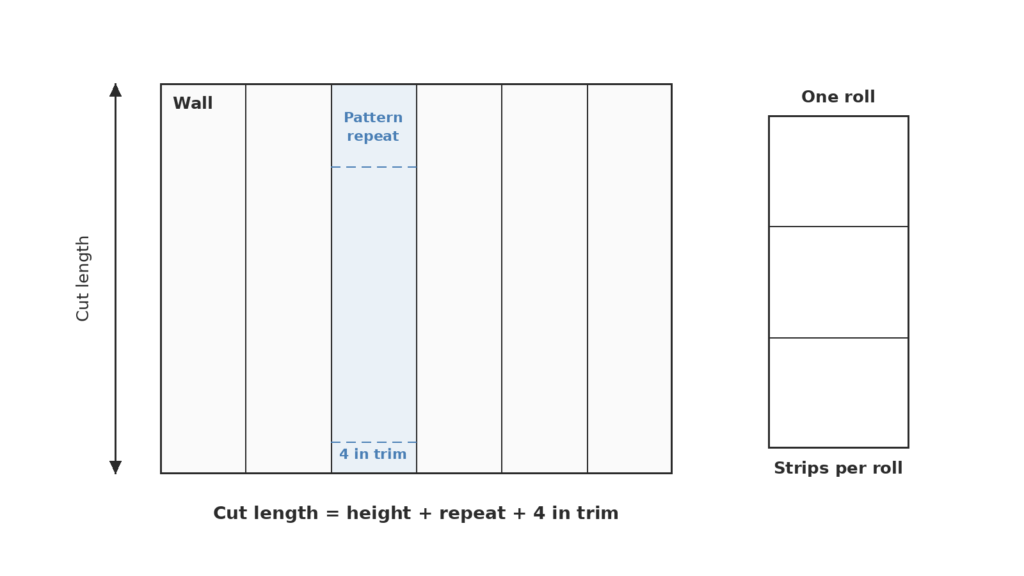
Next comes cut length. Each strip runs floor to ceiling, so cut length is wall height plus pattern repeat plus 4 inches of trim, 2 inches at the top and 2 at the bottom. The repeat matters because each strip must start at the same point in the pattern as its neighbor, and the extra length slides the pattern into place. Trim covers uneven ceilings and floors and gets cut away after hanging.
Then strips per roll. Roll length divided by cut length, rounded down, gives full strips only. Leftover roll shorter than one cut length is waste, not a partial strip. A 33 foot roll gives 3 strips at a 121 inch cut length, because 396 divided by 121 is 3.27, and the 0.27 cannot hang a wall.
Finally, rolls needed. Strips needed divided by strips per roll, rounded up, gives rolls to buy. The tool shows this number first, then the order total with one spare roll added for mistakes, mis-cuts, and future repairs.
What the pattern repeat does
The pattern repeat is the vertical distance between identical points in the design, printed on the label in inches. A repeat of 0 means plain paper with nothing to match. A 24 inch repeat on 9 foot walls pushes cut length from 112 inches to 136 inches, which drops strips per roll from 3 to 2 on a 33 foot roll and raises the roll count. Large repeats cost the most on tall walls, where cut length is already long. For a half-drop pattern, where every other strip shifts by half the repeat, enter the full repeat. The tool adds the full repeat to every strip, which covers the offset and keeps the count safe.
What changes the result
Five inputs move the number. Total wall width sets strips needed, so every foot of wall you skip or add changes the count. Wall height sets cut length, so taller walls mean fewer strips per roll. Pattern repeat lengthens cut length the same way. Roll width changes strips needed: a wider roll covers more wall per strip. Roll length changes strips per roll: a longer roll gives more strips before the leftover runs short.
Doors and windows work differently. The tool takes total width to cover, so subtract the width of any door or window you will not paper, either before entering the total or in the doors and windows box. Measure wall by wall and skip openings wider than about 3 feet; small openings are often papered over and cut out, which uses nearly a full strip anyway. Sloped ceilings and stair walls need the tallest height, since every strip is cut to the longest drop.
Single roll versus double roll
Most US wallpaper is sold as a double roll: 20.5 inches wide and 33 feet long, about 56 square feet of printed paper. A single roll is half that length, 16.5 feet, so it holds fewer whole strips: on 8 foot walls a single roll fits 1 strip where a double roll fits 3. Prices are sometimes quoted per single roll even when only double rolls ship, so check width and length on the label before comparing prices. A European roll measures 0.53 meters wide by 10.05 meters long, close to the same coverage as a US double roll.
Peel-and-stick wallpaper often sells as panels in fixed lengths rather than rolls; use the panel width as roll width and the panel length as roll length, and the same math works. For renter-friendly paste-free options, see peel-and-stick wallpaper for renters. If the paper must come off at move-out, read how to remove wallpaper without damaging paint before choosing a paste type. In homes built before 1978, old paint under the paper may contain lead, so follow these lead-safe prep steps before you scrape or sand a wall.
Rolls for Common Rooms
The table below uses a US double roll, 20.5 inches by 33 feet, on 9 foot walls. Counts are rolls needed before the spare roll. A taller wall or a larger repeat raises every count, so run your own numbers in the tool before ordering.
| Walls to cover | Strips | No repeat | 24 inch repeat |
|---|---|---|---|
| Accent wall, 12 feet | 8 | 3 rolls | 4 rolls |
| 10x10 room, 40 feet | 24 | 8 rolls | 12 rolls |
| 12x12 room, 48 feet | 29 | 10 rolls | 15 rolls |
If full-wall paper feels like too much commitment, rental-friendly wall paneling covers a wall with less work and less risk.
Common Mistakes
- Dividing wall area by printed roll area. Fix: use the strip method. Printed area counts paper you cannot hang, because leftover roll shorter than a strip is waste and every strip loses length to repeat and trim.
- Forgetting the pattern repeat. Fix: read the repeat from the label and enter it. A repeat left at 0 on patterned paper understates the count by whole rolls on tall walls.
- Confusing single rolls and double rolls. Fix: check width and length on the label, and check whether a quoted price means one single roll or one double roll, before ordering.
- Measuring one wall and guessing the rest, or using the shortest height. Fix: measure every wall at its widest point and cut to the tallest height, since every strip is cut to the longest drop.
- Ordering exactly the calculated number, or ordering in two batches. Fix: add one spare roll and order everything at once from the same batch, since dye lots can vary slightly and a mid-project reorder may not match.
FAQs
How do you measure wallpaper?
Measure each wall you plan to paper at its widest point, and measure height from floor to ceiling. Add the wall widths together for total width, then subtract the width of doors and windows you will not paper. Note the pattern repeat, roll width, and roll length from the label. Enter those numbers in the tool for the roll count.
How to calculate how much wallpaper I need?
Count strips, not square feet. Divide total wall width by roll width and round up for strips needed. Add wall height, pattern repeat, and 4 inches of trim for cut length. Divide roll length by cut length and round down for strips per roll. Divide strips by strips per roll and round up, then add one spare roll.
How much wallpaper do I need for a 12x12 room?
A 12x12 room has 48 feet of wall to cover. With 8 foot walls and US double rolls, 20.5 inches by 33 feet, the tool gives 29 strips and 3 strips per roll, which is 10 rolls, with or without a 21 inch repeat. Order 11 rolls in total: 10 to hang plus one spare from the same batch.
How do you calculate wallpaper?
Use the strip method. Strips needed equal total wall width divided by roll width, rounded up. Cut length equals wall height plus pattern repeat plus 4 inches of trim. Strips per roll equal roll length divided by cut length, rounded down. Rolls needed equal strips divided by strips per roll, rounded up. Add one spare roll on top.
How much wallpaper will I need?
It depends on total wall width, wall height, pattern repeat, and roll size. A small accent wall may need 3 rolls, while a full 12x12 room needs 10 rolls before the spare. The repeat moves the count most on tall walls. Enter your own measurements in the tool above for an exact count.
What is a double roll of wallpaper?
A US double roll is 20.5 inches wide and 33 feet long, about 56 square feet of printed paper. It equals two single rolls joined end to end, and a single roll is 16.5 feet long. Some prices are quoted per single roll even when only double rolls ship, so always check the width and length on the label.
How to measure for wallpaper rolls?
Measure wall by wall. Take the width of each wall at its widest point and the height from floor to ceiling, using the tallest height on sloped ceilings. Add the widths, subtract doors and windows you will not paper, and read the pattern repeat and roll size from the label. Those five numbers feed the tool.
Key Takeaways
- Count strips, not square feet: strips per roll and cut length decide the roll count.
- Pattern repeat is the biggest lever: a large repeat on tall walls can add several rolls.
- A US double roll measures 20.5 inches by 33 feet, about 56 square feet printed; check whether a price means a single or a double roll.
- Measure every wall at its widest point and cut to the tallest height.
- Subtract door and window widths you will not paper before entering the total width.
- Order one spare roll on top of the calculated count, all from the same batch.
- Custom roll width and length make the tool work for European rolls and peel-and-stick panels too.
Conclusion
One set of measurements settles the order: total wall width, wall height, pattern repeat, and roll size. The strip method turns those numbers into a roll count you can check by hand, and the spare roll plus the same-batch rule protect the job from mis-cuts and dye-lot shifts.
Measure twice, enter the label numbers exactly, and run the tool before paying, since a short order costs more in delay and mismatch than one extra roll. If the paper covers one wall rather than a room, rental-friendly accent wall ideas show how a single bold wall changes a space without a full-room commitment. Recheck the count if you switch papers, since a new repeat or roll size changes the math from the start.