
Most home offices fail on light before anything else. A dim corner, a harsh overhead bulb, or a screen glowing in a dark room all make long workdays harder, and the fix is usually not a bigger desk or a better chair. It is a desk lamp that puts steady, adjustable light exactly where your work is. The best desk lamp for home office use is not the brightest one or the prettiest one. It is the one whose brightness, colour, and position fit your desk, your screen, and your eyes.
This guide starts with the four numbers that decide whether a lamp helps or hurts, then gives five adjustable desk lamps for home office setups of every size.
Quick answer: For most desks, choose a dimmable LED lamp with about 400 to 800 lumens, a colour range from warm 2700K to cool 6500K, and a CRI of 85 or higher, then place it beside your screen so it lights your work without glaring off the monitor. The Bostitch swing arm clamp lamp below is the best simple starting point for small desks if you do not need dimming, the Honeywell HWT-H2 is the best eye-care pick, and the LitONES clamp lamp covers large desks and video calls.
The 4 Numbers That Matter Before You Buy
Brightness is measured in lumens, and it is the number buyers guess at most. Eye-strain guides commonly suggest about 400 to 800 lumens for desk work, with more for large desks and less for small, dark rooms where a bright lamp only adds glare. That is why dimming matters as much as the top number. A dimmable lamp with a wide range lets you match the light to the time of day, the room, and the task, instead of living with one fixed brightness.
Colour temperature, measured in Kelvin, decides whether light feels warm or cool. Warm light around 2700K feels relaxed and suits evening reading, neutral light around 4000K suits general desk work, and cool light around 6500K feels alert and suits detailed tasks. Adjustable desk lamps for home office setups usually offer three or more colour steps across that range, and that flexibility is worth more than any single colour.
CRI, the colour rendering index, measures how truly colours look under the light, on a scale where 100 matches daylight. A CRI of 85 or higher is a common guide threshold for comfortable desk work, and lamps rated 94 or 97 show colours and skin tones noticeably better than cheap lamps that do not state a CRI at all.
Two more words decide comfort: flicker-free and glare. Flicker-free means the lamp’s driver does not cycle the light in a way that tires eyes, and guides point to flicker-free certification or IEEE 1789 compliance as the check to look for. Glare is light bouncing off your screen or shining straight into your eyes, and it is fixed by position and shielding more than by brightness.
The 5 Picks at a Glance
| Pick | Best for | Brightness | Colour range | Mount | Watch out |
|---|---|---|---|---|---|
| Bostitch VLF100 swing arm | Small desks, clamp users | 700 lumens | Not stated by maker | Clamp mount | Single colour, push-button only |
| Honeywell HWT-H2 | Eye care, standard desks | 550 lumens | 2700K-5700K | Weighted base | Not wide enough for very large desks |
| Bostitch Modern touch | Simple daily use | Not stated by maker | 3 colour modes | Base | Higher price for the size |
| Bostitch folding rechargeable | Cordless, travel, small spaces | 180 lumens | 2700K-6500K | Tabletop | Too dim for large desks |
| LitONES swing arm clamp | Video calls, large desks | 1200 lumens | 3000K-6500K | Clamp mount | Bright light needs dimming down |
The 5 Best Desk Lamps for a Home Office
Product links in this guide are Amazon affiliate links. As an Amazon Associate, Steal The Decor earns from qualifying purchases. Prices and availability change, so check the listing before you buy.
1. Bostitch VLF100 Swing Arm Clamp Lamp: Best for Small Desks
The Bostitch LED swing arm desk lamp, model VLF100, is the classic clamp lamp: a metal swing arm with a 36-inch reach that clamps to the desk edge and swings light over the work without taking any desk space. Its maker-stated specs are 700 lumens from a 9-watt LED, with flicker-free and glare-free light, a replaceable E26 bulb, and a metal build.
The honest drawback is control. This is a desk lamp with a clamp and a push-button switch, not a dimmable colour-changing lamp, and the maker does not state a colour temperature or CRI for it. Skip it if your desk edge is too thick for a clamp, if you need dimming, or if you want adjustable colour. Buy it if you want a sturdy, simple, bright task light that disappears off the desk surface.

2. Honeywell HWT-H2 Sunturalux Lamp: Best Eye-Care Pick
The Honeywell HWT-H2 Sunturalux desk lamp is the eye-care pick for long workdays. It uses 48 full-spectrum LEDs, and its stated specs line up closely with the eye-strain guidance in this guide: 550 lumens, a CRI of 94 or higher, flicker-free and glare-tested light, four colour-temperature presets at 2700K, 4000K, 5000K, and 5700K, and stepless dimming from 10 percent to 100 percent. A long rectangular head spreads light evenly over the work area, a weighted base holds it steady without a clamp, and the base adds USB-A and USB-C charging ports. A memory function restores your last setting, and a 30-minute auto-off timer helps in the evening. For best desk lamp for eyes searches, this is the pick whose numbers fit the guidance best.
The honest drawback is reach. At 550 lumens with a compact head, it lights a standard desk well but will not evenly cover a very wide desk or a dual-monitor setup on its own. Skip it if you have a very large desk, if you need a clamp, or if you want a cool 6500K setting. Buy it if you have a standard desk, long reading or screen sessions, and care more about comfortable, high-CRI light than raw brightness.
3. Bostitch Modern Touch Lamp: Best Simple Daily Lamp
The Bostitch Modern Desk Lamp, model VLED1821, is the pick for people who want adjustable light without a complicated lamp. It offers three colour-temperature modes for relaxing, reading, and tasks, six dimmer levels, and a flexible silicone neck that bends light where you need it. A built-in USB port charges a phone from the lamp base, and the maker rates its LEDs for up to 50,000 hours at 8 watts.
The honest drawback is value. It usually costs more than other lamps of its size, and the maker does not state its lumens or CRI, so you cannot compare its brightness or colour quality on paper against the Honeywell or LitONES picks.
4. Bostitch Folding Rechargeable Lamp: Best Cordless Pick
The Bostitch folding rechargeable lamp, model KT-VLED1810, is the pick for cordless use: a folding lamp with a rechargeable battery that runs up to 3 hours, charges over USB, and folds flat for travel or storage. Its stated specs are 180 lumens, three colour temperatures at 2700K, 4000K, and 6500K, a head that adjusts up to 180 degrees, and touch control at 4.5 watts. That makes it a useful lamp for a small desk, a bedside table, a bag, or a room where the desk sits far from an outlet, and it pairs naturally with the guide to how to light a dark room with no outlets.
The honest drawback is brightness. At 180 lumens it is far dimmer than every other pick here with a stated lumen rating, and it will not light a large desk or a dual-monitor setup on its own. Skip it as a main desk lamp for serious work, and skip it if you need a clamp. Buy it as a second lamp, a travel lamp, or a small-desk lamp where cordless freedom matters more than brightness.
5. LitONES Swing-Arm Clamp Lamp: Best for Video Calls and Large Desks
The LitONES LED desk lamp with clamp is the pick for people whose desk doubles as a video-call studio. Its stated specs are 1200 lumens, three colour temperatures from 3000K to 6500K, ten brightness levels from 10 percent to 100 percent, a CRI of 95 or higher, and a swing arm with five pivot joints that aims light where you need it, including toward you for calls. It clamps to the desk edge to save surface space, and a remote lets you change brightness and colour without reaching for the lamp.
The honest drawback is that 1200 lumens is a lot of light in a small room, and at full brightness it can feel harsh until you dim it down. Skip it if your desk edge cannot take a clamp or if you want the simplest possible lamp. Buy it if you take video calls daily, work at a large desk, want high-CRI light, and like fine dimming control.

Set It Up Right: 7 Steps
Buying the lamp is half the job. Position decides whether the light helps or glares, so follow these steps after unboxing, before judging the lamp.
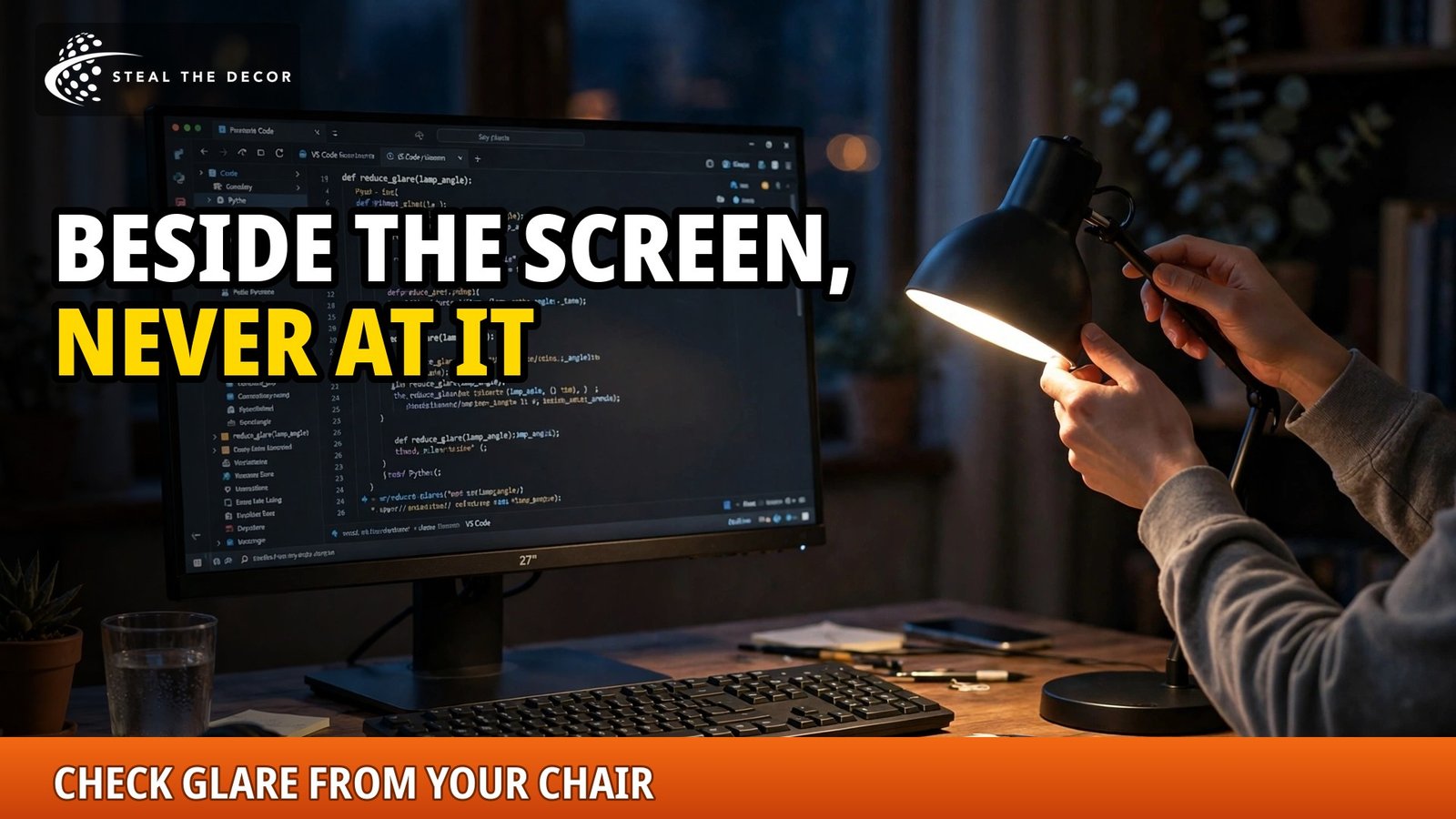
- Put the lamp beside the screen, not behind it. Place it on the side of your writing hand, so your hand does not shadow your work.
- Set the height so the light falls on the desk, not your eyes. The lamp head should sit above your work and below your eye line when seated.
- Aim the head down at the desk. Angle it at your papers or keyboard, never toward your face or straight at the screen.
- Check for screen glare. Sit in your normal position and look for bright reflections on the monitor, then move the lamp until they disappear.
- Match brightness to the room. Dim the lamp until the desk feels lit but the screen does not look dim by comparison, and the room does not feel dark around it.
- Pick the colour for the time of day. Use warm light in the evening, neutral light for general work, and cool light only for detailed tasks.
- Live with it for one full workday. Adjust height, angle, brightness, and colour once more after a day of real use, since a five-minute test hides most problems.
Choosing Between Lamp Types
LED desk lamps now dominate the market, and for good reason: they run cool, they dim smoothly, they offer colour control, and their energy efficient light bulbs last far longer than old incandescent bulbs. Architect lamps, the classic multi-joint arm lamps, still appeal for their reach and industrial look, and many take replaceable bulbs, which means the lamp can outlive its bulb. Desk lamp reviews tend to split on this point: integrated-LED lamps look cleaner and dim better, while bulb lamps are easier to repair and let you choose your own bulb colour. Best desk accessories lists often mix lamps, organisers, and stands together, so judge a lamp on its light numbers first and its extras second.
Ambient office lighting matters too, because a desk lamp alone in a dark room creates contrast that tires eyes. A desk lamp should be the brightest light on your work, not the only light in the room. A soft room light, a battery-operated under-cabinet lighting strip on a shelf, or plug-in pendant lights in the room all reduce the contrast between screen and surroundings. The desk itself matters as well: rental-friendly wall paneling behind a desk can soften reflections, and an area rug over carpet under the desk zone makes the whole workspace feel finished, which is why lamp choice belongs in a room plan, not alone.
Some buyers shop by accessory instead of light. Desk lamps with pen holders, USB ports, wireless chargers, and clocks all exist, and they suit small desks where one object must do two jobs. The same caution applies to brand searches. A quick desk lamp search on Amazon, including budget brands like Clearsun, shows how crowded the cheap end is and how many listings hide their CRI or lumens. BenQ is a respected name in desk lighting, but its best-known desk product is a monitor-mounted light, a separate category from the lamps in this guide, and it is not one of these picks.
Buying Mistakes That Waste Money
The most common mistake is buying by brightness alone. A 1200-lumen lamp with no dimming is worse for evening work than a 700-lumen dimmable lamp, because you cannot turn it down when the room goes dark. The second mistake is ignoring glare: a bare LED strip aimed at eye level will hurt no matter how good its CRI is. The third mistake is buying a clamp lamp for a desk edge it cannot grip, or a heavy base lamp for a desk with no free space. Measure the desk edge, measure the free desk area, and check the lamp’s mount before ordering.
The fourth mistake is trusting listings that hide specs. If a lamp listing does not state lumens, colour range, or CRI, assume the numbers would not impress you, and keep shopping. Light bulbs for lamps, whether integrated LEDs or replaceable bulbs, should always come with a lumen rating and a Kelvin rating, and a lamp that publishes neither is not a bargain, it is a gamble. Pinterest lighting boards show the same trap at room scale: pretty pictures, no numbers.
Frequently Asked Questions
How many lumens do I need for a home office desk lamp?
Most desks need about 400 to 800 lumens, with more for large desks and less for small, dark rooms. A dimmable lamp matters more than the top number, since you will use less light at night than during the day. Start in that range and adjust to the room.
What color temperature is best for working at a desk?
Neutral light around 4000K suits most desk work, warm 2700K suits evening reading, and cool 6500K suits detailed tasks. An adjustable lamp covering 2700K to 6500K is the safest choice, because one fixed colour will feel wrong at some point in the day.
Is a high CRI desk lamp worth it?
Yes, if you care about colour. A CRI of 85 or higher shows colours truly, and lamps rated 94 or 97 show them better still. For design, photo, or craft work, high CRI is essential. For plain typing, it is a comfort upgrade rather than a necessity.
Should I choose a clamp lamp or a base lamp?
Choose a clamp mount if your desk is small and the edge can take a clamp, since it saves desk space. Choose a base lamp if the desk edge is too thick, too thin, or already crowded, or if you move the lamp between rooms. Measure the edge before ordering a clamp.
Can a desk lamp really reduce eye strain?
A good lamp helps, but it does not cure eye strain alone. Steady, flicker-free, dimmable light without glare reduces fatigue, and so do breaks, screen brightness matched to the room, and a lit room instead of a dark one. A lamp is one part of that setup.
Are rechargeable desk lamps bright enough for real work?
Some are, most are not. The folding pick here gives 180 lumens, which suits small desks, reading, and travel, but not large desks or dual monitors. For a main work lamp, choose a corded lamp with at least 400 lumens and dimming.
Where should I place a desk lamp to avoid screen glare?
Place it beside the screen, on your writing-hand side, with the head above the work and aimed down at the desk, never at your face or the screen. Sit in your normal position and move the lamp until screen reflections disappear, then leave it there.
Key Takeaways
- The best desk lamp for home office use is dimmable, with about 400 to 800 lumens, a 2700K to 6500K colour range, and a CRI of 85 or higher.
- Clamp lamps save small desks; bright swing-arm lamps suit large desks; high-CRI lamps suit long eye-care sessions; cordless lamps suit travel and small spaces but stay dimmer.
- Place the lamp beside the screen, aim it down at the work, and check for screen glare from your normal seated position.
- Judge a lamp on its light numbers first: lumens, Kelvin, CRI, dimming, flicker-free, and glare control, with extras as tiebreakers only.
- Never buy a lamp that hides its specs, and never buy a clamp lamp without measuring the desk edge first.
Conclusion
Eye care desk lamps are not a luxury for home workers. They are the cheapest upgrade that changes how a whole workday feels, because steady, adjustable light removes fatigue you stop noticing only after it is gone. Start with the four numbers, pick the lamp that fits your desk size and mount, and set it up by the steps above. Your eyes will notice the difference within a day, even if you cannot name what changed.
Which desk situation is yours: a small desk needing a clamp, a large desk needing bright, wide light, long sessions that call for eye-care light, or a desk that doubles as a video studio? Pick the matching lamp, measure your desk edge and free space, and order the one whose numbers fit. Good light is a small purchase with a daily return.
