
Table of Contents
The first one died in nineteen days. A fiddle leaf fig six feet of it bought on a Saturday because the nursery tag said “bright indirect” and my brain heard “any light at all.” By week three the bottom leaves were brown at the edges and dropping onto the rental carpet one at a time like the plant was leaving a trail out of my apartment.
My desk sits in the interior corner of a one bedroom in Chicago. No window in that corner. One overhead LED panel on maybe nine hours a day plus a small lamp. My lease says no drilling no wall anchors no holes over a quarter inch. So every fix had to be damage-free and reversible.
Over fourteen months I tested nineteen plants in that exact spot and tracked which ones held their color which stretched thin and sad and which quietly died. Eleven survived. Nine are worth your money. This piece covers the best low light office plants for a dim desk the real cost of setting each one up the watering rhythm that stopped killing mine and the setup tricks that keep water off a laminate desktop and off rental carpet. If you have been hunting for plants for a windowless office and keep landing on lists written for sunny living rooms this one was tested in the dark.
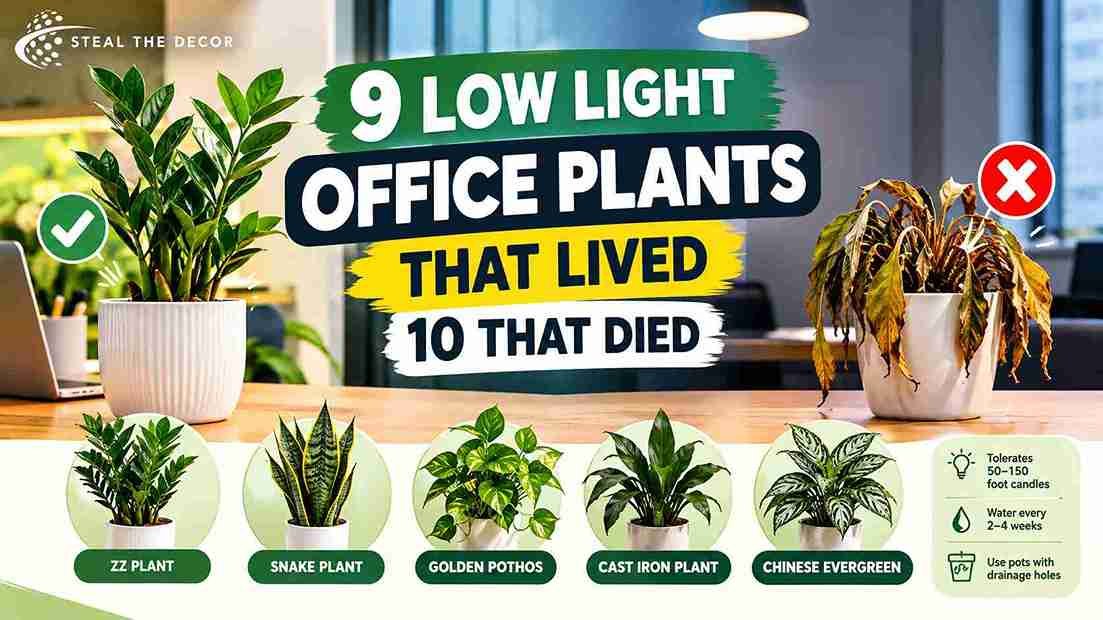
Quick Answer: The best low light office plants are the ZZ plant (Zamioculcas zamiifolia) the snake plant (Dracaena trifasciata) golden pothos (Epipremnum aureum) the cast iron plant (Aspidistra elatior) and Chinese evergreen (Aglaonema). All five tolerate 50 to 150 foot candles which matches a typical windowless office lit only by overhead fluorescent lighting. Water them every two to four weeks and keep them in pots with drainage holes.
What Counts as Low Light in an Office and Why Renters Should Care
Low light means roughly 50 to 250 foot candles and a foot candle is just a measure of how much light lands on a surface one foot from the source. A bright south window delivers 1000 foot candles or more. A north facing window gives 200 to 500. An office with no windows lit only by ceiling panels usually sits between 30 and 150.
That gap matters more than most plant tags admit. Nursery tags are written for houses with windows not for a cubicle or a desk shoved against an interior wall. Plants sold as “easy” still assume real natural light somewhere in the room.
Renters get hit twice here. You cannot move a window you cannot add one and in most apartments you cannot mount a light fixture to the ceiling without drilling. So the fix has to come from the plant list itself or from a lamp that plugs into an outlet. Small offices and studio corners run into this hardest since one ceiling panel has to cover the whole indoor space.
The low light conditions in my corner measured 74 foot candles with a phone light meter app at 2 p.m. Nine plants held their dark green leaves at that level for over a year. That is the number this whole article is built around. Once you know your light conditions as a number picking plants stops being guesswork.
There is a second reason this matters beyond the plants staying alive. A 2024 University of Exeter workplace study found people reported better focus and mood in offices with living greenery so wellbeing at work is part of the payoff in a room with little light and no view.
Bottom line: measure your desk before you buy anything because “low light” on a plant tag and low light in a windowless workspace are two different things.
Do Low Light Office Plants Actually Survive in an Office With No Windows?
Yes a short list of tolerant plants survives in an office with no windows as long as artificial light runs at least eight hours a day. Plants do not need sunlight specifically. They need photons in the right range and fluorescent lighting and modern LED panels both produce usable light. That is why a handful of species thrive in low light while most houseplants sulk.
Plants for offices split into two groups once you test them side by side. A few keep plants alive with almost no input from you. The rest need indirect light from a real window and will slowly fade without it.
Here is where it works. If your ceiling panel runs eight to ten hours on weekdays and your desk sits within about six feet of it the ZZ plant the snake plant and the cast iron plant will hold steady. Growth slows to a crawl. New leaves may appear twice a year instead of monthly. That is survival not thriving and that is the honest version.
Here is where it fails. If the lights go off Friday evening and stay off until Monday morning plants get about 40 hours of light per week instead of 70. In my test the pothos in a weekend-dark office lost its variegated leaves and went plain green within two months. Variegation costs the plant energy so dim light is the first thing it drops.
The other failure point is a fully dark room. No windows plus lights that stay off most of the day equals no plant full stop. That is when a grow bulb stops being optional. A Sansi 15W Grow Light Bulb by Sansi screwed into an existing desk lamp (typically $16 to $25) lifted my corner from 74 to about 310 foot candles at 18 inches.
Bottom line: most renters find that eight or more hours of daily artificial light keeps hardy plants alive, and anything less than that calls for a grow bulb in a lamp you already own.
The 9 Best Low Light Office Plants, Ranked by What Survived My Desk
The ZZ plant is the single most reliable plant for a dark office corner, and nothing else in my test came close. Below are the nine that lived, ranked by how little they asked of me. Each entry lists the light floor it held, watering rhythm, mature size, pet safety, and the renter risk that matters for your deposit.
These are the best plants for an office with weak light, large or small, and each one is an easy care pick you can keep on a desk or on the floor. Watch how differently plants perform once the foot candle number drops below 100.
- ZZ plant (Zamioculcas zamiifolia) holds its glossy foliage down to about 50 foot candles and stores water in potato-like rhizomes under the soil. Water every three to four weeks and it forgives you for forgetting. Expect 2 to 3 feet tall indoors, around $18 to $40 at Costa Farms or a local nursery. The ASPCA lists it as toxic to cats and dogs, so keep it off a low shelf if you have pets. Renter risk: none, since it rarely drips and almost never drops leaves.
- Snake plant (Dracaena trifasciata) survives at 50 to 75 foot candles and goes four to six weeks between waterings in winter. It is also one of the air-purifying plants named in the 1989 NASA Clean Air Study, though the study used sealed chambers and a single plant will not purify the air in a real room on its own. Tall snake plants reach 3 to 4 feet and work as a floor plant beside a desk, while the dwarf ‘Hahnii’ stays under 8 inches for a low light plants for office desk setup. Price runs $15 to $45 depending on size. Toxic to pets per the ASPCA. Renter risk: none, and the stiff leaves never shed onto carpet.
- Golden pothos (Epipremnum aureum) is the fastest grower on this list and trails 4 to 6 feet from a shelf or a filing cabinet. Water every 7 to 10 days and it tells you when it is thirsty by drooping, then recovers within hours. Expect $10 to $22 for a 6 inch pot. Toxic to pets. Renter risk: low, though trailing vines near an outlet need a route planned so nothing sits in a damp spot. If you want yours overhead instead of trailing sideways, the no-drill methods in my walkthrough on how to hang plants without drilling work for a planter up to about 5 pounds.
- Cast iron plant (Aspidistra elatior) earned its name by refusing to die. It holds at 25 to 50 foot candles, which is the lowest floor here, and wants water only every three weeks. It grows slowly to about 2 feet, costs $25 to $50, and is listed as non-toxic to cats and dogs by the ASPCA. Renter risk: none. This is the pick for plants for dark office corners where nothing else works.
- Chinese evergreen (Aglaonema) brings a splash of color that the rest of this list does not, and it is the fastest way to brighten a gray cubicle without paint. The ‘Silver Bay’ cultivar carries pale silver markings and the ‘Siam Aurora’ runs pink along the veins. It holds at 75 to 150 foot candles and drinks every 10 to 14 days. Size runs 1 to 2 feet, price $20 to $35, toxic to pets. Renter risk: low.
- Peace lily (Spathiphyllum) is the one plant here that flowers in low light settings, and it is the answer people search for when they want a peace lily for office without windows. It needs water weekly and wilts dramatically when dry, which is either a helpful signal or a stress depending on your personality. Expect 1 to 3 feet and $18 to $38. Toxic to pets. Renter risk: medium, because weekly watering near a laminate desktop is where water rings start.
- Heartleaf philodendron (Philodendron hederaceum) looks like pothos but has softer, thinner leaves and handles slightly lower light. Water every 10 days, expect trailing vines of 3 to 4 feet, price $12 to $25. Toxic to pets. Renter risk: low.
- Parlor palm (Chamaedorea elegans) is the only true palm that held up in my corner, and it gives height without bulk. It wants water every 7 to 10 days and grows to 2 to 4 feet over several years. Price runs $20 to $45. The ASPCA lists it as non-toxic, which makes it the best large pick for a pet household. Renter risk: low, though it sheds dry frond tips that need vacuuming off carpet.
- Spider plant (Chlorophytum comosum) rounds out the list and puts out baby plantlets you can pot up for free. It prefers medium to low light and holds color better around 150 foot candles than at 75. Water weekly, expect an 18 inch spread, price $12 to $20. Non-toxic per the ASPCA. Renter risk: low.
A note on peperomias: the Peperomia obtusifolia held on at my desk but lost its compact shape and stretched toward the lamp within four months. It made the survivor list, not the recommended list. It does not do well in low light for long.
Bottom line: if you want one plant and zero effort, buy the ZZ plant, and if you want one plant and some color, buy the Chinese evergreen.
Pro Tips for Renters:
- Buy the plant in its plastic nursery pot and drop that pot inside a decorative planter without drainage. You get the look you want and you can lift the inner pot out to water at the sink, which keeps every drop away from your floor.
- Wipe the leaves with a damp cloth once a month. Dust cuts light absorption, and in low light environments your plant cannot afford to lose any.
- Rotate the pot a quarter turn every time you water. Plants in dim corners lean hard toward the brightest side and a rotation habit keeps them upright without a stake.
- Skip fertilizer from November through February. Plants in limited natural light grow slowly and unused fertilizer salts build up in the soil and burn the roots.
- Group two or three pots together in spaces with minimal light rather than spreading indoor plants around the whole room, since one lamp then covers all of them. Put a felt furniture pad under any pot that sits on a laminate desktop. A $4 pack of pads has saved me from two water rings that would have cost far more at move-out.
How to Set Up Low Light Office Plants Without Damaging Your Rental
Setting up live plants in a rental takes about 25 minutes and costs under $15 in supplies beyond the plants themselves. Follow these seven steps in order.
Step 1: Measure the light at your desk before you buy. Use a free light meter app on your phone and take a reading at the exact spot the pot will sit, at midday, with your normal lights on. Write the foot candle number down. Common mistake: measuring at the window or near the ceiling panel instead of at pot height, which overstates your light by two to three times.
Step 2: Keep the plastic nursery pot and buy a cachepot to hide it. A cachepot is just a decorative outer pot with no drainage hole. The plant lives in the vented plastic pot inside, so roots never sit in standing water. Common mistake: repotting straight into a pretty ceramic pot with no drainage, which is the number one killer of indoor plants in offices.
Step 3: Add a saucer and a felt mat under the cachepot. Stack it in this order, felt mat on the bottom, saucer on top of the mat, cachepot on top of the saucer. This two layer setup is what keeps condensation off a laminate desk and off rental carpet. Common mistake: using a cork coaster, which soaks through and leaves a dark ring.
Step 4: Place the pot within six feet of your light source and away from vents. Heating and cooling vents dry the leaf edges within weeks and the damage looks like underwatering even when your watering is fine. Common mistake: putting the plant on top of a filing cabinet directly under a ceiling air vent.
Step 5: Water at the sink, not at the desk. Lift the inner nursery pot out, carry it to the sink, run water through until it drains freely, let it sit for ten minutes, then return it to the cachepot. Common mistake: pouring water into the pot while it sits on the desk, which is how every water ring I have seen started.
Step 6: Add a grow bulb only if your reading came in under 50 foot candles. Screw a grow bulb into a lamp you already own rather than mounting a fixture, because clamp mounts and ceiling fixtures create the holes your lease cares about. Common mistake: buying a purple bulb, which works for the plant but makes a workspace unpleasant to sit in for eight hours.
Step 7: Hang anything overhead with adhesive only, and stay under the weight rating. Command Ceiling Hooks by 3M hold up to 2 pounds and Command Outdoor Window Hooks by 3M handle 3 pounds when applied to a clean, dry, painted surface per the 3M application instructions. Common mistake: hanging a wet, fully watered pot, which can double the weight the hook actually carries.
Bottom line: the cachepot plus saucer plus felt mat stack is the single setup detail that turns a plant from a deposit risk into a damage-free desk upgrade.
Common Mistakes Renters Make With Office Plants
Most office plants die from too much water, not too little light, and that pattern held across every plant I tested. Here is what trips people up.
Watering on a calendar instead of by feel. A weekly schedule works in a bright room and drowns a plant in a dim one, because plants in low-light conditions use water far more slowly. Stick your finger two inches into the soil and water only when it comes out dry. A $10 moisture meter does the same job if you would rather not guess.
Buying a plant that was never going to work. Fiddle leaf figs, most succulents, calathea, and fiddle-adjacent trending plants all want real light and none of them tolerate low light for long. I lost $52 on that fiddle leaf fig before I accepted it. Start with the ZZ plant or the cast iron plant and add trickier plants once you know your actual numbers.
Using a pot with no drainage hole. Water collects at the bottom where you cannot see it and roots rot from below while the leaves still look fine. By the time the plant droops, the root ball is usually gone. The nursery pot inside a cachepot solves this for a few dollars.
Ignoring pests that came home from the store. Fungus gnats arrive in the soil of roughly one plant in four, and a warm office is a good place for them to breed. Check the soil surface for movement before you buy, and let the top inch dry fully between waterings, which breaks their life cycle.
Leaving plants through a dark holiday break. Two weeks with the office lights off is the hardest stretch of the year for plants for windowless rooms. Move the pot near any window in the space before you leave, or set the grow lamp on a $9 outlet timer.
Putting the plant directly on a wood or laminate surface. I did this for three months with a peace lily and found a faint ring under the pot that took vinegar and patience to lift. Felt mat, every time.
Bottom line: if a plant in a dim office is struggling, check the soil moisture before you blame the light.
Renter-Safe Plants, Pots, and Grow Lights I Actually Recommend
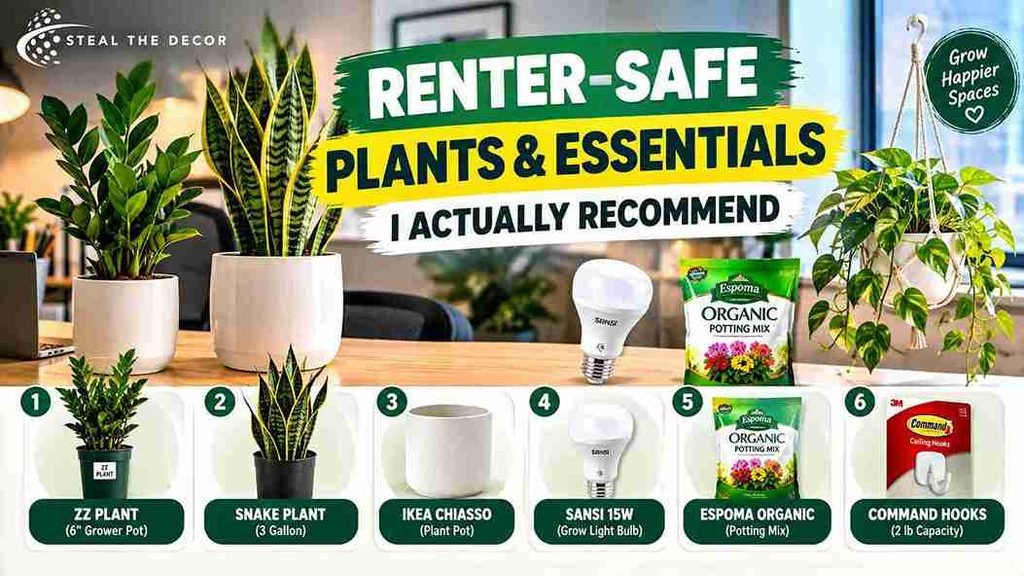
These six products are the ones still in use at my desk after fourteen months. Prices move, so treat every figure as a range rather than a promise. Two are best low-light plants picks and the rest are the pots, soil, and light that make an office environment workable for them.
- Costa Farms ZZ Plant in a 6 inch grower pot arrives established rather than as a cutting, which matters because a young ZZ plant in dim light takes a long time to bulk up (typically $22 to $38). Damage risk is none.
- Costa Farms Snake Plant Laurentii, 3 gallon is the floor-height option that fills the gap between a desk and a wall without needing any mounting hardware (typically $38 to $65). Damage risk is none.
- IKEA CHIASSO plant pot is a plain ceramic cachepot in a few sizes and it is the cheapest way to hide a plastic nursery pot (typically $6 to $13). Damage risk is minor residue only if it sits directly on wood without a mat.
- Sansi 15W Grow Light Bulb by Sansi fits a standard E26 lamp socket and puts out full spectrum white light rather than purple, so it works in a room you sit in (typically $16 to $25). Damage risk is none since nothing gets mounted.
- Espoma Organic Potting Mix drains faster than standard bagged soil, which is what you want when a plant in lower light takes weeks to dry out (typically $12 to $18). Damage risk is minor residue from spills during repotting.
- Command Ceiling Hooks by 3M hold a small hanging planter up to 2 pounds and release cleanly with the stretch tab (typically $8 to $14 per pack). Damage risk is minor residue, and risk of paint damage rises on textured or freshly painted surfaces per 3M application instructions.
| Product / Method | Price Range | Ease of Use (1-5) | Damage Risk | Best For | Our Rating |
|---|---|---|---|---|---|
| Costa Farms ZZ Plant, 6 inch | $22-$38 | 5/5 | None | Darkest desk corner | 5/5 |
| Costa Farms Snake Plant Laurentii, 3 gallon | $38-$65 | 5/5 | None | Extra large floor plant | 5/5 |
| IKEA CHIASSO plant pot | $6-$13 | 5/5 | Minor residue | Hiding a nursery pot | 4/5 |
| Sansi 15W Grow Light Bulb | $16-$25 | 4/5 | None | Rooms under 50 foot candles | 4/5 |
| Espoma Organic Potting Mix | $12-$18 | 4/5 | Minor residue | Repotting in dim rooms | 4/5 |
| Command Ceiling Hooks by 3M | $8-$14 | 4/5 | Risk of paint damage | Hanging pots under 2 pounds | 4/5 |
Table is narrow enough to scan on a phone. Set it to render mobile responsive in Elementor.
Bottom line: a ZZ plant, a plain cachepot, and a felt mat is a complete plant care setup for under $40 and it carries zero deposit risk.
What to Check With Your Landlord Before You Bring Plants In
Check your lease for water damage language before you buy a single plant, because that clause is the one that costs renters money. Run through this list first.
- Read the section on tenant-caused water damage and note whether it names flooring, cabinetry, or window sills specifically.
- Check whether the carpet has a replacement schedule written into the lease, since a stained carpet in year one is charged differently than one in year five.
- Ask whether the building has a pest policy that covers soil-borne insects like fungus gnats.
- Confirm that window sills can hold weight, because some older buildings restrict anything placed on them.
- Ask about ceiling attachments in writing, even for adhesive hooks, so you have the answer on record.
- In a shared or coworking office, check whether the space has a plant policy and whether cleaning staff will water or move your pots.
- Photograph the desk surface and the carpet under it on the day you set up, so you have a dated before shot.
- Look up your state tenant handbook for what counts as normal wear and tear, since the definition varies by state. The HUD tenant rights pages link out to each state resource.
Bottom line: a five minute lease check and one dated photo protect you better than any product on this page.
Real Results: What $63.47 Bought in My Windowless Home Office
The whole setup cost $63.47 and three of the four plants are still alive fourteen months later. Here is the full breakdown from my receipts in 2025.
- Costa Farms ZZ Plant, 6 inch: $24.98
- Costa Farms Snake Plant Laurentii, 6 inch: $16.99
- Golden pothos, 6 inch, local nursery: $11.50
- Two IKEA CHIASSO pots: $13.00 total
- Felt pad multipack: $3.99
- Tax: minus the rounding, total came to $63.47
What worked: the ZZ plant has not changed in appearance since day one, which sounds boring and is exactly what you want from low maintenance office greenery. Plants thrive on being left alone in a dim corner more often than people expect. The snake plant pushed out two new leaves in month nine.
What failed: the golden pothos lost its variegation by month three and went solid green. My office lights run about nine hours on weekdays and nothing on weekends, and that weekend gap is what did it. The plant is alive and trailing, so I count it as a partial win, and I moved it to a shelf closer to the lamp where the new growth is coming back speckled.
What I would change: I would have bought the grow bulb in month one instead of month seven. The $19 bulb did more for all three plants than any pot, soil, or fertilizer I tried.
Bottom line: based on what I have tested, $65 and a lamp bulb covers a full desk setup with room to replace one mistake.
Have you lost a plant to a dark office corner? Measure your desk light this week and tell me the number in the comments, because the fix usually starts there.
FAQ: Low Light Office Plants for Renters
What are the easiest low light office plants for a beginner?
The ZZ plant (Zamioculcas zamiifolia) and the cast iron plant (Aspidistra elatior) are the easiest low light office plants for a beginner, because both tolerate 25 to 75 foot candles and go three to four weeks between waterings. Both cost $18 to $50 and rank as the best low light picks for a cubicle with no natural light at all.
How do I care for plants in an office with no windows?
Water only when the top two inches of soil feel dry, keep the plant within six feet of your main light source, and run the office lights at least eight hours a day. Wipe the leaves monthly so dust does not block light. Skip fertilizer in winter, since plants in dim rooms grow slowly and unused nutrients build up.
Do low light office plants damage a desk or rental carpet?
Low light office plants do not damage a desk or rental carpet when the pot sits on a saucer over a felt mat, and when watering happens at a sink rather than at the desk. Water rings and carpet stains come from pouring water into a pot in place, not from the plant itself.
Do office plants really grow under fluorescent or LED lights?
Yes, office plants grow under fluorescent and LED lights, because plants use light in the blue and red ranges that both bulb types produce. Growth runs slower than in a bright window. A full spectrum grow bulb such as the Sansi 15W Grow Light Bulb raises a dim corner from about 75 to over 300 foot candles.
How much do low light office plants cost to set up?
A full desk setup costs $40 to $70 in 2025 prices, covering one established plant at $18 to $38, a plain cachepot at $6 to $13, a felt mat pack at about $4, and an optional grow bulb at $16 to $25. Buying an established 6 inch plant rather than a cutting is worth the extra cost in a dim room.
Which low light office plants are safe around cats and dogs?
The cast iron plant (Aspidistra elatior), the parlor palm (Chamaedorea elegans), and the spider plant (Chlorophytum comosum) are listed as non-toxic to cats and dogs by the ASPCA toxic and non-toxic plant database. The ZZ plant, snake plant, pothos, peace lily, and philodendron are all listed as toxic.
What should I do if my office plant starts dying?
Check soil moisture first, since overwatering causes most office plant failures. If the soil is wet and the leaves are yellowing, stop watering for two weeks and move the pot closer to your light. If the soil is dry and the plant is stretching toward the lamp, add a grow bulb before replacing the plant.
Key Takeaways
- The ZZ plant (Zamioculcas zamiifolia) tolerates roughly 50 foot candles and three to four weeks between waterings, making it the most reliable of the low-light plants for an office with no windows.
- The cast iron plant (Aspidistra elatior) holds its dark green leaves at 25 to 50 foot candles, the lowest light floor of any plant tested for this article by StealTheDecor.
- Golden pothos (Epipremnum aureum) loses its variegated leaves within two to three months in an office where the lights stay off on weekends, though the plant itself survives.
- A plastic nursery pot placed inside a decorative cachepot, set on a saucer over a felt mat, prevents water rings on laminate desks and stains on rental carpet.
- A full spectrum grow bulb such as the Sansi 15W Grow Light Bulb screws into an existing lamp and raised one windowless desk from 74 to about 310 foot candles at 18 inches, which lifts plants for low-light corners out of survival mode.
- The cast iron plant, parlor palm (Chamaedorea elegans), and spider plant (Chlorophytum comosum) are listed as non-toxic to cats and dogs by the ASPCA, while the ZZ plant, snake plant, pothos, and peace lily are listed as toxic.
- A complete renter-safe desk plant setup cost $63.47 in 2025, covering three plants, two ceramic pots, and a felt pad multipack.
One Last Thing Before You Buy
Fourteen months in, the corner that killed a $52 fiddle leaf fig now holds three plants that barely need me. The two things that changed the outcome were measuring the actual light at pot height and switching to the cachepot stack so watering never happened at the desk. Everything else was detail.
If your workspace still feels flat once the plants are in, the color problem is usually the wall behind the desk rather than the desk itself, and the removable options in my roundup of rental-friendly accent wall ideas cost less than a large plant. A rug helps too, and the sizing rules in my walkthrough on putting an area rug over carpet apply to a home office as much as a living room. Renters working with a tight budget will find more of the same thinking in my rental kitchen makeover on a budget.
So which corner of your place has been sitting empty because you assumed nothing would grow there? Tell me the room and the light situation in the comments and I will point you at the right plant.
Everything I tested is linked above, and I have kept every one of them on my own desk. You do not need a window to have a workspace that feels alive, and you do not need to risk a single dollar of your deposit to get there.
AFFILIATE DISCLOSURE
Some links below are affiliate links, which means StealTheDecor may earn a small commission at no extra cost to you. Every product named here is one I bought with my own money and kept in my apartment for at least four months.