

Table of Contents
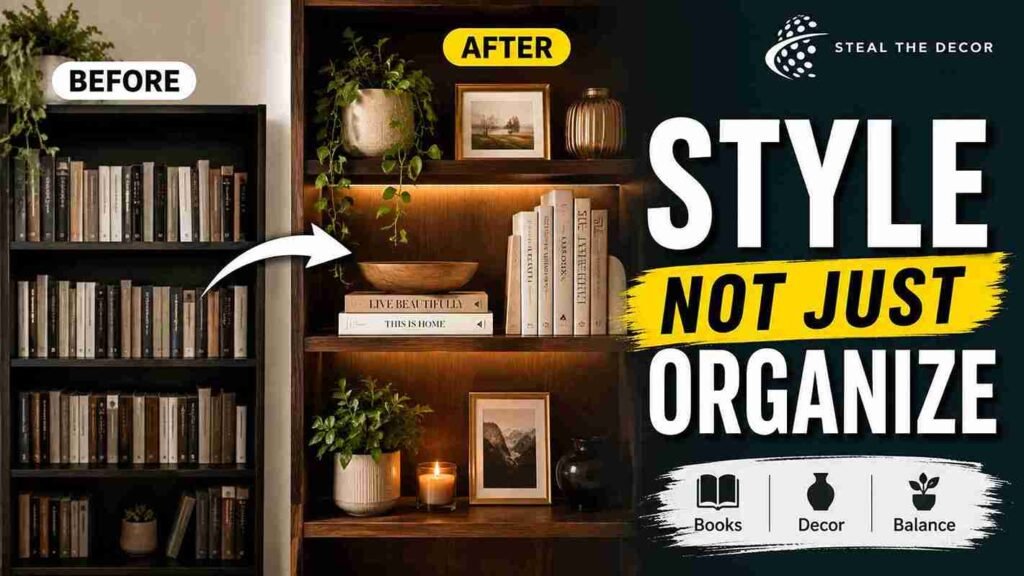
Books stacked sideways, upright, diagonally—in a way that looked less “curated library” and more “moving day that never finished. ” That was my bookshelf for the first eight months in my apartment. Learning how to style a bookshelf properly turned out to be less about buying new furniture and more about rearranging what I already owned, plus about $38 in small decor pieces. Over three weekends I tested five different styling methods on the same secondhand shelf, photographed each one, and kept notes on what actually looked intentional versus what just looked like clutter with better lighting.
This guide walks through the exact formula that worked, the arrangement methods I tried and rejected, the mistakes that made my shelf look worse instead of better, and a full room-by-room breakdown so you can adapt it to your own space. A full bookcase in a living room, a single floating shelf in a studio—either way, this works.
⚡ The Short Version: To style a bookshelf, declutter first, then group books by category. Mix in decor using the two-thirds rule—roughly two-thirds books and one-third objects like vases, bookends, plants, or framed photos. Stack some books horizontally to break up vertical lines, group decor in odd numbers (3s work best), and leave 10–15% of each shelf empty for visual breathing room. A well-styled bookshelf usually costs under $50 if you’re using items you already own plus a few small accessories.
What Is Bookshelf Styling (And Why It’s Different From Organizing)
Bookshelf styling and bookshelf organizing solve two different problems. Organizing answers “Can I find my books?”—usually through alphabetical order, genre, or color. Styling answers “Does this shelf look intentional?” Different question entirely. It borrows more from interior design than from library science.
A shelf can be perfectly organized and still look flat. Every book is upright, spines aligned, with zero visual interest. Stylists solve for visual balance instead—varying height, texture, and negative space so your eye has somewhere to land. Home stylists tracking interior design trends keep pointing to the same thing: layered decor—mixing books, objects, and empty space—as the real difference between a shelf that reads as “furniture” versus one that reads as “decor.” It’s a distinction Apartment Therapy covers well too.
And this matters more in a rental than it does in a house you own—you can’t fix a boring shelf by knocking down a wall or building custom built-ins. A rented bookcase has to pull double duty: real storage on the shelves you actually use daily, and a bit of intentional styling on the shelves people actually see when they walk in. Once I stopped trying to make every shelf equally “styled” and treated two or three shelves as the visual focus instead, the whole piece finally started to look designed instead of just full.
Does Bookshelf Styling Actually Work in a Small or Rental Space? (Reality Check)
Short answer: yes, but with real limits. Styling works well when you’ve got at least a few decor objects to mix in and a shelf with some visible negative space to work with. It works less well if your shelf is so small—or so packed with required storage (textbooks, binders, everyday items)—that there’s no room to breathe.
In my case, a five-shelf bookcase in a 650-square-foot one-bedroom, styling meant sacrificing some storage efficiency for looks. I moved a few less-used books to a closet bin to free up space. Not a fun trade, but worth it. If you’re working with a tight footprint, pair this with a guide on how to decorate a rental without damage so you’re not stuck choosing between storage and style. Minimalist bookshelf styling — fewer books, more negative space — tends to work better in small apartments than a fully packed, maximalist look, mostly because it needs less real estate to read as “designed” rather than “crowded.”
Bottom line: if your shelf’s already at capacity for practical storage, style around the edges first — a few decor pieces, one styled shelf—before you attempt a full overhaul.
How to Style a Bookshelf Step by Step (The Formula I Use)
This is the exact sequence I now use every time I restyle a shelf—refined after the version that failed.
- Take everything off the shelf. You can’t style around clutter you can’t see clearly. Wipe down the shelves while they’re empty — it’s the only time you’ll actually want to.
- Sort into three piles: books staying, books going into storage, and decor objects. Be honest about what you’ll actually reread versus what’s dead weight.
- Group books by category first, not color. Loosely group by subject or size before you even think about aesthetics. Keeps the shelf functional, not just pretty.
- Stack roughly a third of your books horizontally. Pick 3–6 books per stack, tallest on the bottom. This breaks up the repetitive vertical lines of spines-only shelves and gives you a flat surface to set a small object on top of.
- Add one anchor object per shelf. A vase, a small plant, a framed photo — any of these work as a focal point. I used a $12 ceramic vase from a thrift store as my anchor on the middle shelf. Became the visual center of the whole piece, honestly more than I expected from a $12 thrift find.
- Use bookends to define sections. A pair of Umbra Prisma Bookends by Umbra (around $20–$28) holds a smaller stack upright without letting it lean—a matter more than it sounds like it would.
- Layer in height variation. Prop a small piece of framed art against the back of a shelf instead of laying it flat. Adds depth without needing wall space, and it pairs well with ideas from a guide on how to style a blank wall behind a TV if your shelf sits near one.
- Step back and edit. Remove one item from every shelf that feels crowded. This is the step people skip — and it’s the one that makes the biggest visual difference.
I remember standing across the room after step 8, half expecting the shelf to look worse with less on it. It didn’t. It looked finished for the first time in eight months.
If your shelf sits against an accent wall, a lot of these same layering principles carry over from a faux-brick accent wall or a removable boho mural—the goal in both cases is texture and depth, not just filled space. And if you’re leaning framed art against the shelf rather than hanging it, a piece framed using tips from how to frame a poster cheaply without a frame works well here.
💡 Pro Tips for Renters:
- Use removable putty instead of glue under decorative objects on higher shelves. Keeps things from sliding during a move or a heavy-footed neighbor’s stomping, and it comes off residue-free.
- Don’t center your anchor object dead-center on every shelf. Offsetting it slightly left or right of center reads as more intentional than perfect symmetry.
- If your shelf gets dim light, borrow a trick from how to light a dark room with no outlets — a battery puck light tucked behind a stack adds a warm glow without any wiring.
- Rotate 2–3 items seasonally (a small pumpkin in fall, a pinecone in winter) so the shelf doesn’t feel static year-round.
- If you’re short on decor objects, raid your kitchen. A small ceramic bowl or a wooden cutting board propped upright can double as a shelf accent.

How to Arrange Books on a Shelf (By Color, Height, or Category)
Three common ways to arrange books. Each one has real tradeoffs.
By color: Books grouped by spine color create the most visually striking, Instagram-friendly shelf. The tradeoff is functional — you’ll forget where anything actually is within a week. I’d recommend this only for a small display shelf, never your main working bookcase.
By height: Arranging books tallest-to-shortest (or in a gentle wave) creates a clean, structured look that reads as more “designer” than random placement. Easiest method for beginners, too — zero memorization required.
By category: Grouping by subject, genre, or use (cookbooks together, novels together) keeps the shelf functional first, styled second. This is what I landed on for my main shelf; then I applied color and height variation within each category group. Best of both approaches, honestly.
Bottom line: if you only remember one thing, arrange by category first, then adjust for height and color inside each group. Looks curated without sacrificing usability.
Best Decor Items to Style a Bookshelf With
You don’t need a design budget to style a shelf well. You need the right handful of objects, used sparingly.
- Bookends — Keep leaning stacks upright and define visual sections. (Umbra Prisma Bookends by Umbra, around $20–$28)
- Small vases or vessels — Add a soft, organic shape to break up the straight lines of books. Even an empty vase works as a sculptural object.
- Woven baskets—A small Mkono Woven Storage Basket by Mkono (around $15–$22) hides remote controls or chargers while adding texture.
- Framed photos—Personal, low-cost, and they instantly make a shelf feel lived-in rather than staged.
- Small plants—A trailing pothos or a faux plant like an IKEA FEJKA Artificial Plant by IKEA (around $10–$18) softens hard shelf edges. Want to go real and vertical instead? This pairs naturally with hanging plants without drilling just above the shelf.
- A small tray—Corrals loose objects (candles, coasters) into one visually “contained” grouping instead of scattered clutter.
| Item | Price Range | Ease of Use (1–5) | Damage Risk | Best For | Our Rating |
|---|---|---|---|---|---|
| Umbra Prisma Bookends | $20–$28 | ⭐⭐⭐⭐⭐ | ✅ None | Keeping stacks upright | 5/5 |
| Ceramic vase (thrifted or new) | $8–$25 | ⭐⭐⭐⭐⭐ | ✅ None | Anchor object per shelf | 5/5 |
| Mkono Woven Storage Basket | $15–$22 | ⭐⭐⭐⭐ | ✅ None | Hiding clutter, adding texture | 4/5 |
| Small framed photos | $5–$20 | ⭐⭐⭐⭐⭐ | ✅ None | Personal, low-cost styling | 5/5 |
| IKEA FEJKA faux plant | $10–$18 | ⭐⭐⭐⭐⭐ | ✅ None | Softening hard lines | 4/5 |
Bookshelf Styling by Room Type
Living room: This shelf gets the most eyes, so lean into the anchor-object method and keep one shelf entirely styled—not for storage—as the visual centerpiece. Living room bookshelf styling benefits most from height variation and a color palette that actually matches the room around it.
Bedroom: Softer, more personal. Favor photos, candles, and books you actually reread over statement decor. If your bedroom shelf sits under a window, coordinate it loosely with your rental-friendly accent wall ideas or a removable wallpaper for small bedrooms nearby so the palette feels connected instead of competing.
Home office: Function first. Keep reference books accessible on lower shelves and save the top shelf for styling—a plant, a framed print, one small stack. If cord clutter from a nearby desk setup is an issue, hiding lamp cords nearby keeps the whole zone looking intentional.
Small apartment / studio: One styled shelf can visually anchor an entire zone when you don’t have room for a full bookcase. A single floating shelf styled with the two-thirds rule reads as a reading nook even in 300 square feet—especially with a warm light source nearby, similar to hanging plug-in pendant lights from the ceiling above the corner.
Common Bookshelf Styling Mistakes to Avoid
Overcrowding every shelf. This was my first attempt, and—not gonna lie—it looked worse than the unstyled version. Every surface packed edge to edge reads as clutter, no matter how nice the individual objects are. Leave real negative space on at least one shelf.
Ignoring negative space entirely. The opposite problem: too much empty shelf reads as unfinished, not minimalist. Aim for roughly 10–15% empty space per shelf. Not 50%.
Using a mismatched color palette. Five decor objects in five unrelated colors compete instead of complementing. Pick 2–3 colors total across the whole shelf, including the objects and any visible book covers.
Too many small trinkets. Individually cute items become visual noise as a group. Edit ruthlessly — three well-chosen objects beat ten small ones every time.
Forgetting the top and bottom shelves. Most people style eye-level shelves and abandon the top and bottom. Even a single plant on top or one styled basket on the bottom keeps the whole piece cohesive.
Skipping the “step back” test. Take a photo of your shelf from across the room. Clutter that looks fine up close often reads as messy from a normal viewing distance—this was the mistake that took me three tries to actually fix.

Real Results: My Bookshelf Restyle for Under $50
I spent $47.63 total across three weekends: a $12 thrifted ceramic vase, $24 for a pair of bookends, and $11.63 for a small faux plant on clearance. Everything else — the books, a woven basket I already owned, two framed photos — came from stuff already sitting in my apartment.
The first attempt failed. I tried arranging purely by color, which looked stunning in photos and was completely unusable within a week because I couldn’t find anything. Then I overcorrected—went fully by category with zero styling, which solved the usability problem but looked exactly like it had before I started. Not gonna lie, that second attempt was almost more discouraging than the first. It took a third pass, combining category grouping with the two-thirds rule and one anchor object per shelf, before the shelf actually looked usable and intentional at the same time.
The biggest visible change, in my experience? The bookends and the single anchor vase. Not from buying more decor — from using less of it, more deliberately. Worth naming honestly: this formula works best when you already own at least a handful of non-book objects to work with. Starting from an entirely bare bookcase with nothing but books? Budget an extra $15–$20 for one or two small accent pieces before you begin. Books alone rarely create the visual variation styling depends on.
🔑 Key Takeaways
- The two-thirds rule — roughly two-thirds books to one-third decor objects — is the foundation most professional shelf stylists use to balance a bookshelf visually.
- Umbra Prisma Bookends by Umbra, priced around $20–$28, hold leaning book stacks upright and help define visual sections without any tools or damage to a rental shelf.
- Arranging books by category first, then adjusting for height and color within each group, keeps a shelf both functional and visually cohesive.
- Leaving 10–15% of each shelf as negative space keeps a styled bookshelf from reading as cluttered, even when it’s fully stocked with books.
- A full bookshelf restyle can cost under $50 using existing books and decor plus a small number of new accent pieces like a vase, bookends, and a faux plant.
- Grouping decor objects in odd numbers, particularly threes, reads as more intentional and less staged than pairs or single centered objects.
- Styling works in small apartments and rentals without any drilling, adhesive, or permanent changes to the shelf itself—fully deposit-safe.
Conclusion
A styled bookshelf comes down to editing, not buying. Group what you already own with intention, add one or two anchor pieces, and leave room for the shelf to breathe. That’s the whole trick, really. The formula in this guide took me three failed attempts to land on—hopefully this saves you the trial and error.
Have you tried restyling your bookshelf? I’d love to hear what worked in your space in the comments below. And if you’re tackling other no-damage projects next, my full guide on how to decorate a rental without damage is a good next stop—same deposit-safe philosophy, applied to the rest of your apartment. Before you start any project that involves your walls or built-ins, it’s worth a quick check of your lease terms; Nolo’s overview of renters’ rights is a solid, plain-language starting point if you’re unsure what your landlord allows.
Every product mentioned above is one I actually tested myself. Nothing recommended here that I haven’t tried in my own apartment.
FAQ: Bookshelf Styling Questions, Answered
What is the two-thirds rule for shelf styling?
The two-thirds rule means keeping roughly two-thirds of a shelf’s contents as books and one-third as decor objects like vases, bookends, or framed photos. It stops a shelf from looking either too bare or too cluttered—it’s the ratio most professional stylists default to.
How many books should you put on a shelf for styling?
There’s no fixed number since it depends on shelf size. A good guideline: fill each shelf to about 80–85% capacity, leaving 15–20% open for negative space and decor objects to sit comfortably without feeling crammed.
What do you put on a bookshelf besides books?
Common non-book items include bookends, small vases, framed photos, plants (real or faux), woven baskets, candles, and small sculptural objects. The goal is variety in shape and texture — not filling every gap.
How do I make my bookshelf look less cluttered?
Remove roughly 20% of what’s currently on the shelf, group what’s left by category, and add one clear anchor object per shelf. Editing down almost always improves a shelf more than adding anything new does.
Is bookshelf styling expensive?
Not necessarily. My full restyle cost under $50 using mostly items I already owned, plus two or three inexpensive decor pieces. The formula matters more than the budget — a $500 shelf can still look cluttered without one.
What’s the best way to style a small bookshelf?
Lean minimalist: fewer books, more negative space, one strong anchor object per shelf instead of several small ones. Small shelves get overwhelmed by clutter faster than large bookcases do.
Does bookshelf styling work if I rent and can’t drill anything into the shelf itself?
Yes—everything here is freestanding (books, bookends, vases, baskets) and needs no drilling or adhesive on the shelf itself. If your styling extends to the wall behind it, stick to no-drill methods like the ones covered in how to hang a tapestry without damage or command hooks for kitchen organization if you’re extending organization ideas into an adjacent kitchen shelf.
More Rental-Friendly Projects to Pair With Your New Bookshelf
Already deep in a decor mood? These renter-tested guides pair naturally with a freshly styled bookshelf:
- Hang a heavy mirror without studs near your shelf to bounce light around a reading nook
- Damage-free ways to hang large mirrors if your shelf sits in a smaller room that needs the extra depth
- Create a grid gallery wall with adhesive strips above the shelf for a full styled corner
- Hang a gallery wall without nails as an alternative no-drill framing method
- Large-scale wall art for apartments if you want one big statement piece instead of a gallery
- Removable wall decals for a minimalist look to tie the wall behind your shelf into the same palette
- Peel-and-stick wallpaper for renters as a backdrop for open or ladder shelving
- Peel-and-stick wallpaper on textured walls if your rental has stucco or orange-peel texture behind the shelf
- Peel-and-stick wood plank wall for a warmer backdrop behind open shelving
- Washi tape faux wall frames as a low-cost way to frame the space above your shelf
- Using fabric as wallpaper in a rental for a softer, textile-based backdrop
- Hide ugly wall vents if your shelf placement is dictated by an awkward vent location
- Rental-friendly wall paneling for a more architectural backdrop
- Remove wallpaper without damaging paint if you’re prepping the wall behind your shelf first
- Area rug over carpet guide to ground a reading nook in front of your shelf
- Keep a rug from bunching on carpet once that reading-nook rug is down
- Cleaning a vintage rug if you thrifted one for the same corner
- Best interlocking temporary flooring if your shelf sits over bare rental subfloor
- Best light temperature for a living room to make sure your styled shelf actually photographs and reads well at night
- Cover a boob light without replacing it if overhead lighting is fighting your new styled corner
- Organize a tiny rental pantry using the same category-first, style-second logic from this guide
- Magnetic organizer for the side of a fridge if you want to apply these styling principles in the kitchen next