
Table of Contents
The cord ruined the whole thing.
I’d spent two weekends hunting for the right console table for my 650-square-foot rental—a slim, mid-century piece that finally made my entryway look like an adult lived there. Lamp on top, books arranged, tray styled just right. Stepped back to admire it. And there it was: a thick black cord running down the leg, across the hardwood, to the only outlet in the room. The whole effect died in about two seconds—which is exactly when I got serious about how to hide lamp cords without drilling a single hole or losing a cent of my deposit.
Over the next three weekends I tested 11 different methods—some on a glass console table, some along baseboards, and one running straight under a rug. Two failed outright. Badly. This is the honest version, failures included, with exactly what I paid down to the cent.
⚡ The Short Version: To hide lamp cords in a rental without damaging walls, run cords along table legs and baseboards with Command Cord Bundlers by 3M, sleeve visible sections with a color-matched fabric cord sleeve, and stash excess slack in a basket or storage box. For glass tables, clear adhesive clips are non-negotiable—standard clips show right through. Never run a round cord under a rug in a high-traffic area; use a flat cord protector instead. Budget $15–$40 for a full setup.
What Are the Best Ways to Hide Lamp Cords in a Rental?
Hiding lamp cords isn’t about rewiring anything. It’s about strategic placement and removable products that come off clean when you move. The real gap between homeowner advice and renter advice comes down to one thing: renters need methods that leave zero trace at move-out.
Most decor articles casually suggest running wire through the wall or installing a floor outlet. Fine if you own the place. Not an option here. What actually works is adhesive that releases without peeling paint, cord routing that needs no tools, and a couple of tricks nobody bothers mentioning because they only matter once you’ve actually tried to hide a cord on glass.
What surprised me most: the cheapest fix on this list — a basket I already owned — outperformed a $22 raceway kit in one specific spot. Cost and effectiveness didn’t track together at all.
The method that works for you depends on your furniture, your wall texture, and where your outlets happen to be. There’s no universal answer here—just the nine that held up.
Does Hiding Lamp Cords Actually Damage Walls?
Yes and no, and this is where a lot of articles gloss over the real answer.
Adhesive clips from Command by 3M are damage-free when removed correctly. I’ve used them across three different apartments without a single paint peel. The catch: you have to pull the tab straight down toward the floor, not sideways. Pull it wrong and you’re patching a wall.
Cheap tape is a different story entirely. In my first apartment, I used generic double-sided mounting tape from a dollar store to run a cord along the baseboard. Pulled it up a year later, and three strips of paint came with it—my landlord noticed at move-out, and it cost me $40 from my deposit.
Running a cord under a rug carries its own risk. Standard round lamp cords aren’t built for foot traffic, and over months the insulation wears down from being stepped on repeatedly. If you’re going to do this at all, you need a flat cord protector rated for floor use—not a bare cord and a hope.
For other damage-free wall solutions, my guide on rental-friendly accent wall ideas covers more adhesive-based transformations that follow the same removal rules.
Damage-free is genuinely achievable. You just have to use the right product and actually read the removal instructions instead of assuming you know how tape works.
Actually—let me walk that back slightly. Damage-free is achievable if you follow the instructions. Skip them, rush the removal, or grab whatever’s cheapest at the dollar store, and even a good product can leave a mark.
9 Renter-Safe Methods to Hide Lamp Cords (Tested and Ranked)
Here’s the section I wish existed when I started. Ranked from best to “Why did I even bother?” with exactly what I paid for each.
1. Adhesive Cable Clips — Command Cord Bundlers by 3M Cost: $6.97 for a pack of 8 · Damage Risk: ✅ None when removed correctly · Best For: table legs, baseboards, any visible surface
These are the MVPs of the whole list. I ran one line along the back of my console table leg and another behind the sofa baseboard. Four months in, the clips haven’t budged, and from three feet away they’re basically invisible.
What worked: they hold a genuinely heavy floor lamp cord without sagging. What I learned: measure your cord’s diameter before buying — some clips are sized for thin phone-charger cables and won’t grip a real lamp cord. Found that out the annoying way, mid-project.
2. Fabric Cord Sleeve, Color-Matched Cost: $8.24 for 6 feet · Damage Risk: ✅ None · Best For: cords running down visible furniture legs
A stretchy fabric tube that slides over the cord and hides the black plastic underneath completely.
What worked: matched to my light wood table leg, the cord basically vanished. What I learned: order a swatch or check the color in daylight first. My first attempt was a shade too orange next to the actual wood—had to reorder and eat the $7 loss.
3. Paintable Cord Raceway — D-Line Cable Cover Cost: $19.99 for a 6-foot kit · Damage Risk: ✅ None, removable adhesive · Best For: cords traveling more than a few feet along a wall
A plastic channel that sticks to the wall, closes over the cord, and takes paint so you can match it to your trim.
What worked: for a cord that needs to cross a whole room, this is the cleanest fix by far. What I learned: paint the raceway before you stick it up. I painted mine in place and got paint on the wall around it—a fifteen-minute touch-up that was entirely avoidable.
4. Decorative Basket to Hide Slack Cost: $0, already owned it · Damage Risk: ✅ None · Best For: hiding excess cord at the outlet
It was the cheapest method on the list, and it outperformed everything else in one specific spot—behind my floor lamp, where three feet of extra cord was just coiled on the floor.
What worked: the basket swallowed all of it, and it looks like intentional styling, not a hack. No damage. None at all. What I learned: this only works if the basket is actually big enough. A small one just makes the mess more visible, not less.
5. Cable Raceway Under a Floating Shelf Cost: $12.49 · Damage Risk: ✅ None, removable adhesive · Best For: lamps sitting on a floating shelf
A slim raceway mounted to the shelf’s underside routes the cord invisibly down to the nearest outlet.
What worked: from the front, there’s genuinely nothing to see. What I learned: measure the shelf depth first — the widest raceway I found didn’t fit under a shallow 6-inch shelf.
6. Adhesive Wire Clips Along the Table Leg Cost: $7.49 for a pack of 10 · Damage Risk: ✅ None · Best For: solid wood or metal table legs at least an inch wide
Small clips that run down the back of a leg and keep the cord from swinging into view.
What worked: it was simple, cheap, and did the job on both my nightstand and entry table. What I learned: thin metal legs under an inch wide won’t hold the clip flat—that’s where the fabric sleeve method wins instead.
7. Flat Cord Protector Under a Rug Cost: $10.99 · Damage Risk: ⚠️ Low, only when the right cord is used · Best For: running cords under rugs safely
The only method I recommend for under-rug cord management is only with a flat cord, never a round one. I’ll admit I was skeptical this would actually stay invisible under foot traffic. It did.
What worked: six months in place, no visible ridge, no complaints from anyone tripping over it. What I learned: I tested a standard round cord under the same rug first. Two weeks in, you could already see the impression in the rug backing. Switched to the flat protector immediately and never looked back.
⚠️ Safety Note: Avoid running standard round cords or heavy-duty extension cords under rugs in high-traffic areas — stepping on them repeatedly can damage the internal insulation and create a genuine fire hazard. Use a flat-designed cord protector rated for floor use, and never route a cord under a rug that sits over a heating vent.
8. Furniture-Integrated Routing Cost: $0, used what I had · Damage Risk: ✅ None · Best For: desks and console tables with back panels
Not a product — a technique. Route the cord behind furniture legs or through gaps most pieces already have.
What worked: my desk had a back-panel gap I hadn’t even noticed. Cord went through it, down the leg, done—no clips needed. What I learned: check your furniture from the back and underside before buying anything. A lot of pieces already have a cord channel built in; you just haven’t looked.
9. Cordless, Rechargeable Lamps Cost: $25–$60 · Damage Risk: ✅ None · Best For: eliminating the problem entirely
The nuclear option. No cord, no outlet dependency, charges overnight like a phone.
What worked: on my nightstand, this solved the middle-of-the-room problem instantly. What I learned: check the battery life before buying — some cheap models only run 4–6 hours, which isn’t enough for a full evening.
If your rental has other visible eyesores you’re trying to work around, my guide on hiding ugly wall vents covers the same damage-free approach for a different problem.
💡 Pro Tips for Renters
- Test adhesive on a hidden spot first — a section of baseboard behind furniture, not the middle of the wall, so a failed bond doesn’t leave a visible mark. And if your rental has textured walls — I feel you. Clips alone often aren’t enough there; lean on the raceway or fabric sleeve instead.
- For glass tables, clear clips are non-negotiable. I tried both—black clips catch the light from every angle, clear ones disappear completely.
- Match fabric sleeves to your wall, not your furniture. The sleeve that matched my table leg was actually visible against the wall behind it; the one that matched the wall blended in from every direction.
- Keep your receipts. Some landlords will reimburse “damage prevention” purchases if you ask — I got $15 back for my raceway kit, no argument.
- Measure twice before ordering fabric or raceway. Add 20% to whatever you think you need. A gap that’s two feet short looks worse than the original cord ever did.
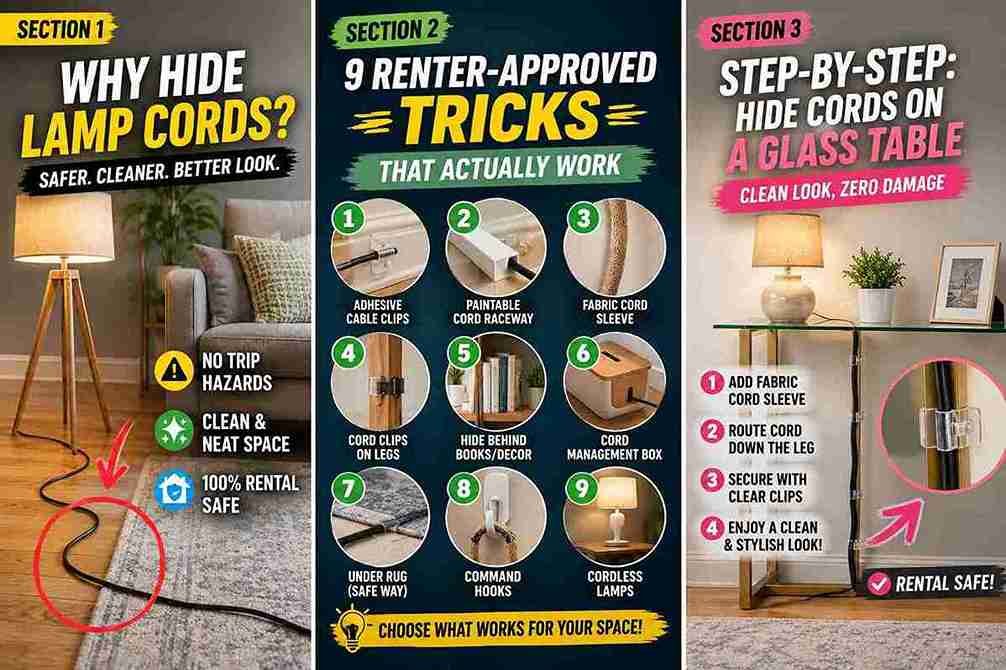
Step-by-Step: How to Hide a Lamp Cord on a Glass Table
Honestly? I didn’t think a $16 setup would beat a table that cost ten times that. It did.
Step 1 — Gather your supplies. You’ll need clear adhesive cord clips, a fabric cord sleeve color-matched to your wall, and a small piece of cardboard for a faux backing board. Total cost for this setup ran about $16.00.
Step 2 — Attach clear clips to the underside of the tabletop. Never on top—the goal is a clip you can’t see from any normal viewing angle. Space them every 8–10 inches along the back edge.
Step 3 — Run the cord through the clips in a straight line. If you’re using a fabric sleeve, slide it over the cord before clipping it in, so the entire visible stretch is covered.
Step 4 — Build a faux backing board for excess slack. Cut cardboard to the width of the table’s back panel, wrap it in fabric that matches your wall, and attach it to the back legs with double-sided tape — nowhere near the glass. Coil the extra cord behind it.
Step 5 — For thin metal legs, skip the clips and use a fabric sleeve instead. Match the sleeve color to the metal finish, not the glass. On a black hairpin-leg table, a black sleeve disappears against the leg almost entirely.
Skipping the backing board step is the single biggest mistake here—without it, you trade a visible cord for a visible coil of slack, which honestly looks worse.
How to Hide Lamp Cords in the Middle of the Room (No Wall Nearby)
This was the hardest problem on the whole list. My sofa sits in the center of the living room, nowhere near an outlet, and the floor lamp beside it has a cord stretching six feet across the open floor.
Option 1 — Flat cord protector under the rug. What I actually used. The flat profile lies flush against the floor, and the protector covers the section under the rug. Total cost: $17. You genuinely can’t feel it underfoot.
Option 2 — Floor outlet installation. A permanent modification requiring a cut into the floor and new wiring. Skip this entirely unless your landlord approves it in writing and covers the cost themselves.
Option 3 — Battery-powered lamp. The cleanest option by far. I switched my office-corner lamp to a rechargeable model—no cord, no outlet dependency, roughly 10 hours per charge.
Bottom line for this one: if a cord has to cross an open floor with no wall in reach, go with a flat cord protector under a low-pile rug, or skip the cord entirely with a rechargeable lamp. A standard round cord under a rug in a high-traffic path is a real hazard, not just an eyesore.
Common Mistakes Renters Make Hiding Lamp Cords
I made almost all of these myself. But the color-matching one still stings the most—it’s such a simple fix that almost nobody bothers with it.
Using cheap double-sided tape. Half the price of Command strips, and it cost me $40 in paint damage at move-out. The tape was cheap. The repair wasn’t. Stick with removable adhesive products built for walls.
Running a standard round cord under a rug. Two weeks of foot traffic and you’ll already see flattening in the cord and an impression in the rug’s backing. Use a flat cord protector, full stop.
Not measuring before you buy. A cord sleeve two feet too short leaves a visible gap that looks worse than the bare cord did. Measure the exact run, then add 20%.
Forcing a cord into an undersized clip. Phone-charger clips will crack under a real lamp cord’s weight within a week. Check the diameter rating before you buy.
Ignoring color matching. Black clips on a white wall are the most common reason a “hidden” cord still reads as obviously hidden. Match the clip to the surface, not to the cord.
Skipping the removal instructions. Pulling a Command-style tab sideways instead of straight down toward the floor is how paint comes off with the strip. It takes thirty seconds to read the package. Do that first.
For other adhesive-based fixes that follow the same removal logic, my guide on damage-free ways to hang large mirrors covers heavier items using the same principle.
Best Cord Concealers for Lamps: Renter-Safe Products We Actually Recommend
| Product / Method | Price Range | Ease of Use (1–5) | Damage Risk | Best For | Our Rating |
|---|---|---|---|---|---|
| Command Cord Bundlers by 3M | $6–$9 | ⭐⭐⭐⭐⭐ | ✅ None | Table legs, baseboards | 5/5 |
| D-Line Cable Cover (paintable raceway) | $15–$25 | ⭐⭐⭐⭐ | ✅ None | Long wall runs | 4.5/5 |
| Fabric Cord Sleeve | $8–$14 | ⭐⭐⭐⭐ | ✅ None | Glass or open-leg furniture | 4.5/5 |
| Coordinated Flat Extension Cord | $10–$15 | ⭐⭐⭐⭐ | ⚠️ Low | Under-rug routing | 4/5 |
| Adhesive Wire Clips (10-pack) | $7–$9 | ⭐⭐⭐⭐⭐ | ✅ None | Table legs, baseboards | 4.5/5 |
| Rechargeable Table Lamp | $25–$60 | ⭐⭐⭐⭐⭐ | ✅ None | Eliminating cords entirely | 5/5 |
What to Check With Your Landlord Before You Start
And before you spend a cent on any of this—talk to your landlord first. A five-minute conversation can save you a returned Amazon order and a headache later.
- Does your lease mention wall adhesives or modifications specifically? Some leases restrict Command-style strips by name.
- Are extension cords under rugs allowed at all? A couple of my past leases banned this outright over fire code concerns.
- Does a raceway count as a “permanent installation” once it’s painted? Ask before you commit to painting it on the wall.
- What’s the actual penalty for wall damage? Knowing the dollar figure up front changes how careful you are with adhesive choices.
- Are there existing floor outlets under any furniture or rugs you haven’t noticed?
- If your walls are textured, does your lease treat small adhesive marks as normal wear and tear?
If you’re unsure what your lease actually allows, USA.gov’s tenant rights resource is a solid starting point for understanding your rights and where to find state-specific rules before you stick anything to the walls.
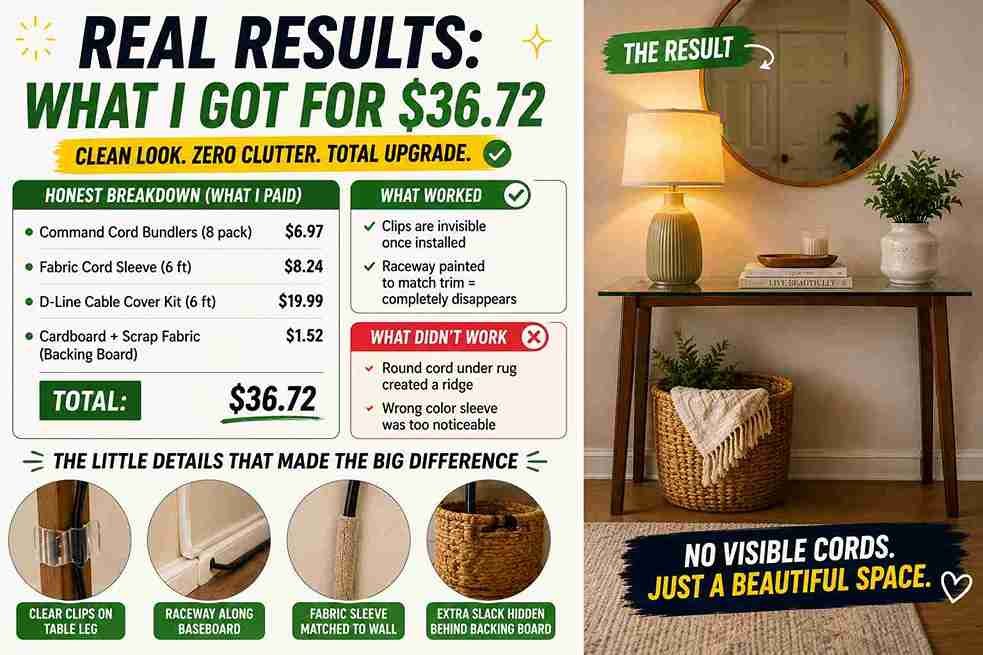
Real Results: What I Got for $36.72
Here’s the honest breakdown of everything I kept and used:
- Command Cord Bundlers: $6.97 — used all 8, no leftovers
- Fabric cord sleeve: $8.24 — used the full 6 feet
- D-Line Cable Cover kit: $19.99 — used the whole 6-foot length
- Cardboard and scrap fabric for the glass-table backing board: $1.52 from a craft-store remnant bin
Total: $36.72. Not counted in that figure: the first fabric sleeve I ordered in the wrong color, which cost me an extra $7 and a wasted week waiting on shipping.
What worked: the clips are essentially invisible once installed, and the raceway along my baseboard, once painted to match the trim, disappears from a standing height. What didn’t work: My first attempt at under-rug routing used a round cord instead of a flat one—a visible ridge showed up within a week, and my roommate caught her foot on it. What I’d do differently: order fabric swatches before committing to a full sleeve, and buy the flat cord protector from the start instead of testing a round cord first.
🔑 Key Takeaways
- Command Cord Bundlers by 3M hold a lamp cord flush against painted drywall and remove cleanly when the pull-tab technique is used correctly, making them the most deposit-safe option for most rental setups.
- Glass and open-leg furniture require clear adhesive clips and a color-matched fabric sleeve—standard black clips remain visible through glass from any angle.
- Running a standard round cord under a rug creates a measurable fire and trip hazard within weeks; a flat cord protector solves both problems.
- A complete lamp-cord-hiding setup for a one-bedroom rental typically costs $15 to $40 using a combination of clips, raceway, and fabric sleeve.
- Cheap double-sided tape is the single most common cause of paint damage in cord-hiding projects—Command-style removable adhesive avoids this entirely.
- Rechargeable table lamps eliminate the cord problem altogether and typically run $25–$60 with 8–12 hours of runtime per charge.
- Always check your lease before installing anything — some agreements restrict adhesives, cord covers, or under-rug cables by name.
Conclusion
Hiding lamp cords in a rental doesn’t have to be complicated. I spent $36.72 and about two hours total, and the visual clutter in my living room is just gone — the entryway finally looks the way I pictured it three weekends ago.
If you’re only taking one thing from this guide on how to hide lamp cords: start with adhesive clips and a fabric sleeve. Those two alone solve most of the visibility problem. Add a basket or raceway for the leftover slack, and you’re most of the way there. If you’re tackling this as part of a bigger refresh, my guide to rental-friendly wall paneling pairs well with these tricks, and a piece of large-scale wall art above the console table pulls the eye away from anything still slightly visible.
Have you tried hiding lamp cords in your rental? Tell me what worked — and what failed spectacularly — in the comments below. All the products I tested and recommend are linked above. I’ve tried every single one myself.
🧰 More Renter Hacks You’ll Actually Use:
- How to frame a poster cheap without a frame—Click here →
- The ultimate damage-free home styling guide (2026 edition)—Click here →
FAQ: Hiding Lamp Cords for Renters
How do you hide lamp cords without damaging walls?
Use removable adhesive clips from Command by 3M or a similar brand. The key is proper removal — pull the tab straight down toward the floor, never sideways, so the adhesive stretches and releases cleanly. Cheap double-sided tape almost always damages paint on removal.
Can you run a lamp cord under a rug?
Yes, but only with a flat cord protector rated for floor use—never a standard round lamp cord. Foot traffic wears down round-cord insulation over time and creates a genuine fire hazard, so stick to flat-designed protectors and check your lease first.
What’s the best way to hide cords on a glass table?
Use clear adhesive clips on the underside of the tabletop, invisible from the front. For excess slack, build a small fabric-wrapped cardboard backing board behind the table legs—never use black clips on glass, since they’re visible from every angle.
How much does cord management cost for a renter?
A full setup runs $15–$40: adhesive clips ($6–$9), a fabric cord sleeve ($8–$14), and a raceway or storage solution if needed ($12–$25). Add $10–$15 for under-rug supplies if your lamp sits away from any wall.
What products are safest for rental walls?
Command-brand adhesive clips are the most reliable for damage-free removal, and paintable raceways like D-Line are safe when the adhesive tabs are used as directed. Avoid generic mounting tape and anything requiring screws.
How do you remove adhesive clips without peeling paint?
Pull the tab straight down toward the floor, never sideways or upward—the adhesive stretches and releases cleanly. If there’s no pull tab, floss can saw through the adhesive from behind. If it feels like it’s resisting, you’re pulling the wrong direction.
Are cordless lamps worth it for renters?
Yes, if you want to skip cord management entirely. Rechargeable table lamps run $25–$60 and typically last 8–12 hours per charge, which makes them a solid fix for rooms with limited outlets or lamps that sit far from any wall.