
Table of Contents
I bought a rug I had no business buying.
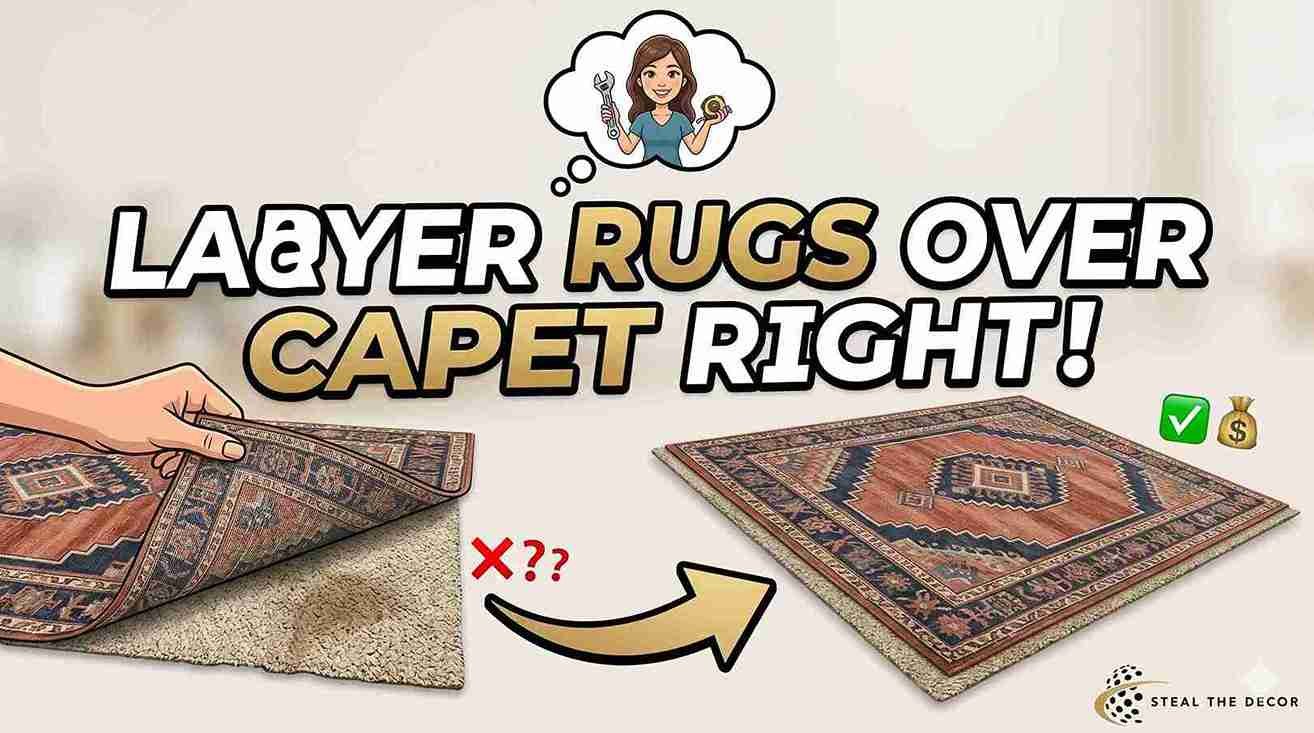
It was 8 p.m. on a Tuesday. I was scrolling through a flash sale, saw a geometric flatweave with rust and navy tones, and clicked “Buy” before measuring a single inch of my rented apartment’s beige wall-to-wall carpet. The rug arrived four days later. I unrolled it, stepped back, and immediately watched it ripple into something that looked like a crumpled napkin.
That was my introduction to the area rug-over-carpet dilemma. I’d read the Reddit threads. I’d heard the warnings. “Don’t do it.” “It’ll bunch up.” “You’ll trip and die.” But I also knew my apartment needed something. The builder-grade carpet was stained in three places — thanks, previous tenant — and I couldn’t rip it out without losing my security deposit. So I decided to figure out how to layer rugs on carpet the hard way. By failing at it. Repeatedly.
What I learned over the next eighteen months — across two apartments, four rugs, three rug pads, and one truly humbling furniture anchor incident — changed how I see rental decorating. If you’ve ever stared at your wall-to-wall carpet and thought, “Can I just throw a rug on this and call it done?” the answer is yes. But the how matters more than the what.
This is everything I wish someone had told me before I made a $22 mistake with a rubber-backed rug pad that still haunts my Amazon order history.
What Does “Area Rug Over Carpet” Actually Mean?
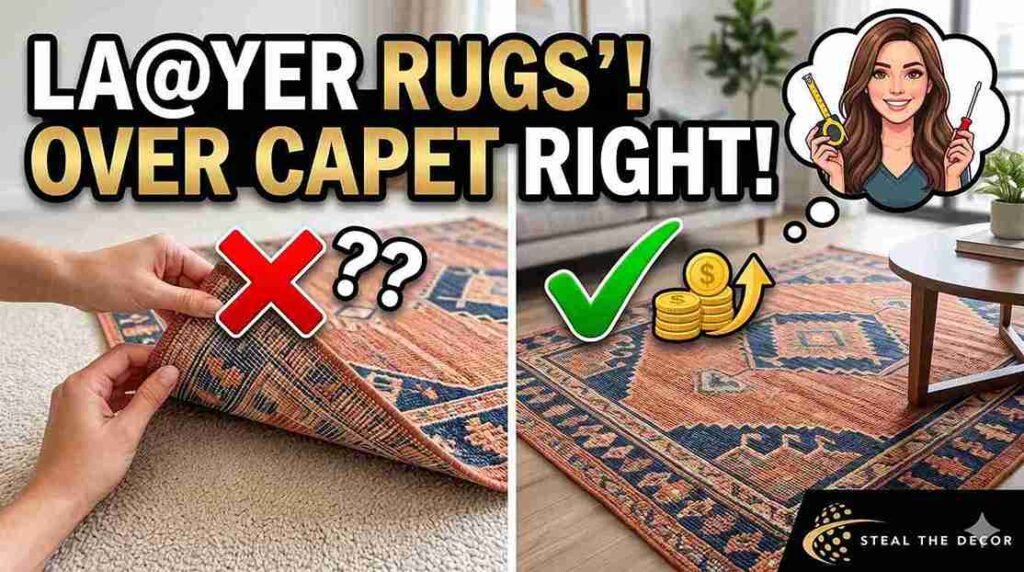
Area rug over carpet is the practice of layering a decorative or functional area rug on top of existing wall-to-wall carpeting—also called broadloom—to define a space, conceal damage, add texture, or anchor furniture in a room where removing the permanent carpet isn’t an option.
Most people assume rugs only belong on hardwood or tile. That assumption cost me six months of staring at a bare, stained carpet because I thought I had no options. The reality is that layering rugs on carpet is common in rentals, dorm rooms, and older homes where broadloom is glued or tacked down and can’t be easily replaced.
| Rug Type | Works on Carpet? | Slipping Risk | Best Pad Type |
| Flatweave (kilim, dhurrie) | Yes, the best option | Low-Medium | Felt + natural rubber combo pad |
| Low-profile synthetic | Yes | Medium | Felt pad or carpet-to-carpet pad |
| High-pile shag | Avoid | High | Even with a pad, it tends to shift |
| Hide rug (cowhide) | Yes | Low | No pad needed, usually |
| Rubber-backed utility | No | Low but risky | None—rubber traps moisture |
I’ve tried three of these categories and returned one. The hide rug is still in my living room. The shag went back to Wayfair within 48 hours.

Why I Decided to Layer a Rug Over Carpet
The Stain Situation No One Talks About
My apartment’s living room carpet had a wine stain that wasn’t mine. It was there when I moved in, documented in my inspection photos, and yet I stared at it every single day. A $200 area rug over carpet solution suddenly seemed smarter than losing my $1,400 deposit over someone else’s merlot.
The rug didn’t just hide the stain. It gave the entire room a focal point. Before the rug, my furniture looked like it was floating in a sea of beige. After, the seating area felt intentional. That’s the thing about layering rugs—it creates visual zones in open-plan spaces even when the flooring is uniform, wall-to-wall carpet.
High-Traffic Areas Were Wearing Down Fast
The path from my couch to the kitchen passes through a narrow stretch of carpet that was starting to look matted and sad. I noticed the pile height flattening within the first year. A rug pad with a flat weave on top absorbed the daily foot traffic and reduced carpet wear in that spot dramatically. Six months in, the rug itself shows some wear—but the broadloom underneath is protected.
I Couldn’t Change the Carpet
This is the rental reality. My lease says I can’t remove, replace, or dye the existing carpet. That left me with one creative option: cover it. And before you ask, yes, I checked the lease. Twice. My landlord’s exact words during the inspection walkthrough were, “Just don’t glue anything down.” Fair enough.
Can You Put a Rug Over a Carpeted Floor?
Yes. But the type of rug and the pad you choose determine whether it works or becomes a tripping hazard.
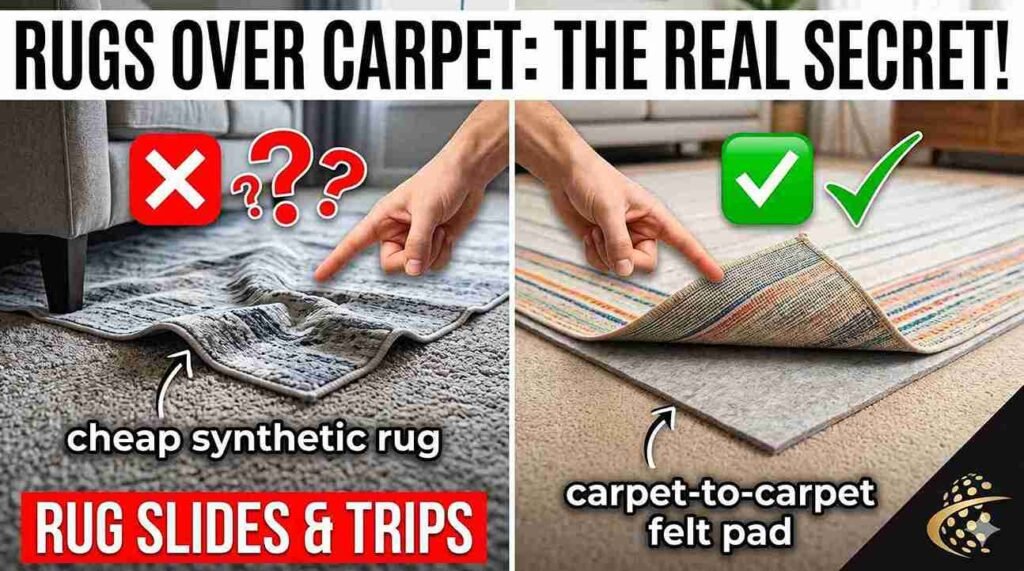
I learned this distinction the hard way. My first attempt used a cheap synthetic rug with a rubber backing — the kind sold as a “non-slip” option for hardwood. I figured, “Non-slip is non-slip, right?” Wrong. On the carpet, that rubber backing gripped the carpet fibers unevenly. By day three, the rug had migrated six inches toward the TV stand and developed a ripple in the middle that I couldn’t flatten.
The issue is friction—or the lack of it. Wall-to-wall carpet is a soft, fibrous surface. A rug placed directly on top has nothing solid to anchor against. It shifts with foot traffic. It ripples when furniture legs press into it. And it can eventually damage the carpet underneath if the backing material traps heat or moisture.
That said, the right combination works beautifully. A flatweave kilim with a carpet-to-carpet felt pad underneath? Rock solid. I’ve had my current setup for eleven months now, and I’ve adjusted it exactly once—after moving the couch to deep-clean underneath.
How to Cover a Carpet With Rugs Without Regretting It
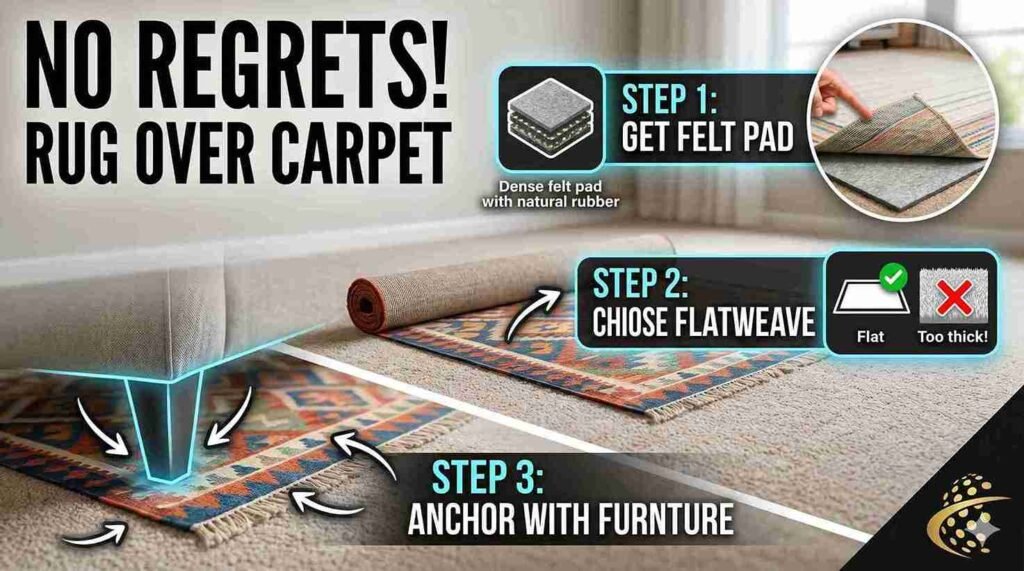
Step One: Forget Everything You Know About Rug Pads
Rug pads for hardwood and tile are designed to grip smooth surfaces. They often contain rubber or latex. On carpet, those same pads can discolor the fibers, trap moisture, and break down into a sticky mess over time. I found this out when I lifted my first rug after two months and saw faint beige-to-slightly-yellow discoloration underneath. The carpet itself was fine — the pad had just compressed the fibers unevenly.
What you need instead is a carpet-to-carpet pad. These are typically made of dense felt, sometimes with a light natural rubber layer only on the rug-facing side. They grip the rug’s backing while allowing the carpet beneath to breathe. I picked up the Mohawk Home Dual Surface Rug Pad for $28 on Amazon, and it was the first pad that actually kept my flatweave from creeping toward the hallway.
Step Two: Choose a Low-Profile or Flatweave Rug
Pile height matters more than you think. A thick, high-pile rug on top of wall-to-wall carpet creates an unstable surface. Your feet sink in. Furniture legs wobble. The edges curl. I tried a plush synthetic rug for exactly three days before I accepted defeat. Walking on it felt like crossing a bouncy castle.
Flatweave rugs — kilims, dhurries, and certain woven synthetics — are the safest bet. They sit closer to the carpet surface, reducing the tripping hazard, and work with rug pads instead of fighting against them. My current living room rug is a NuLoom Thigpen Flatweave in the 8×10 size. I paid $149 at Target during a spring sale. It’s thin enough that doors clear it, thick enough to define the space, and the geometric pattern masks the inevitable cat hair situation.
Step Three: Anchor the Rug With Furniture
Furniture anchors are the unsung heroes of the area rug over carpet setup. Without weight on the edges, even the best pad can’t prevent gradual shifting. I placed the front legs of my sofa on two corners of the rug and used a lightweight console table on the opposite edge. The rug hasn’t budged since.
One mistake I see people make: they center a rug in a room without any furniture touching it. That’s fine on hardwood where a gripper pad holds everything in place. On carpet, it’s asking for trouble. At a minimum, get one heavy furniture leg on one corner. Two corners? Even better.
What Kind of Rug Is Best for Carpeted Rooms?
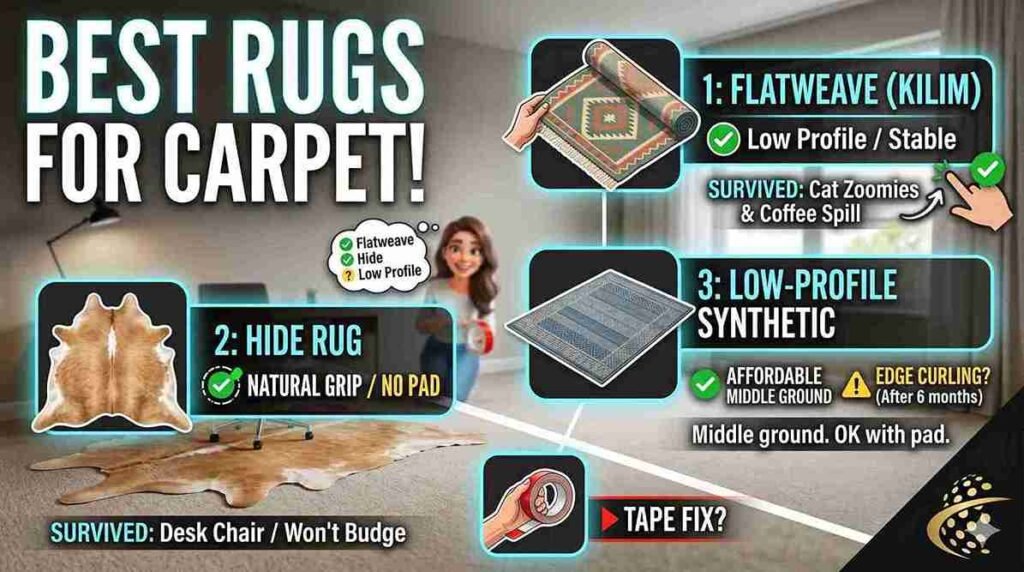
The short answer: flatweave, low-profile, or hide rugs. The longer answer depends on your room’s traffic level, your carpet’s pile height, and whether you have pets or kids adding chaos to the equation.
I’ve tested three categories now. Here’s what survived and what didn’t.
Flatweave Rugs (Kilim and Dhurrie)
These are the workhorses of the layered rug world. No pile. No thick backing. They lie almost flush with the surrounding carpet, which means fewer tripping hazards and less edge curl. My kilim has survived a year of vacuuming, cat zoomies, and one spilled coffee incident. The downside? They’re thin. If you’re looking for plush comfort underfoot, this isn’t it. But if you want pattern mixing and texture mixing without the safety risks, flatweave is the move.
Hide Rugs
I didn’t expect to love a cowhide rug on carpet, but here we are. Hides are naturally thin, slightly grippy on their underside, and they don’t require a separate rug pad in most cases. I bought a small IKEA KOLDHUR hide rug for $59 and placed it under my desk chair. It hasn’t moved. Not once. The natural weight distribution of the hide, plus the irregular shape, means it doesn’t catch on vacuum cleaners the way rectangular rugs do. The con? Hides aren’t everyone’s aesthetic, and they’re not machine-washable. Spot-clean only.
Low-Profile Synthetic Rugs
These occupy the middle ground. They’re thicker than flatweaves but not as plush as shags. I used a low-profile polypropylene rug in my bedroom for eight months. It worked fine with a felt pad, but I noticed slight edge curling by month six. A rug tape solution helped — I’ll get to that — but if I were buying again, I’d go flatweave for the longevity.
How to Make Carpeted Floors Look Better Without Replacing Them
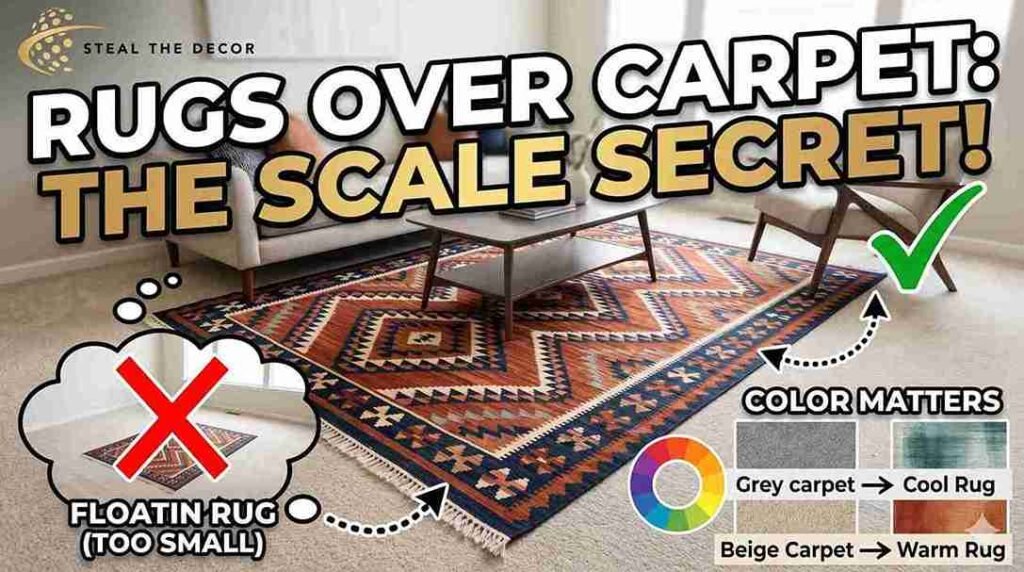
The trick to making carpeted floors look better isn’t just layering rugs. It’s layering them with intention. I’ve seen people throw a random 5×7 in the center of a large room and call it done. It looks lost. Like an island nobody visits.
Scale matters. A rug that’s too small for the space makes the room feel disjointed. I use a simple rug size guide: in a living room, at least the front legs of all seating furniture should touch the rug. In a bedroom, the rug should extend at least 18 inches beyond each side of the bed. My first attempt was a 5×7 in a 12×14 living room. It floated. The 8×10 replacement anchored the entire seating area.
Color strategy matters too. If your wall-to-wall carpet is a neutral beige or gray, you’ve got the freedom to go bold. My carpet is a warm beige — think sand, not greige — so I chose a rug with rust, navy, and ivory tones. The complementary colors on the color wheel made the pairing feel intentional rather than accidental. If your carpet is a cool gray, stick to rugs with cool undertones: blues, greens, and charcoal.
Texture mixing is the second layer of making this work. Flat carpet plus a flat rug reads as boring. But flat carpet plus a textured woven rug? That contrast draws the eye. My kilim has a slightly raised geometric pattern that catches light differently depending on the time of day. It’s subtle, but it’s what makes the layering of rugs on carpet approach look designed rather than desperate.
How to Anchor an Area Rug on Carpet So It Stops Moving
Rug Tape — The $7 Fix I Ignored for Too Long
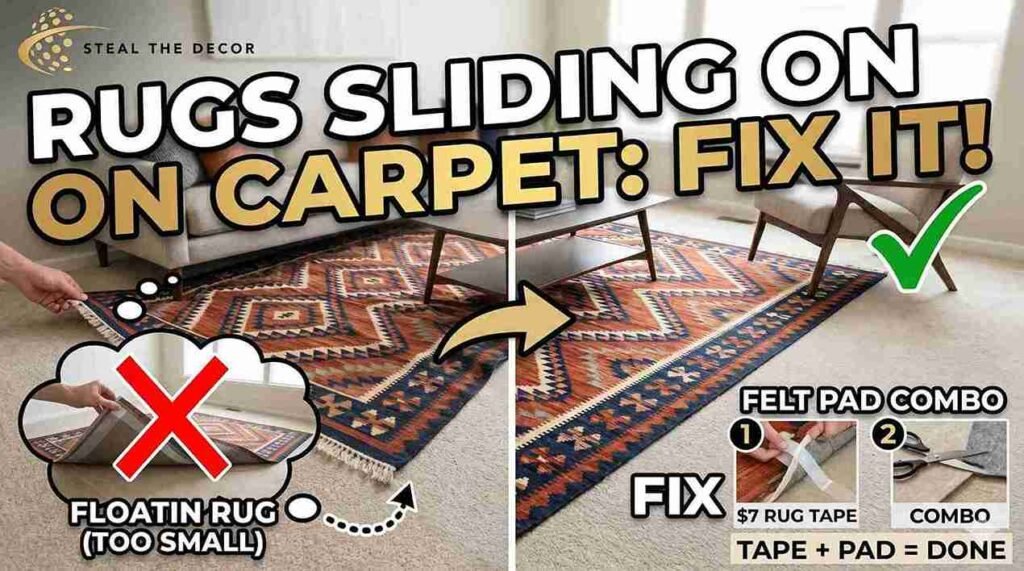
I resisted rug tape. I don’t know why. Maybe I thought it would leave residue. Maybe I assumed it wouldn’t work on carpet fibers. But after my bedroom rug started creeping two inches every week, I bought a roll of XFasten Double-Sided Carpet Tape for $7 at Walmart and applied four strips along each edge.
It worked. Not perfectly — the corners still lifted slightly after heavy foot traffic — but 90% better than no tape at all. The key is applying tape to the rug’s underside, not the carpet. Press firmly. Let it sit under furniture weight for 24 hours before judging the result. When I eventually peeled the tape off, there was no residue on the carpet. Your results may vary depending on carpet fiber, but mine held up fine.
The Felt Pad Combo That Finally Solved It
Rug tape alone helps. Rug tape plus a carpet-to-carpet pad solves the problem almost entirely. The pad provides friction against the broadloom while the tape holds the rug to the pad. I use this combo in my bedroom and my living room now. The living room rug hasn’t been adjusted in six months.
One thing nobody mentions: rug pads need trimming. The pad should be slightly smaller than the rug — about one inch less on each side — so it doesn’t peek out from underneath. I trimmed mine with kitchen scissors on the living room floor. Not elegant, but effective.
Will Rubber-Backed Rugs Damage Carpet? Here’s What Happened to Mine
Short answer: possibly. Longer answer: It depends on the carpet fiber, the pad’s composition, and how long it sits.
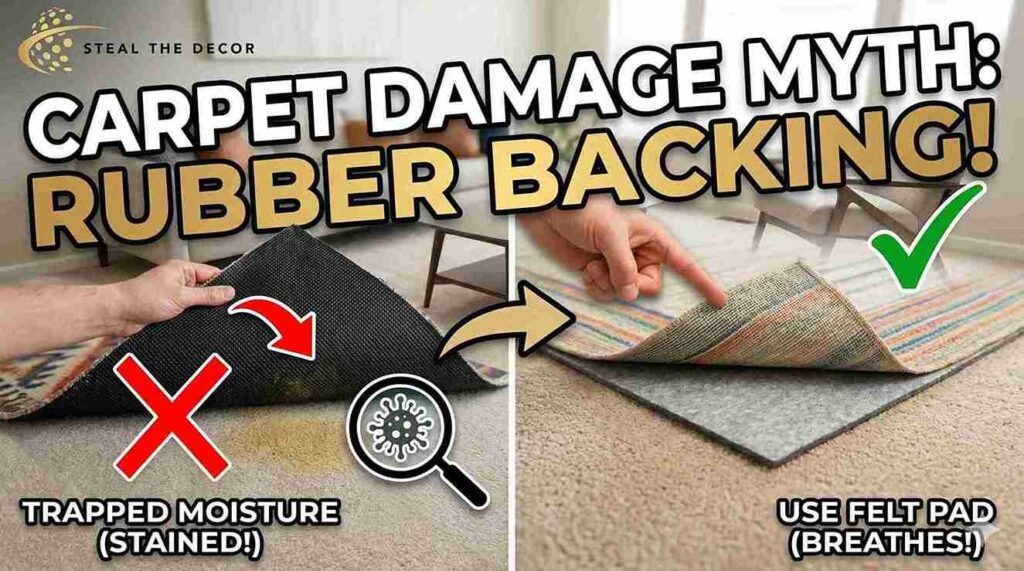
My early mistake involved a rubber-backed utility rug I’d bought for the entryway. It was cheap, maybe $18 at Home Depot. The backing was that black mesh-style rubber that smells vaguely of tires. I put it directly on the carpeted hallway. After three months, I lifted it to clean underneath and found the carpet fibers underneath were compressed and slightly discolored — a faint yellowish tinge against the beige.
The problem wasn’t the rubber itself, exactly. It was moisture. Rubber-backed rugs trap humidity between the pad and the carpet. In high-humidity environments or areas near bathrooms and kitchens, that trapped moisture can lead to mold growth or fiber degradation. The discoloration I saw was likely the beginning of that process. I threw the rug out.
Some rubber-backed rugs claim to be “carpet-safe,” but I’m skeptical now. If you must use one, lift it weekly. Let the carpet breathe. Check for discoloration. Better yet, skip rubber-backed rugs entirely on wall-to-wall carpet and use a felt pad instead.
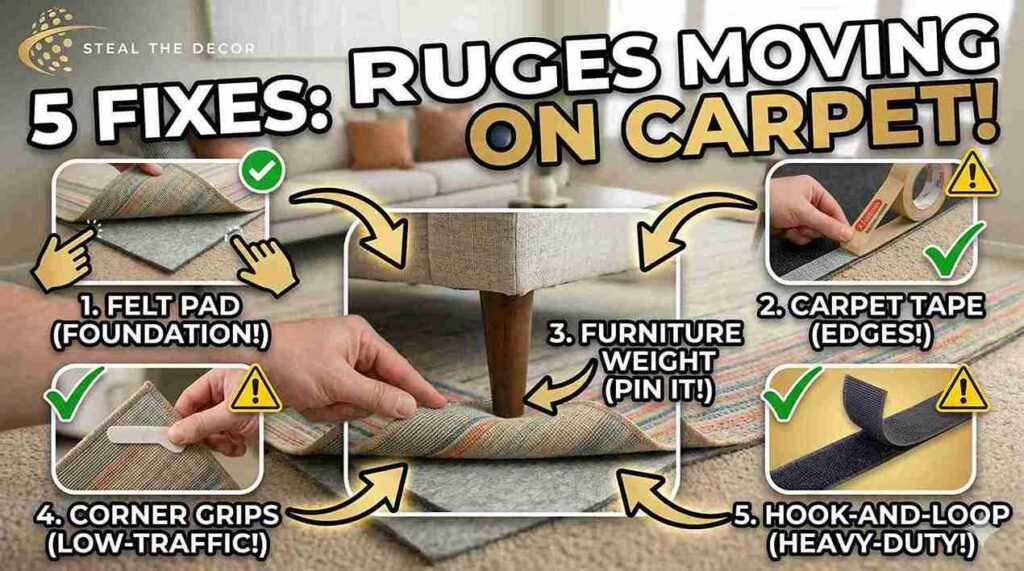
How to Stop a Rug From Moving on Carpet — The 5 Things That Actually Worked
Carpet-to-carpet felt pad—this is the foundation. Without it, nothing else holds long-term. The pad grips both surfaces passively through weight and friction rather than adhesive. I use one under every rug in my apartment now. Cost: $20–$40, depending on size.
Double-sided carpet tape — Apply to the rug’s edges and press firmly. Best used in combination with a pad. I reapply every 6–8 months as the adhesive weakens. XFasten has been my go-to brand.
Furniture weight on corners—The front legs of a sofa, a bed frame, or a heavy armchair pinning the rug down. This is the most underrated anchor. A rug with zero furniture contact will shift. Physics doesn’t care about your decorating vision.
Non-slip rug pad grips—small adhesive grip pads designed for area rug corners. I tried the Gorilla Grip Corner Grips ($9 for a 4-pack at Target). They work okay for low-traffic areas. Not strong enough for hallways or living rooms, but fine for a rug under a desk or in a corner reading nook.
Hook-and-loop strips—These are the heavy-duty option. Industrial-strength Velcro-style strips that attach to the rug backing and grip the carpet. I haven’t personally used these because my felt pad combo works, but a friend swears by them for large area rugs in her playroom. Her kids sprint across that rug daily, and it hasn’t moved.
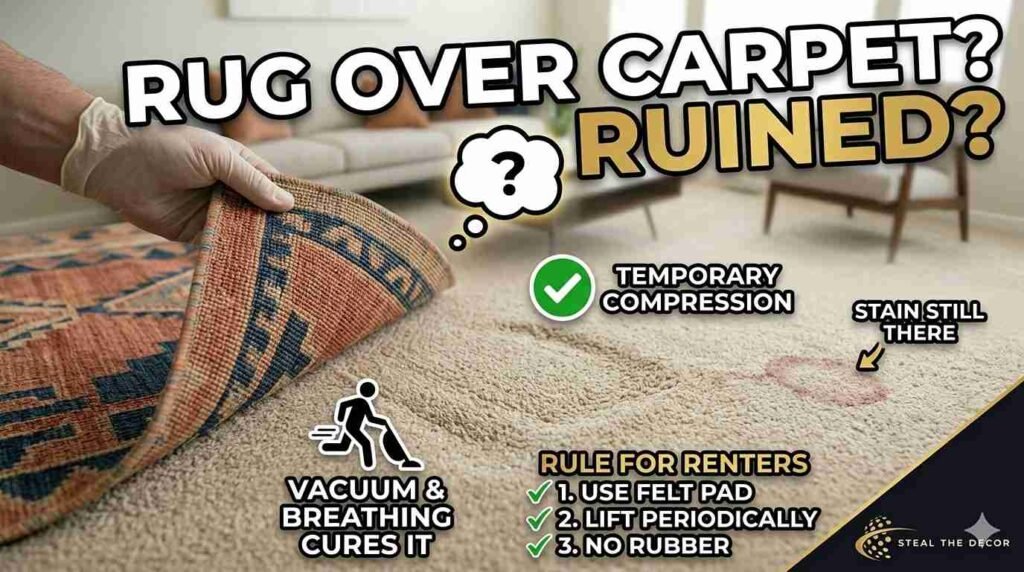
Does Putting an Area Rug Over Carpet Actually Ruin the Carpet?
Let me be honest about what I’ve seen. After eighteen months of layering rugs over broadloom in two different apartments, here’s the actual condition of the carpet underneath.
The good news: no permanent damage. No mold. No ripped fibers. The previous tenant’s wine stain is still the worst thing about this carpet.
The less-good news: There’s a slight compression line where the rug edges meet the carpet. When I lift the rug for deep cleaning, you can see a faint indentation where the rug pad sat. It’s not discoloration—just compressed pile. Running a vacuum over it a few times fluffs it back up, but it takes about 24 hours to fully recover. If I were moving out, I’d lift the rugs a few days before the inspection and let the carpet breathe.
One thing I’ll note: high-pile carpets show compression more than low-pile. My bedroom carpet is a medium-pile plush, and the compression is slightly more visible there. If your carpet is a thick Saxony or frieze style, expect some temporary flattening.
The consensus from what I’ve read and experienced: an area rug over carpet won’t ruin the carpet if you use the right pad, lift it periodically, and avoid rubber-backed products. Long-term placement in the same spot for years might cause more permanent compression, but for renters, rotating rugs every year or two is minimal.
How to Layer Rugs on Carpet — The Process I Finally Figured Out
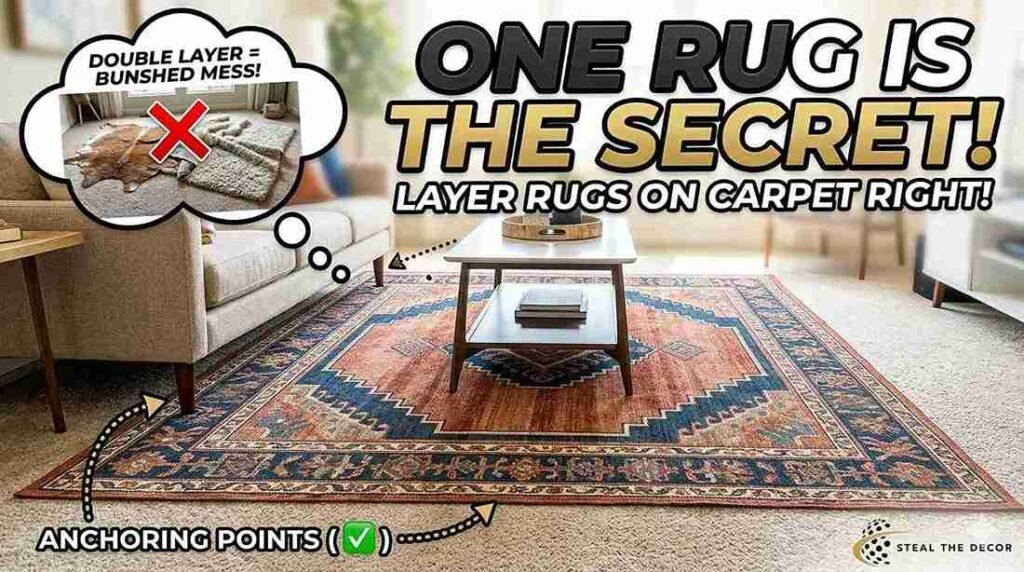
Layering rugs on carpet isn’t the same as layering rugs on hardwood. The base surface is soft, so every additional layer amplifies the instability. I layered two rugs once—a small hide over a larger flatweave—and regretted it within minutes. The hide slipped, the flatweave bunched, and my cat refused to walk across the resulting mess.
That said, single-layer styling with thoughtful texture mixing works wonderfully. My approach now: one statement rug with a quality pad, anchored by furniture, positioned to define a specific zone. No double-layering. No experimental stacking. The broadloom itself acts as a neutral base layer, and the area rug becomes the accent on top.
If you absolutely want a layered look, use a thin hide or sheepskin on top of a flatweave as the base. Avoid two thick rugs stacked. And accept that you’ll be adjusting them weekly. I gave up on the layered look after a month. The single-rug approach has been zero-maintenance by comparison.

How to Choose a Rug Style for Carpet — Color, Pattern, and Texture
I spent too long choosing my first rug based on how it looked in the listing photo. That’s the mistake. The listing photo shows the rug on a white studio floor. Your reality is beige carpet with afternoon sunlight hitting it at an angle. The colors will read differently.
Here’s what I do now: order a small swatch or a cheap 2×3 size first. Most online rug retailers sell small sizes or sample squares. I tested three different patterns this way before committing to the 8×10. The one I thought I’d love — a bold navy medallion — looked almost black against my beige carpet and made the room feel heavy. The rust-and-navy geometric I ended up with looked warmer and brighter in person.
Pattern mixing with existing carpet is simpler than it sounds. If your carpet is solid and neutral, a patterned rug adds interest without clashing. If your carpet already has a pattern or texture, stick to a solid rug or one with a subtle, tone-on-tone design. My carpet is a solid cut-pile with no pattern, so I went bold. No regrets.
Scale is the other factor. A small repeating pattern on a rug can look busy against the carpet’s texture. A larger, more open pattern gives the eye somewhere to rest. I tested a small-scale Moroccan trellis pattern that looked chaotic at full size. The larger geometric print I chose felt calmer.
How to Prevent Ripples and Tripping Hazards in Area Rugs on Carpet
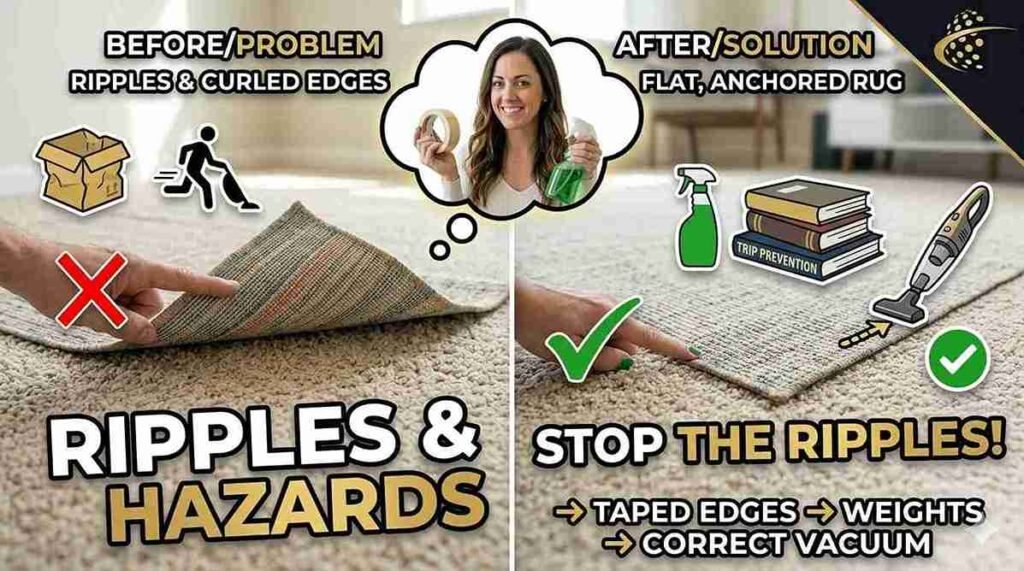
Ripples form when the rug can’t lie flat because something underneath is uneven — or because the rug itself has been folded during shipping and needs time to relax. My flatweave arrived folded, not rolled, and had deep creases that took three days to flatten.
I laid the rug out, placed heavy books on the crease lines, and spritzed the worst areas lightly with water from a spray bottle. By day three, it was flat. A friend recommended a clothes steamer, but I didn’t have one, and the water method worked fine.
Tripping hazards come from curled edges. The most dangerous zone is the entry point where the rug meets the door swing path. If your rug’s edge is anywhere near a doorway threshold, use rug tape on that specific edge. Don’t rely on furniture weight alone. I tripped over my bedroom rug’s corner twice before finally taping it down. It’s been fine since.
Also, vacuum direction matters. Running the vacuum perpendicular to the rug edge can lift and curl the corners over time. I now vacuum parallel to the edges, or better yet, use a handheld attachment along the perimeter. It adds thirty seconds to the routine and saves me from constantly flattening corners with my foot.
Can You Put an Area Rug on Carpet in High-Traffic Areas?
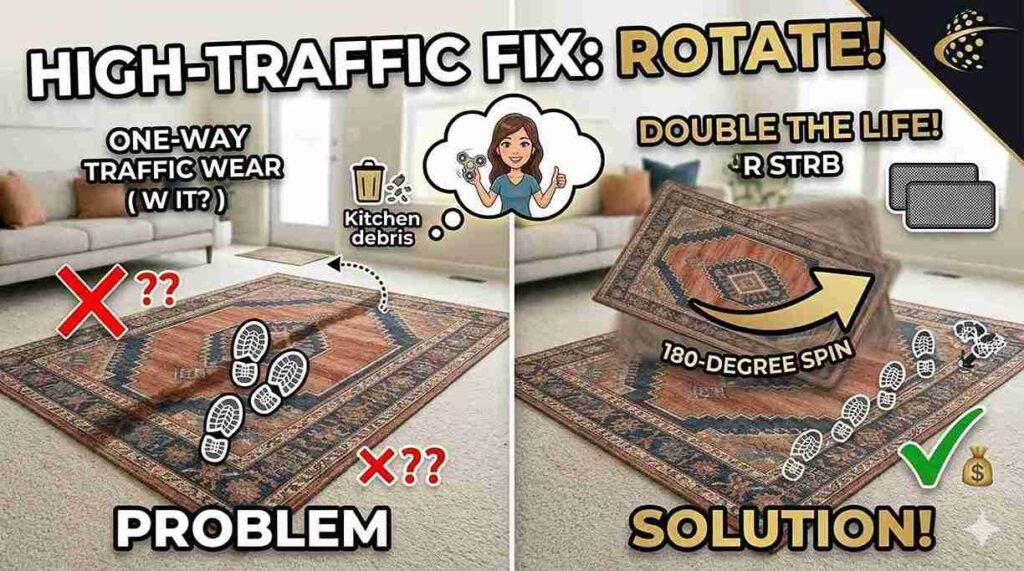
Yes, but it wears faster. My living room rug sits in a path between the couch and the kitchen. That’s the highest-traffic line in my apartment. After eleven months, I can see slight color fading in that diagonal path — the rug fibers are just starting to show wear.
To reduce carpet wear in high-traffic areas, I rotate the rug every six months. A simple 180-degree rotation distributes the foot traffic evenly and extends the rug’s life. The pad underneath stays in place; I just lift the rug, spin it, and set it back down. Takes five minutes.
I also keep a small washable mat inside the kitchen doorway, which catches kitchen-specific debris before it gets tracked onto the living room rug. It’s an extra layer, but it reduces how often I need to deep-clean the main area rug.
Rug Size Guide for Carpeted Rooms — Don’t Make My Mistake
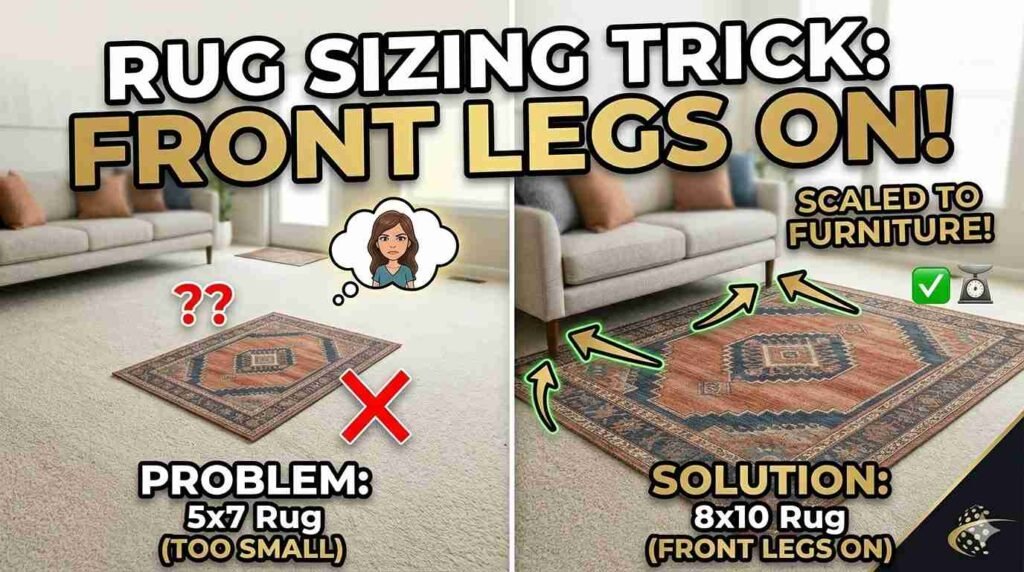
The worst thing I did with my first rug purchase wasn’t the pattern or the backing. It was the size. I bought a 5×7 for a seating area that needed an 8×10 minimum. The rug was too small to anchor the furniture, which made the seating arrangement look unstable and temporary.
Here’s the rough size guide I use now:
Living room: The rug should be large enough that at minimum the front legs of the sofa and chairs sit on it. Ideally, all legs sit on the rug with at least 8 inches of rug extending beyond each side.
Bedroom: For a queen bed, an 8×10 placed horizontally with the bed centered on it, leaving about 2 feet of rug visible on each side and at the foot.
Dining area: The rug should extend at least 24 inches beyond the table edges on all sides so chairs remain on the rug when pulled out.
Entryway or hallway: A runner with 4-6 inches of carpet visible on each side. Don’t let the runner touch the baseboards.
My 5×7 is now under my desk. It’s the right size for that specific zone. The 8×10 is in the living room where it belongs. Scale the rug to the furniture group, not the entire room.
Frequently Asked Questions
Can you put a rug over a carpeted floor?
Yes, you can put an area rug over carpeted floors. The key is using a carpet-to-carpet felt pad instead of a rubber-backed pad, choosing a low-profile or flatweave rug to minimize tripping hazards, and anchoring the edges with furniture weight or rug tape. I’ve done this in two apartments now, and the carpet underneath has stayed protected with no permanent damage.
How to cover a carpet with rugs?
Covering carpet with rugs starts with identifying what you want to conceal—stains, worn patches, or just dated broadloom—then selecting a rug large enough to cover that area plus extend beyond it naturally. Use a non-slip felt pad designed specifically for carpet-to-carpet use, position the rug so furniture anchors at least two corners, and apply double-sided carpet tape to any edges near doorways or walkways. I covered a wine stain this way, and no one has ever noticed it.
How to make carpeted floors look better?
Making carpeted floors look better comes down to three things: layering a well-chosen area rug over the broadloom to create a focal point, varying textures so the flat carpet contrasts with the woven or patterned rug on top, and ensuring the rug size matches the furniture grouping rather than floating randomly in the center of the room. I also keep my carpet freshly vacuumed around the rug edges—the contrast between the clean carpet and the rug pattern makes the whole room feel more intentional.
What kind of rug is best for carpeted rooms?
Flatweave rugs like kilims and dhurries are the best option for carpeted rooms because their thin profile reduces tripping hazards and they sit nearly flush with the surrounding carpet surface. Hide rugs also work well on carpet without needing a pad. Low-profile synthetic rugs are a decent middle ground if you want slightly more cushioning underfoot, but avoid high-pile shags and thick tufted rugs — they create an unstable walking surface and tend to shift constantly.
How can I cover up carpet without removing it?
You can cover up carpet without removing it by layering a large area rug over the affected area, using a carpet-safe felt pad underneath to prevent shifting and protect the broadloom fibers. If the carpet damage is in a high-traffic zone, choose a durable flatweave or low-profile synthetic rug that can handle daily foot traffic without bunching. I successfully concealed a permanent wine stain in my rental living room using an 8×10 kilim and a dual-surface rug pad—the stain is completely hidden, and the rug looks like an intentional design choice, not a cover-up.
What type of rug sits well on carpet?
Flatweave rugs, hide rugs, and low-profile woven synthetics sit most securely on carpet because their thin construction minimizes the height difference between the rug surface and the surrounding broadloom, which reduces edge curl and tripping risk. A kilim or dhurrie with a carpet-to-carpet felt pad underneath sits almost perfectly flat. I’ve had the best results with my flat weave—it hasn’t rippled or shifted noticeably in nearly a year of daily use.
Final Thoughts — Is Layering a Rug Over Carpet Worth It?
For me, the answer is yes. Not because it’s perfect. It isn’t. There’s still a faint compression line under my rug edges. I still have to vacuum around the perimeter carefully to avoid lifting the corners. The rug pad needed trimming, and the rug tape needed replacing once. It’s not a set-it-and-forget-it solution.
But for $180 total—$149 for the NuLoom flatweave and $28 for the Mohawk Home pad, both from Target and Amazon, respectively—I transformed a room I used to avoid. The wine stain is invisible. The seating area has a structure. My landlord asked for photos of the setup so she could suggest layering rugs for other tenants dealing with dated broadloom.
If you’re renting and can’t change your carpet, this is one of the most impactful upgrades you can make. Just skip the rubber-backed pads, size your rug to your furniture, and accept that you’ll need to lift it and let the carpet breathe every few months. The trade-off is worth it.
What’s your experience been with layering rugs on carpet? Did you find a pad or tape that worked better than what I tried? I’m always looking for better solutions—drop your recommendations below.
About the Author
Nina Calloway has moved six times in seven years and has strong opinions about rental-friendly decorating that won’t cost you your security deposit. She once bought the same flatweave rug in two sizes because the first one was “close but not quite right,” and she refuses to learn measurement lessons the easy way. She lives in Denver with a cat who has never once respected a rug edge.
What do you think? Have you tried layering a rug over carpet in your place? Did you find a trick I missed, or did you have a pad fail that topped mine? Tell me in the comments—I genuinely want to know what worked and what absolutely didn’t.
4 thoughts on “How to Put an Area Rug Over Carpet Without Ruining It”