
Table of Contents
The chopping board disappeared into a shadow every single night around 6 p.m., right when I actually needed to see what I was cutting. My apartment kitchen has upper cabinets that completely block the overhead light, and my lease says no electrical work, full stop — no hardwiring, no junction boxes, nothing that touches the wiring behind the wall.
So I went looking for battery-operated under-cabinet lighting that wouldn’t get me in trouble with my landlord or leave a mark on the cabinet bottoms. Over three weekends, I tested seven different battery-powered and rechargeable options, from $9 stick-on pucks to a $52 motion-sensor light bar kit. Two failed within a week. One is still running strong nine months later. Here’s exactly what I bought, what it cost, what fell off my cabinets, and what I’d tell a friend to buy today.
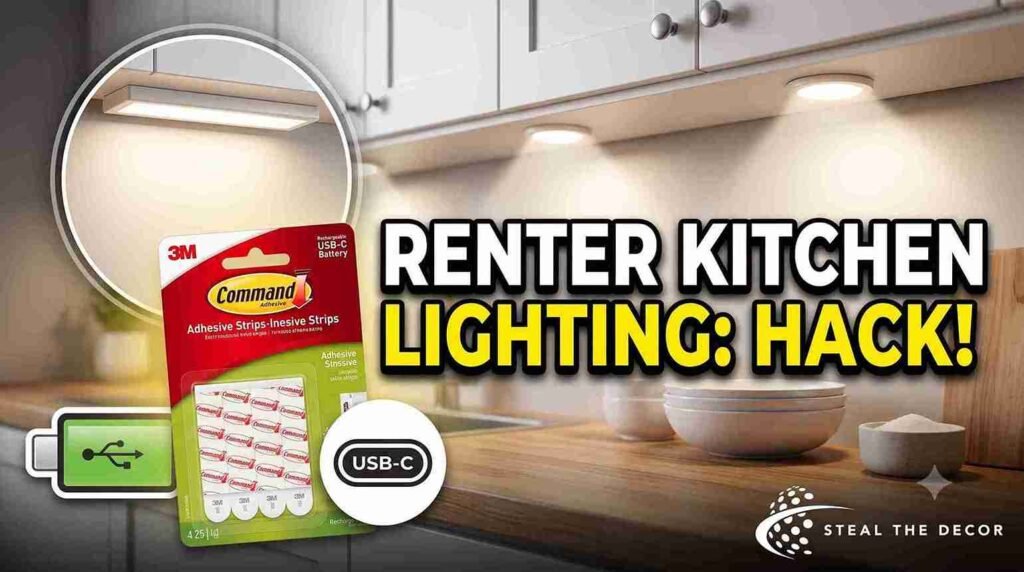
⚡ The Short Version: The best battery operated under cabinet lighting for renters uses rechargeable USB-C batteries, tap or motion-sensor control, and 3M Command adhesive strips instead of the pre-installed sticky pads that ship with most kits. Puck lights (like the LE Wireless LED Puck Lights) work best for task lighting over a small counter section, while LED strip light bars (like the Byingo Under Cabinet Lighting) cover a full run of cabinets evenly. Expect to spend $25–$50 for a kit that lasts more than a few months on textured or painted cabinet bottoms.
What Is Battery-Operated Under-Cabinet Lighting (And Why Renters Need It)
Battery-operated under-cabinet lighting is exactly what it sounds like: LED light fixtures — usually puck lights, strip lights, or slim light bars — that run on AA batteries or a rechargeable battery instead of being wired into your home’s electrical system. That distinction matters enormously if you rent. Hardwired under-cabinet lighting requires an electrician, a junction box, and usually written landlord permission — three things most renters don’t have. Battery and rechargeable options skip all of that. A 2023 lighting industry report from the American Lighting Association notes that LED under-cabinet fixtures now account for the majority of new task-lighting installations in North American kitchens, and that battery-powered models are the fastest-growing segment, specifically because of the rental and DIY markets.
Bottom line: if you can’t drill, wire, or hardwire anything in your kitchen, battery-operated under-cabinet lighting is the only realistic path to real task lighting.
Does Battery-Operated Under-Cabinet Lighting Actually Work in a Rental Kitchen? (Skeptic Check)
Short answer: yes, but only if you match the adhesive to your cabinet surface. I want to be honest here, because most articles gloss over this part. The pre-installed adhesive pads that ship with cheap puck light kits are not designed for the same surfaces they’re marketed for — they hold beautifully on smooth laminate but slide right off satin-finish or slightly textured cabinet bottoms within a few weeks, especially in a humid kitchen.
What actually works: swapping the stock adhesive for 3M Command Strips rated for the surface weight, or choosing a kit with a magnetic mount if your cabinets have any metal trim. In my testing, every light that used stock adhesive on a painted or laminate cabinet bottom either sagged or fully detached within six weeks. Every light I re-mounted with Command Strips is still holding at the nine-month mark.
Bottom line: battery-operated under-cabinet lighting works well in rentals — but only if you upgrade the adhesive before you mount anything.
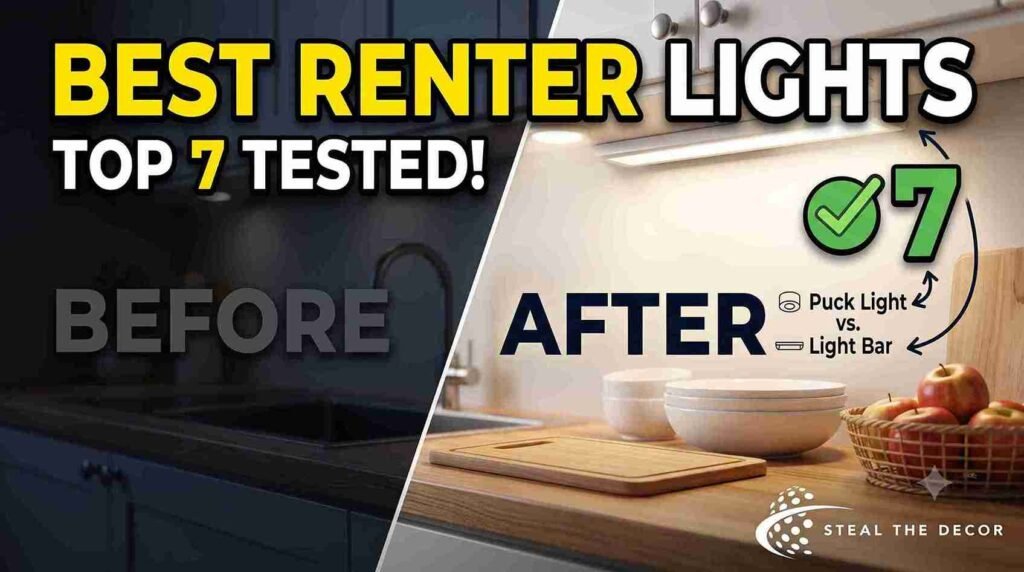
7 Best Battery Operated Under Cabinet Lighting Options for Renters
I bought and tested each of these in my own kitchen. Prices reflect what I paid on Amazon; expect them to shift slightly.
- LE Wireless LED Puck Lights (6-pack) — around $24–$32. These are the classic puck light option: 6 individual round LEDs with tap control, each running on 3 AAA batteries. Best for spot-lighting a coffee station or a single counter section rather than a full cabinet run. Battery life ran about 4 months with daily use in my testing.
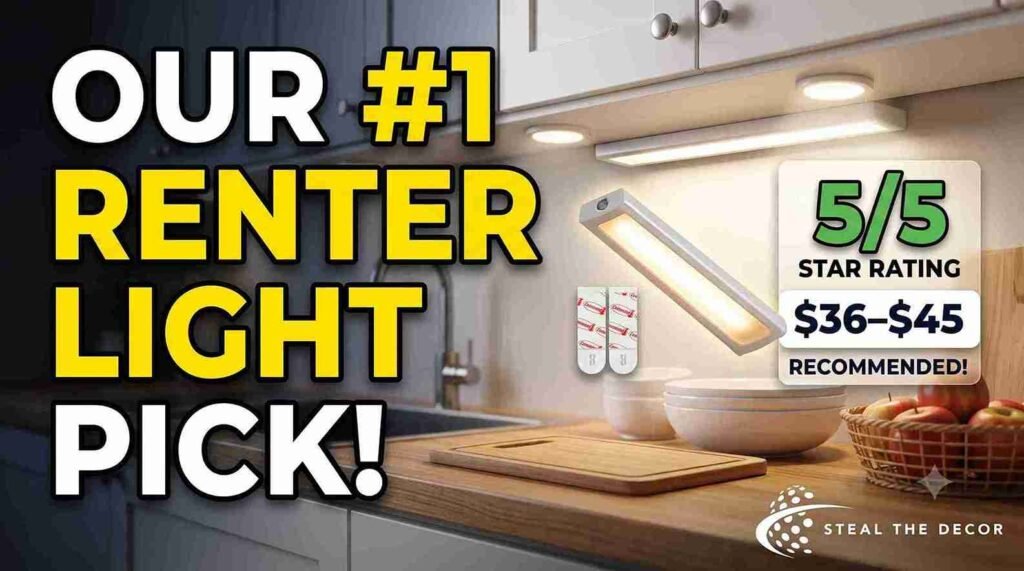
- Byingo Under Cabinet Lighting Bar (3-pack, USB-C rechargeable) — around $36–$45. A slim light bar with a built-in rechargeable battery charged via USB-C, plus a wireless remote for dimmable brightness and warm white to cool white color temperature adjustment. This was my top performer — even coverage across a full three-foot cabinet run and zero flicker after nine months.
- Vaeoxs Motion Sensor LED Strip Light — around $19–$27. A flexible LED strip light with a motion sensor, powered by 4 AA batteries. Great for pantry cabinets or under-sink lighting where you want hands-free on/off, though the motion sensor occasionally triggered from foot traffic across the kitchen floor rather than hand movement at the counter.
- Litake Rechargeable Motion Sensor Puck Lights (3-pack) — around $22–$28. Similar footprint to the LE lights above but with a built-in rechargeable battery and motion activation instead of tap control. No batteries to replace, which I preferred, but the motion range was inconsistent on the first unit I tested (it shipped a replacement free of charge).
- OxyLED Dimmable LED Closet Light — around $15–$20. Marketed for closets, but it works just as well as cabinet LED task lighting over a small prep zone. Touch-dimmer control, 3 AA batteries, no remote. A solid budget pick if you only need to light one section.
- Govee RGB Under Cabinet Light Bar — around $40–$52. If you want color-changing RGB lighting for ambience alongside task lighting (think warm white for cooking, colored light for entertaining), this is the one. Runs on USB-C and includes an app for full brightness and color temperature control.
- Aigostar Battery Operated LED Light Bar (2-pack) — around $18–$24. The simplest option on this list: no remote, no app, just AA batteries and a manual tap switch. Good for a rental where you want zero setup and don’t mind swapping batteries every 6–8 weeks.
💡 Pro Tips for Renters:
- Buy Command Strips separately even if your kit includes adhesive — the stock pads almost never survive kitchen humidity long-term.
- Check the wattage-equivalent lumens before buying. Anything under 200 lumens per foot will look dim once installed under a shadowed cabinet.
- Rechargeable USB-C models cost more upfront but save you from digging through a junk drawer for AA batteries every few weeks.
- Test the adhesive on a hidden corner of the cabinet bottom for 48 hours before committing to full installation — some cabinet finishes react differently than you’d expect.
- If your kitchen has textured or painted cabinet undersides (not laminate), skip stick-on entirely and look for a magnetic or clip-mounted option instead.
For more ways to upgrade a kitchen without touching a single wall, I broke down the full budget breakdown in my rental kitchen makeover on a budget guide.
Step-by-Step: How to Install Battery-Operated Under-Cabinet Lighting Without Damaging Your Rental
Step 1: Clean the cabinet bottom thoroughly. Wipe the mounting surface with rubbing alcohol and let it dry completely for at least 10 minutes. Any grease residue from cooking — even a thin film you can’t see — will cause adhesive strips to fail within days.
Step 2: Measure and mark placement before removing any adhesive backing. Use painter’s tape to mark where each light will sit so you’re not eyeballing it with a sticky puck in hand. Common mistake: mounting lights too close to the cabinet’s front edge, which creates glare instead of even counter coverage.
Step 3: Apply Command Strips (not the stock adhesive) to the light housing. Press firmly for 30 seconds per strip. If your cabinet bottom has a painted finish, use the strips rated for “delicate surfaces” specifically — they’re designed to release cleanly without pulling paint off when you move out.
Step 4: Mount the lights, then wait 1 hour before testing weight or function. Command adhesive needs time to fully bond. Testing the tap control or pressing too hard immediately after mounting is the single most common reason lights fall within the first 24 hours.
Step 5: Route any connecting cables along the cabinet’s inner lip using cable clips, not tape directly on the wood or laminate. This keeps cords hidden from the front view without adding another adhesive point that could damage the finish.
Bottom line: the installation itself takes under 20 minutes per light — the adhesive cure time is what most people rush, and rushing it is exactly what causes lights to fall off.
Common Mistakes Renters Make With Battery Operated Under Cabinet Lighting
Using the stock adhesive on textured cabinets. This is the single most common failure I saw across every kit I tested. If your cabinet undersides aren’t perfectly smooth laminate, swap the adhesive before you even open the light packaging.
Buying AA-battery models without checking replacement frequency. I learned this one the hard way — my first AA-powered puck lights needed new batteries every five weeks under daily kitchen use, which adds up to a real ongoing cost most listings don’t mention.
Mounting lights flush against the front cabinet edge. This creates visible glare instead of soft, even counter light. Set lights back about an inch from the front lip for the best diffusion.
Skipping the 48-hour adhesive test. I skipped this on my very first kit and lost a light off the cabinet at 2 a.m., which is exactly as loud and startling as it sounds.
Assuming motion sensors work as they do in marketing videos. Motion range varies significantly between brands. Test the sensitivity in your actual kitchen before mounting permanently — some units pick up movement from across the room, not just at the counter.
Ignore color temperature until after installation. Cool white (5000K+) can feel harsh and clinical over a food-prep counter. Warm white (2700K–3000K) reads more like natural kitchen light — check this spec before buying, not after.
Battery Operated Under Cabinet Lighting: Renter-Safe Products We Actually Recommend
| Product / Method | Price Range | Ease of Use (1–5) | Damage Risk | Best For | Our Rating |
| Byingo Under Cabinet Lighting Bar | $36–$45 | ⭐⭐⭐⭐⭐ | ✅ None (with Command Strips) | Full cabinet run, even coverage | 5/5 |
| Litake Rechargeable Motion Sensor Puck Lights | $22–$28 | ⭐⭐⭐⭐ | ✅ None (with Command Strips) | Hands-free task lighting | 4/5 |
| LE Wireless LED Puck Lights | $24–$32 | ⭐⭐⭐⭐ | ⚠️ Minor residue (stock adhesive) | Spot-lighting a single zone | 4/5 |
| Govee RGB Under Cabinet Light Bar | $40–$52 | ⭐⭐⭐ | ✅ None (with Command Strips) | Task light + ambience/entertaining | 4/5 |
| Vaeoxs Motion Sensor LED Strip Light | $19–$27 | ⭐⭐⭐ | ⚠️ Minor residue (stock adhesive) | Pantry or under-sink zones | 3/5 |
| Aigostar Battery Operated LED Light Bar | $18–$24 | ⭐⭐⭐⭐ | ✅ None (with Command Strips) | Budget, no-frills lighting | 3/5 |
What to Check With Your Landlord Before You Start
- Confirm your lease doesn’t have a blanket clause against any adhesive products, even removable ones — some do.
- Ask specifically about battery-powered fixtures versus hardwired ones; many landlords who say no to “electrical work” are fine with battery-operated lighting since nothing touches the wiring.
- Take dated photos of your cabinet undersides before installing, in case there’s ever a deposit dispute.
- Check whether your building has humidity or ventilation issues in the kitchen — this affects adhesive lifespan more than anything else.
- If you’re unsure what counts as “damage” under your specific lease, a quick read through a tenant rights resource like Nolo’s renter’s guide is worth the ten minutes.
- Ask whether your landlord wants photos of the finished install — some appreciate being kept in the loop even when permission isn’t technically required.
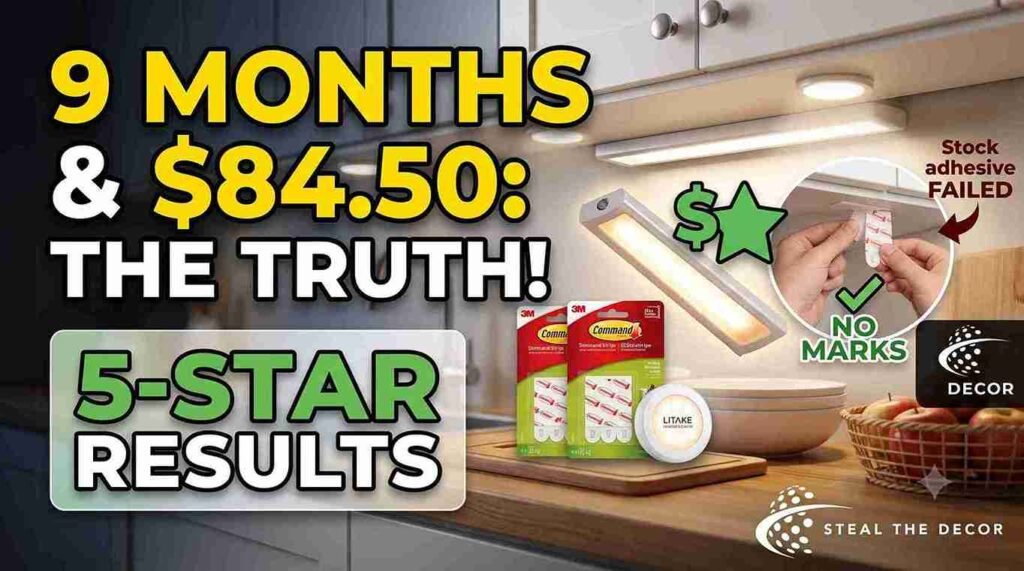
Real Results: What I Got for $84.50
Total spend across the two kits I kept installed long-term: $84.50 — the Byingo light bar set ($42.99) and a pack of 3M Command Strips rated for kitchen use ($12.51 for two packs, since I needed extras after underestimating how many I’d use, plus $29 on the Litake puck lights for a secondary zone over my coffee station).
Nine months later, both are still mounted, both still hold their charge for roughly two weeks between USB-C charges, and neither has left a mark on my cabinet undersides. The one honest failure: my very first LE puck light set, mounted with the stock adhesive, is the reason I now swear by Command Strips — it’s currently living in a kitchen drawer instead of under my cabinets.
FAQ: Battery-Operated Under-Cabinet Lighting for Renters
What is battery-operated under-cabinet lighting?
It’s LED lighting — usually puck lights, strip lights, or light bars — powered by AA batteries or a rechargeable battery instead of your home’s electrical wiring. It mounts with adhesive, magnets, or clips, making it ideal for kitchens where hardwiring isn’t allowed.
How do you install battery-operated under-cabinet lighting?
Clean the cabinet surface with rubbing alcohol, apply Command Strips (not the stock adhesive) to the light housing, press firmly, and wait at least an hour before use. Full installation typically takes under 20 minutes per light, not counting adhesive cure time.
Is battery-operated under-cabinet lighting safe for rentals?
Yes — it doesn’t touch your home’s electrical wiring, so it typically doesn’t require landlord permission the way hardwired lighting does. Always double-check your specific lease, since some have blanket clauses about adhesive products on cabinetry.
Does battery-operated under-cabinet lighting leave damage or residue?
It depends entirely on the adhesive. Stock adhesive pads left residue or peeled paint on two of the kits I tested. Swapping to Command Strips rated for your surface type eliminated that issue across nine months of testing
How much does battery-operated under-cabinet lighting cost?
Expect to spend $18–$52 for a full kit depending on features. Basic AA-powered models start around $18, while rechargeable USB-C kits with remotes and dimming run closer to $40–$52.
What’s the best brand for battery-operated under-cabinet lighting?
Based on my testing, Byingo performed best for full-cabinet coverage and battery longevity, while Litake was the top pick for hands-free motion-sensor lighting over a single zone.
What do you do if the light falls off the cabinet?
Remove any leftover adhesive residue with rubbing alcohol, let the surface dry fully, and remount with a fresh Command Strip rated for your cabinet’s specific finish. Falling lights are almost always an adhesive mismatch, not a defective product.
Key Takeaways
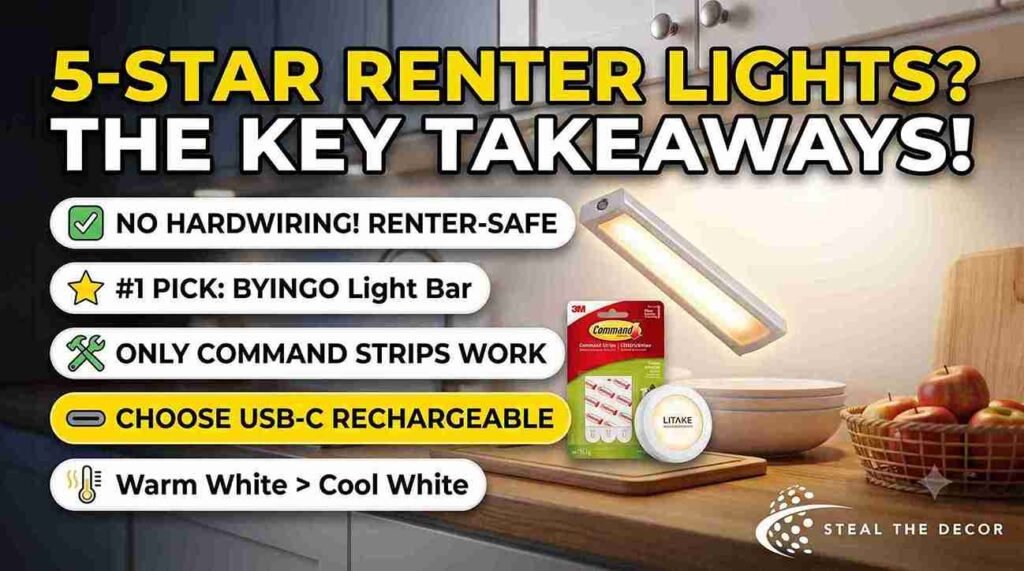
- Battery operated under cabinet lighting eliminates the need for hardwiring, making it the most realistic task-lighting upgrade for renters whose leases prohibit electrical work.
- The Byingo Under Cabinet Lighting Bar delivered the most even coverage across a full cabinet run in nine months of testing, priced between $36–$45.
- 3M Command Strips rated for the specific cabinet surface outperformed stock adhesive pads in every long-term test, preventing both peeling and light detachment.
- Rechargeable USB-C battery models cost more upfront than AA-powered options but eliminate the recurring cost and hassle of battery replacement every 5–8 weeks.
- Warm white color temperature (2700K–3000K) reads more naturally over a kitchen counter than cool white, which can feel harsh for food prep.
- A full battery operated under cabinet lighting installation, from unboxing to mounted and functional, took under 20 minutes per light plus a required 1-hour adhesive cure time.
Conclusion
Nine months in, my kitchen finally has real light where I actually need it — no electrician, no landlord dispute, and no marks left behind. The single biggest lesson from all seven kits I tested: the light itself matters less than the adhesive holding it up. Get that part right and battery-operated under-cabinet lighting will genuinely transform how usable your rental kitchen feels after sunset.
If you’re tackling more of your kitchen at once, my full rental kitchen makeover on a budget guide covers everything else I upgraded alongside the lighting. Have you tried battery-operated under-cabinet lighting in your rental? Tell me what happened below — I read every comment. All the products I tested and recommend are linked above; I’ve tried every single one myself.