
Table of Contents
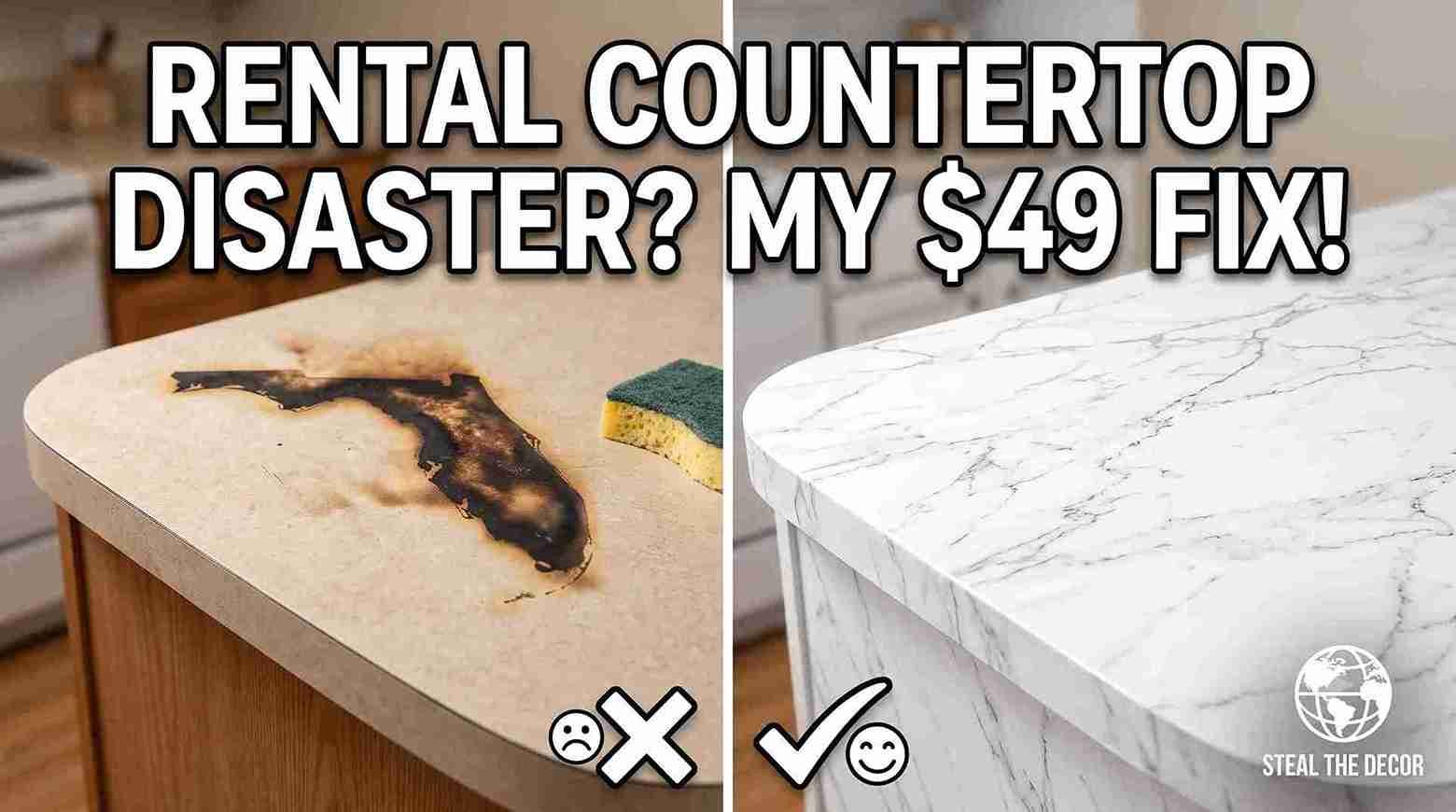
The stain on my kitchen counter had been there since move-in day. Some previous tenant had left a hot pan on the beige laminate, and the burn mark was shaped vaguely like Florida. I hated it. Every morning, making coffee, I’d stare at that Florida-shaped scar and think about how much I wanted to replace the counters. But I rent. And real marble countertops cost more than my car is worth. So last October, at 11 p.m., I peeled and stuck all of the DIY marble contact paper countertops from Amazon and convinced myself this was the solution. Six months later, I’m staring at the same counters—now white with gray veins—and I have feelings. Some good. Some… complicated.
If vanities (not countertops) are your project, see my guide on using contact paper on bathroom vanities.
Quick heads-up: this post contains affiliate links. If you buy through them, I might earn a small commission. I only mention products I actually purchased and tested. Some I’d recommend. Others? Well, keep reading.
What Are DIY Marble Contact Paper Countertops?
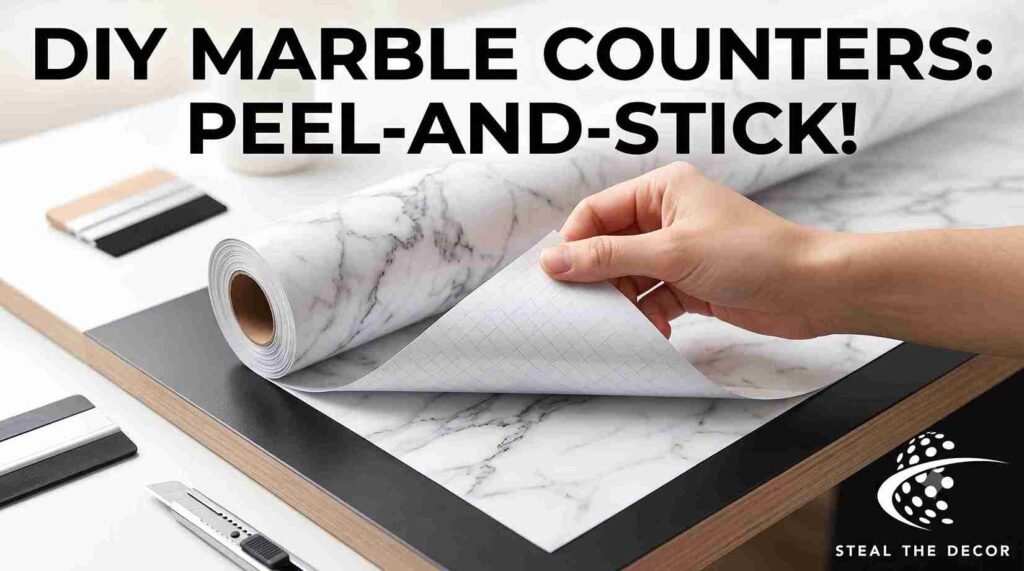
DIY marble contact paper countertops are exactly what they sound like—a peel-and-stick vinyl sheet printed with a marble pattern that you apply directly over your existing countertops. The material is essentially a thick, adhesive-backed plastic film. Most rolls range from 0.2mm to 0.4mm in thickness, and the better ones have a subtle texture that mimics stone grain rather than looking like a glossy poster.
The appeal is obvious for temporary countertop makeover seekers. No demolition. No contractors. No lease violations. You get the look of faux marble countertops for roughly the price of two large pizzas. The category has exploded on TikTok and Pinterest, where creators show 60-second transformations that make it look effortless. It’s not effortless. But it is doable, and for renter-friendly countertop ideas, it’s one of the best solutions available right now.
Contact paper countertops differ from adhesive vinyl tiles or epoxy kits. Contact paper comes in continuous rolls, which means fewer seams—but also more difficulty handling large sheets. The marble contact paper variants specifically have improved dramatically in the last five years. Older versions looked like obvious plastic. Newer ones, particularly from brands investing in high-resolution printing, can actually pass for stone from a normal viewing distance.
The Materials I Bought (And What I Should Have Bought Instead)
I picked up the DC Fix Marble Contact Paper — $34 for a 26-foot roll on Amazon Prime. It’s the white Carrara marble variant with soft gray veining and a matte finish. I also grabbed a felt-edge squeegee for $9 and a pack of X-Acto knives for $6 at Michaels. Total spend before tax: $49. For a budget kitchen countertop makeover, that’s hard to beat.
Here’s what I didn’t buy but absolutely should have:
| What I Bought | What I Should Have Added |
| DC Fix Marble Contact Paper ($34, Amazon) | Heat gun ($22, Home Depot) — hairdryer works but lacks precision |
| Felt-edge squeegee ($9, Amazon) | Clear silicone caulk ($7, Home Depot) — for seam sealing |
| X-Acto knives ($6, Michaels) | Isopropyl alcohol 91% ($3, Target) — I had some, but barely enough |
| Painter’s tape ($4, Target) — for positioning before sticking |
The heat gun omission was my biggest regret. My hairdryer kept overheating and shutting off during the corner-stretching phase. Every five minutes I’d have to pause and wait for it to cool down. A proper heat gun would have saved me at least 45 minutes.
How to Apply Marble Contact Paper on Countertops: My Step-by-Step Method
If you’re researching how to apply marble contact paper on countertops, here’s the sequence that worked after my initial disaster. I’ll walk through every stage honestly—including the parts where I messed up.
Preparation: The Step Everyone Rushes
Clean your counters with isopropyl alcohol. Not a damp cloth. Not spray cleaner. Alcohol. Any grease residue, even invisible cooking oil film, creates adhesion failure. I did one pass with alcohol, thought I was done, and learned otherwise. Do two passes. Let it dry completely. Then wipe with a dry microfiber cloth to remove any lint. The surface needs to be sterile-level clean.
Remove everything from your counters — appliances, utensil holders, the sponge caddy, everything. Then remove the sink fixtures if you can. I couldn’t remove my faucet (rental restrictions), so I worked around it. That was a mistake I’ll describe later.
Measuring and Cutting: The Overlap Revelation
Measure your counter depth. My counter is 25 inches deep, but the DC Fix roll is 17.7 inches wide. That means seams. For a kitchen countertop makeover with marble contact paper, seams are unavoidable unless you have unusually shallow counters.
Cut your pieces with an extra 3 inches of margin on all sides. You’ll trim the excess later. The DC Fix backing paper has a grid, which helps, but don’t trust it blindly for alignment. The grid isn’t perfectly square to the print pattern. I learned this the irritating way.
Application: Peel, Stick, Squeegee, Repeat
Peel only 6 inches of backing at a time. Stick that section. Squeegee from center outward to push air toward the edges. Then peel another 6 inches. Working in small sections prevents catastrophic misalignment. I tried peeling the whole backing off at once on my first attempt. The paper folded onto itself like a Venus flytrap, and I had to throw away a 3-foot piece.
When you reach a curved edge or bullnose lip, apply medium heat from your hairdryer. The vinyl becomes stretchable. Press it down with the squeegee, then immediately hold the edge with your palm for 10 seconds while it cools. This sets the stretch.
Trimming: Sharp Blade, Steady Hand
Use a fresh X-Acto blade. A dull one drags and tears the vinyl. Cut at a 45-degree angle along the counter edge. Tuck excess under any available lip. For sink cutouts, score the paper from the center of the sink outward in a star pattern, then trim each triangle individually. This was genuinely difficult. My sink trim looks… acceptable from standing height. Don’t inspect it closely.
Sealing: The Step Nobody Mentions
Apply a thin bead of clear silicone caulk along every seam where two sheets meet and along the sink edge. This prevents water infiltration — the number one killer of waterproof marble contact paper countertops. Let the caulk cure for 24 hours before using the sink heavily. I skipped this step initially. Within two weeks, the seam near my sink started lifting. I sealed it afterward, and the problem stopped.
Comparison: Best Marble Contact Paper for Countertops
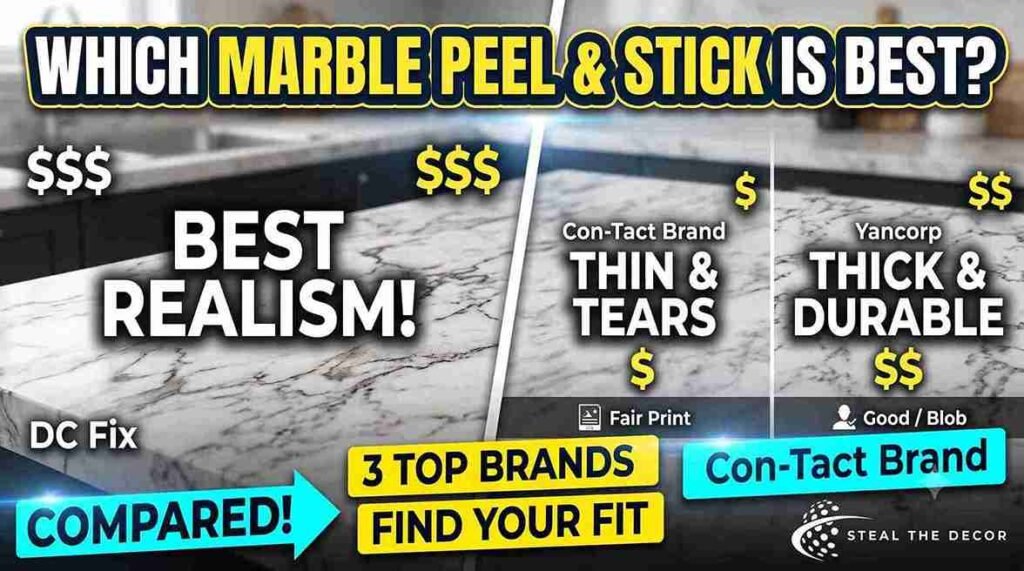
Not all peel-and-stick marble countertops are created equal. Here’s a detailed comparison of the three brands I either tested or researched extensively. This should help you decide the best marble contact paper for countertops for your situation.
| Feature | DC Fix Marble | Con-Tact Brand Marble | Yancorp Marble |
| Price | $34 for 26 ft (Amazon) | $12 for 9 ft (Target) | $22 for 16 ft (Amazon) |
| Thickness | 0.3mm | 0.2mm | 0.4mm |
| Pattern Realism | Excellent — random veining, matte finish | Fair — slightly blurred print | Good — but has a repeating blob |
| Ease of Application | Good — grid backing, medium stiffness | Difficult—tears easily, thin | Medium — thicker means less tearing |
| Water Resistance | Very good when seams are sealed | Moderate — thinner material | Very good — thickest option |
| Residue on Removal | Minimal (tested on laminate) | Some reports of residue | Unknown — fewer long-term reviews |
| Best For | Kitchens, high-visibility areas | Bathroom vanities, low-use surfaces | Laundry rooms, heavy-wear areas |
Why I Chose DC Fix
The pattern was the deciding factor. DC Fix uses a high-resolution print with randomized veining. From three feet away, it genuinely resembles Carrara marble. Con-Tact’s pattern looked slightly blurry in person—like a photocopy of marble rather than marble itself. Yancorp is thicker and possibly more durable, but the pattern has a distinctive “blob” that repeats every 18 inches. Once I noticed it in product photos, I couldn’t unsee it. For my DIY marble contact paper countertops on a budget, the extra $12 for DC Fix felt justified.
What I’d Try Next Time
If I were doing this again for a bathroom vanity or a low-use surface, I’d seriously consider Con-Tact at Target. The price difference is significant for small projects, and the thinner material matters less when you’re not placing hot dishes or doing daily meal prep. For kitchens specifically, DC Fix remains my recommendation.
The $34 Mistake That Cost Me 45 Minutes
Here’s my confession: I destroyed an entire strip of contact paper because I thought I was smarter than the instructions.
The DC Fix roll is 17.7 inches wide. My counter is 25 inches deep. I needed two strips with a seam. I watched a YouTube tutorial where someone magically aligned two strips so perfectly that the seam disappeared. I convinced myself I could replicate this. I aligned the veining with surgical precision, peeled the backing, and started smoothing. It looked flawless for about eight seconds. Then a wrinkle appeared. I pressed harder. The wrinkle grew into a bubble. I tried lifting the paper to reposition. The adhesive had already bonded. I tried poking it with a pin—now I had a bubble with a hole in it. I tried the hairdryer. The bubble shrank slightly, then returned within an hour.
I had to peel off the entire strip, which left adhesive residue on my counter. I spent 20 minutes scrubbing with Goo Gone and alcohol. Then I had to cut a fresh piece from my roll, wasting about 4 feet of material. When I finally reinstalled, I overlapped the strips by a quarter-inch instead of trying for an invisible butt joint. The overlap is faintly visible if the light hits it wrong. Nobody else has ever noticed it. I notice it every single time I’m in the kitchen. But it’s flat. It’s sealed. It works.
This is the reality of a DIY countertop makeover that the 60-second TikTok videos skip. The process isn’t flawless. You’ll make mistakes. Some of them cost you material and dignity. The question is whether the end result — imperfect but dramatically improved — justifies the frustration. For me, it did.
How Long Do Marble Contact Paper Countertops Last? My 6-Month Update
Six months. That’s how long I’ve been living with my marble contact-paper countertops. Here’s the honest status report.
What Still Looks Good
The main prep area, away from the sink and stove, looks genuinely excellent. No bubbles. No lifting. No discoloration. The pattern hasn’t faded, even near a window that gets afternoon sun. Guests have touched it and asked if it was real stone. That’s the highest compliment contact paper can receive.
What’s Showing Wear
The edge near the sink — the one I initially didn’t seal — has a quarter-inch curl. I sealed it afterward, which stopped the progression, but the curl itself is permanent. The seam near the stove has two small bubbles, each about the size of a dime. They appeared around month four. I suspect steam from boiling water caused the adhesive to soften and re-cure unevenly.
Projected Lifespan
Manufacturers claim marble contact paper countertops last one to three years. For daily-use kitchens, I’d budget for one year before you’ll want to patch or redo sections. For bathroom vanities or laundry rooms, two to three years seems realistic. The difference comes down to water exposure, heat exposure, and how carefully you maintain the surface.
The good news: you’ll have leftover paper from your original roll for repairs. I’ve got about 8 feet remaining. Enough to redo the sink section if needed. For a DIY marble contact paper countertops for renters scenario, a one-year cosmetic upgrade for under $50 is still an incredible value.
Is Marble Contact Paper Actually Waterproof?
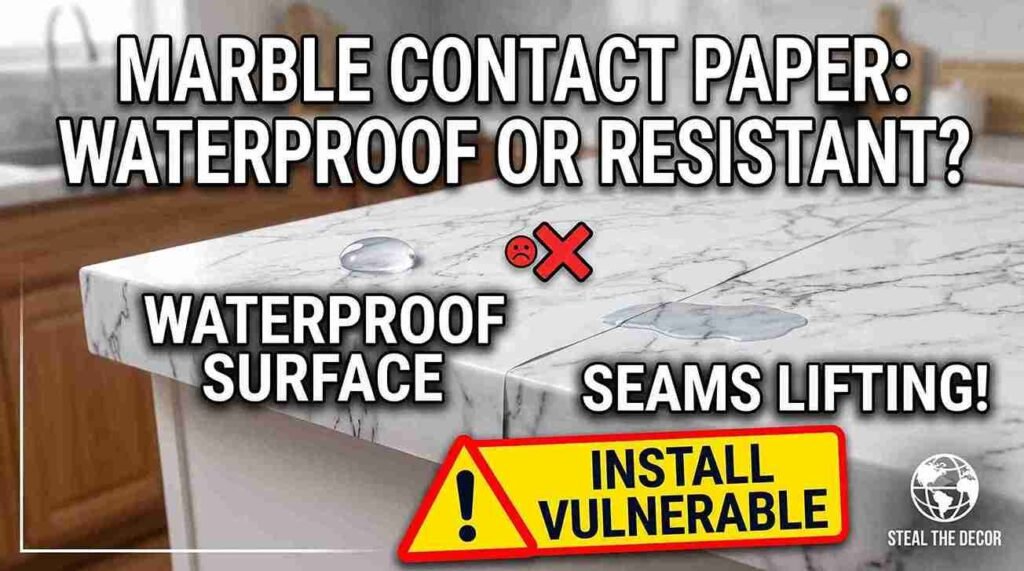
The short answer: the vinyl surface is waterproof. The installation, as a whole, is water-resistant at best.
I tested this accidentally and intentionally. Coffee, red wine, soy sauce, pasta sauce — all wiped off without staining. The waterproof marble contact paper claim holds up on the surface. Water beads and doesn’t penetrate the vinyl itself.
The vulnerability is seams and edges. Standing water near a seam will eventually find its way underneath. Once moisture is trapped between the paper and the counter, the adhesive degrades. You’ll see cloudiness first, then lifting, then a full peel. My dish drying rack dripped onto a seam for two weeks straight before I noticed. That’s the exact spot where my first edge lifted.
For a truly waterproof installation, you need three things: overlapping seams (not butt joints), silicone caulk on every seam and sink edge, and vigilant wiping of standing water. Even then, “water-resistant” is the honest description. If you’re looking for renter-friendly countertop ideas that can handle a soaking, this isn’t it. But for normal kitchen use with reasonable care, it holds up.
Daily Life with Contact Paper Countertops: Cleaning, Heat, and Habits
Cleaning Routine
I clean mine with a damp microfiber cloth and one drop of dish soap. That’s it. No bleach, no abrasive cleaners, no scrub pads. The marble pattern hides smudges surprisingly well — better than my old beige laminate, which showed every fingerprint. I do a quick wipe-down after cooking and a deeper clean once a week with diluted white vinegar. No issues after six months.
Heat Management
You cannot put hot pans directly on peel-and-stick marble countertops. The vinyl will melt. I keep a trivet next to my stove at all times. I also discovered that a slow cooker radiating heat for eight hours softened the adhesive underneath one spot. Now I place a wooden cutting board under my slow cooker as a heat shield. These are small adjustments, but they’re non-negotiable for longevity.
What Changed
I’m more aware of my counters now. Not in an anxious way — more like I respect them because I installed them myself. I wipe spills quickly. I don’t drag heavy appliances. I use a cutting board for everything. If you want a zero-maintenance surface where you can place anything anywhere without thinking, faux marble countertops made of contact paper are not for you. If you already wipe down your counters after meals, you won’t notice much difference.
Contact Paper vs. Alternatives: Which Budget Countertop Makeover Wins?
DIY marble contact paper countertops aren’t the only game in town. Here’s how they compare to the main alternatives for a budget kitchen countertop makeover.
| Method | Cost | Difficulty | Durability | Renter-Friendly |
| Marble Contact Paper | $30–$50 | Medium | 1–3 years | ✅ Fully removable |
| Epoxy Countertop Kit | $100–$200 | High | 5–10 years | ❌ Permanent |
| Butcher Block Overlay | $150–$300 | Medium-High | 10+ years | ❌ Requires installation |
| Countertop Paint Kit | $50–$80 | Medium | 2–5 years | ❌ Difficult to reverse |
| Peel-and-Stick Tiles | $40–$80 | Low-Medium | 2–4 years | ✅ Removable but grout lines collect dirt |
For a temporary countertop makeover in a rental, contact paper and peel-and-stick tiles are the only reversible options. Tiles offer more pattern variety but have grout lines that trap crumbs and moisture. Contact paper gives you a seamless look but requires more skill to apply without bubbles.
If I owned my home, I’d skip all of these and save for quartz. But I don’t. So contact paper wins for my situation.
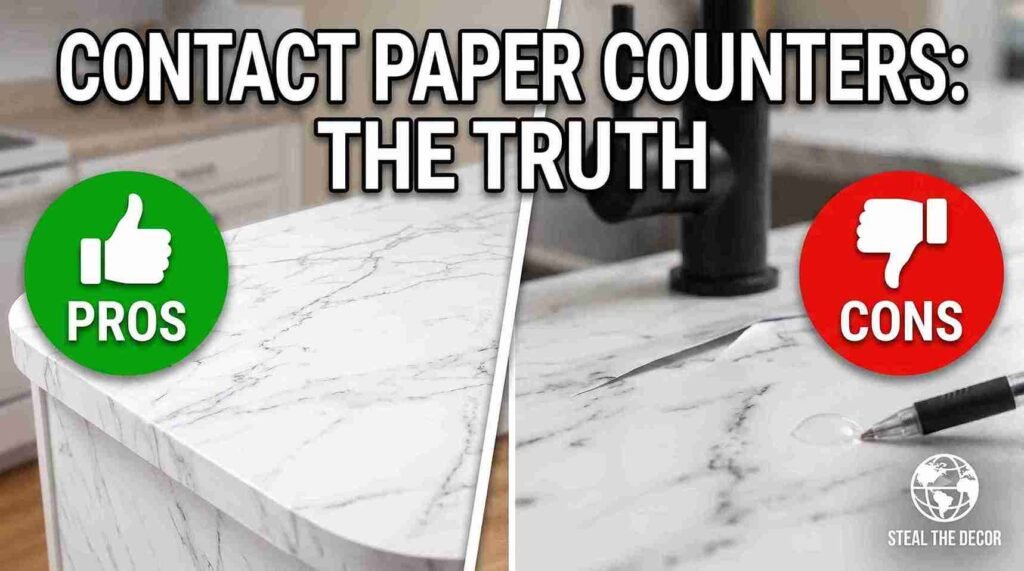
Pros and Cons: The Unvarnished Truth
Nothing I’ve tried in home improvement is perfect. Here’s my honest assessment.
What I Genuinely Like
The transformation is dramatic for $34. My kitchen went from “dated rental” to “bright and intentional” in one evening. The paper hides the old stains and burn marks completely. When guests visit, they compliment the counters—and I get to decide whether to reveal my secret or accept the praise mysteriously.
What Frustrates Me
The seam near my stove still taunts me. Those two tiny bubbles haven’t grown, but they haven’t disappeared either. The edge curl near the sink, while stable now, is visible when the morning light hits it. And I’m always slightly conscious of water—a privilege I didn’t appreciate with my old indestructible laminate.
The “Meh” Category
The overall experience sits in my “meh but worth it” mental folder. I didn’t return the product. I didn’t write a passionate five-star review. I didn’t rip it off in frustration. It’s a $34 cosmetic improvement that made my rental kitchen happier to inhabit. It’s not a miracle. It’s contact paper. Accept that, and you’ll be satisfied.
Frequently Asked Questions
u003cstrongu003eCan you put marble contact paper on countertops?u003c/strongu003e
Yes. u003cstrongu003eMarble contact paperu003c/strongu003e adheres best to smooth, non-porous surfaces like laminate, sealed stone, or ceramic tile. Rough or porous surfaces like unsealed granite or raw wood won’t bond well. Fill deep scratches or gouges before applying; the paper highlights every imperfection underneath. My laminate counters were ideal. The paper stuck almost too aggressively in some spots.
u003cstrongu003eHow long do marble contact paper countertops last?u003c/strongu003e
Most u003cstrongu003emarble contact paper countertopsu003c/strongu003e last one to three years. Heavy-use kitchens trend toward the one-year mark. Bathrooms and laundry rooms often reach three years without issues. Seam sealing and careful maintenance extend the lifespan. My kitchen counters are at six months with minor wear—one edge curled, two small bubbles—but still look 90% good.
u003cstrongu003eIs marble contact paper waterproof?u003c/strongu003e
The vinyl surface is waterproof and resists stains. However, the installation is water-resistant, not waterproof, because moisture can penetrate seams and edges. Once water reaches the adhesive layer, lifting begins. Sealing seams with clear silicone caulk dramatically improves water resistance. Wipe spills promptly and avoid standing water near seams.
u003cstrongu003eDoes contact paper damage countertops?u003c/strongu003e
Quality u003cstrongu003econtact paperu003c/strongu003e generally removes cleanly from laminate and sealed stone. Warming the paper with a hairdryer during removal softens the adhesive for easier release. It may pull up paint, varnish, or loose particles on poorly bonded surfaces. Test a small, hidden area first. My laminate counters showed zero damage after I removed a practice piece.
u003cstrongu003eWhat is the best marble contact paper for countertops?u003c/strongu003e
u003cstrongu003eDC Fix Marble Contact Paperu003c/strongu003e ($34 for 26 feet, Amazon) offers the best combination of pattern realism, thickness, and ease of application. Con-Tact Brand ($12 for 9 feet, Target) is a budget alternative but thinner and harder to handle. Yancorp ($22 for 16 feet, Amazon) is the thickest but has a visible repeating pattern. For kitchen use, DC Fix is my recommendation.
u003cstrongu003eAre marble contact paper countertops worth it?u003c/strongu003e
For renters or anyone seeking a u003cstrongu003ebudget kitchen countertop makeoveru003c/strongu003e, yes — u003cstrongu003emarble contact paper countertops are worth itu003c/strongu003e. The $30–$50 investment transforms ugly counters for one to two years. The trade-off is durability and the learning curve during installation. If you expect permanent, zero-maintenance stone, you’ll be disappointed. If you want a cosmetic upgrade that costs less than dinner out, it delivers.
What I’d Tell My October Self
That 11 p.m. impulse buy last October changed my kitchen. Not perfectly. Not permanently. But meaningfully. I stopped hating the Florida-shaped burn mark because I stopped seeing it. The white marble pattern — printed vinyl, not stone — made my rental kitchen feel like someone cared about it. That someone was me, sweating over a hairdryer at midnight, redoing a corner for the third time while my cat judged me from the doorway.
My DIY marble contact paper countertops aren’t flawless. There’s that bubble near the stove I’ll patch this weekend. The sink edge I should probably re-caulk. The seam I still notice when the light hits it sideways. But for $49 and an evening of work, I’d make the same decision again. I’d just overlap my seams from the start. And buy the caulk on day one.
What about you? Have you tried a temporary countertop makeover that actually lasted? Or did your contact paper peel up in two weeks and leave you swearing off Pinterest forever? I genuinely want to hear the real stories—the disasters, the victories, the “meh” results. Drop a comment below. I read them all, especially the ones that make me feel less alone about my steam near the stove.
About the Author
Ali Ahmad has lived in four apartments in seven years and has modified something in every single one, despite lease agreements that explicitly said not to. His current obsession is removable wallpaper, but the contact paper countertop project remains the one his mother-in-law actually complimented. He keeps a roll of leftover DC Fix in the hall closet “just in case,” fully aware that it’s been there untouched since October.
1 thought on “DIY Marble Contact Paper Countertops: My $49 Rental Kitchen Disaster (And What I’d Do Differently)”