
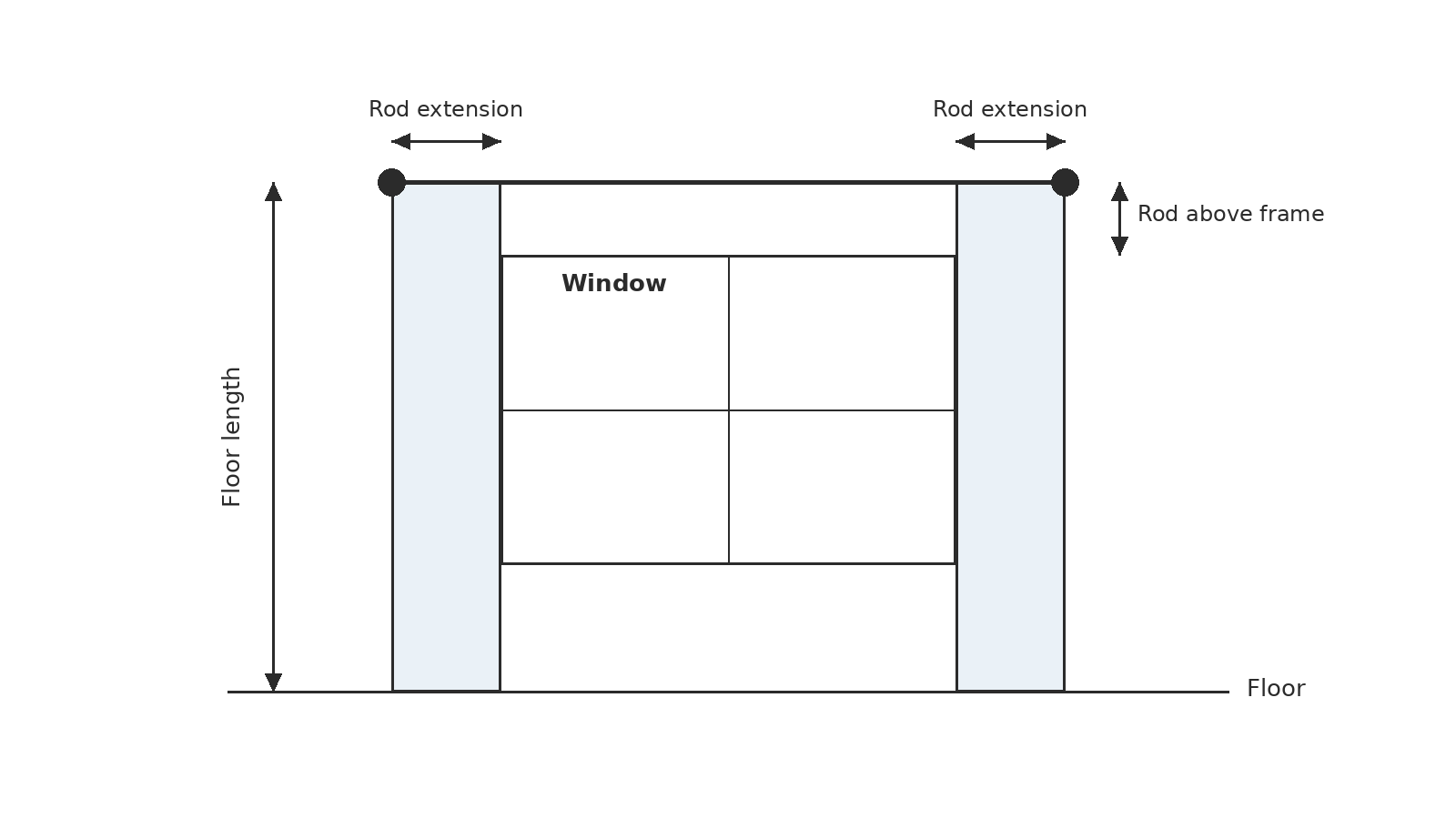
Curtains bought on a guess usually fail in one of two ways: they hang flat with no gather, or they stop short of the floor and make the window look smaller. This curtain size calculator fixes both problems before you order. Enter the window width, where the rod will sit, and how full you want the fabric, and it returns the rod width, the number of panels, the exact length, and the ready-made length to buy. Measure the window first (width trim to trim, floor to top of frame, both in inches), then check the result against the formula printed below it.
Table of Contents
Quick Answer
Mount the rod 4 to 6 inches above the window frame and 4 to 6 inches past each side. Buy total fabric 2 times the rod width for a standard gathered look, and round panels up to a pair. Set length from the rod to the floor: float stops 0.5 inch above it, kiss touches it, puddle adds 4 inches. Buy the next ready-made length up.
How to Use the Curtain Size Calculator
- Measure the window width. Run a tape measure from outside trim to outside trim in inches, and enter that number first.
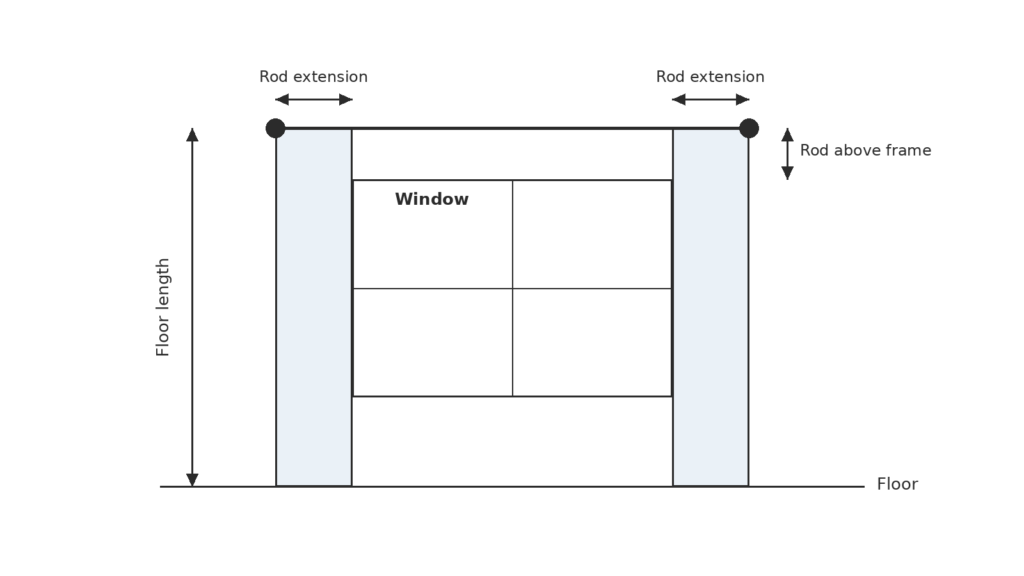
- Choose the rod position. Enter how far past each side the rod will extend and how far above the frame it will sit. Start with 6 inches of extension and 6 inches above the frame if you have no fixed bracket yet.
- Measure floor to top of frame. Measure straight down from the top of the window frame to the floor in inches. Measure after the rug is down, since a thick rug changes floor clearance.
- Pick fullness and panel width. Standard fullness is 2 times the rod width. Panel width is the width printed on the panel listing, usually 52 inches for ready-made panels.
- Pick length style and drop. Float, kiss, or puddle sets where the hem lands. If rings or clips hold the fabric, enter the drop from the rod to the top of the fabric, usually 1 to 2 inches. For grommet tops, where the fabric rises above the rod, enter a negative drop such as -1.5. Switch the units box to centimeters if your tape measure reads in cm.
- Read the shopping list. The result gives rod width, total fabric width, panel count, exact length, and the ready-made length to buy. Renters can hang the same rod without wall holes: see these damage-free decorating ideas for renters for tension rods and no-drill brackets.
How the Result Works
The width formula
The tool works from the rod, not from the window alone. Rod width equals window width plus extension on both sides. Total fabric equals rod width times fullness. Panel count equals total fabric divided by one panel width, rounded up, then rounded up again to an even number so panels come in pairs, with a minimum of 2. A 76 inch rod at standard fullness needs 152 inches of fabric, which is 4 panels of 52 inches.
The length formula
Rod height from the floor equals floor to top of frame plus rod height above the frame. Exact length equals rod height minus the ring or clip drop, then adjusted by style: float subtracts 0.5 inch, kiss subtracts nothing, puddle adds 4 inches. Buy length equals the smallest ready-made length that is equal to or longer than the exact length. A long panel can be hemmed shorter, but a short panel cannot be made longer.
Assumptions and limits
The tool assumes standard ready-made panels and a floor-length curtain. It sizes one straight window; bay windows, arched windows, and windows with baseboard heaters under the hem need a custom check. For street-facing windows, curtains pair well with a temporary window privacy film that adds daytime privacy without blocking the curtain look.
Sill and cafe lengths, manual rule: this tool does not size short curtains, since they need a sill height the tool does not ask for. Measure from where the fabric hangs to the sill or apron, then buy the next standard short length up (24 or 36 inches where sold).
Worked examples
- Standard living room window. Window 60 inches, extension 8 inches, rod 6 inches above the frame, floor to frame 84 inches, standard fullness, 52 inch panels, float, no drop. Result: rod 76 inches, fabric 152 inches, 4 panels, exact length 89.5 inches, buy 96 inches.
- Wide window, full drape. Window 96 inches, extension 10 inches, rod 6 inches above the frame, floor to frame 96 inches, full fullness, 54 inch panels, kiss, 1 inch drop. Result: rod 116 inches, fabric 290 inches, 6 panels, exact length 101 inches, buy 108 inches.
- Small window, light puddle. Window 36 inches, extension 6 inches, rod 4 inches above the frame, floor to frame 60 inches, light fullness, 52 inch panels, puddle, no drop. Result: rod 48 inches, fabric 72 inches, 2 panels, exact length 68 inches, buy 84 inches.
Standard Curtain Size Chart
Ready-made floor-length curtains come in fixed lengths. Match your exact length to the next size up.
| Ready-made length | Best for | Buy tip |
|---|---|---|
| 63 inches | Short windows and rooms with low ceilings | Check sill clearance before ordering |
| 84 inches | Standard 8 foot ceilings with a rod above the frame | A common living room length |
| 96 inches | 9 foot ceilings | Also fits 8 foot ceilings with a puddle finish |
| 108 inches | 10 foot ceilings | Good for tall windows with a kiss finish |
| 120 inches | Tall rooms and ceiling-mounted rods | Measure twice before ordering |
| 132 inches | Very tall rooms and puddle styles | Less widely stocked, check availability first |
| 144 inches | Very tall rooms and dramatic puddle styles | Order early if a matching pair matters |
Fullness factors: Light 1.5 times rod width for sheer and casual panels; Standard 2 times rod width for a normal gathered look; Full 2.5 times rod width for a rich, deep gather. When floor-length curtains meet furniture, check clearance first: see arranging furniture in a long narrow living room for how far pieces should sit from the window wall.
Common Mistakes
- Measuring the window instead of the rod. Window width alone gives a flat result. Fix: choose extension first, then size fabric from rod width.
- Buying one flat panel per side. Two panels that just cover the rod look stretched when closed. Fix: buy total fabric 2 times rod width and round up to a pair.
- Hanging the rod right at the frame. A low, narrow rod makes the window look smaller and the ceiling lower. Fix: mount 4 to 6 inches above the frame and 4 to 6 inches past each side. For damage-free mounting ideas, see hanging fabric without wall damage.
- Forgetting rings, clips, and finials. Hardware between the rod and the fabric shortens the finished length. Fix: enter the drop from rod to fabric top in the tool.
- Measuring before the rug is down. A thick rug raises the floor and changes where the hem lands. Fix: place the rug first, then measure floor to frame.
FAQs
How wide should curtains be?
Total curtain fabric should be 1.5 to 2.5 times the rod width. For a standard gathered look, use 2 times the rod width. A 76 inch rod needs 152 inches of total fabric. Divide that total by one panel width and round up to a pair. Light sheers can use 1.5 times, while a very full drape needs 2.5 times.
How long should curtains be?
For floor-length curtains, length runs from where the fabric hangs on the rod to the floor. A float finish stops about 0.5 inch above the floor. A kiss finish just touches it. A puddle finish adds about 4 inches of fabric on the floor. Measure after the rug is down, then buy the next ready-made length up.
How do you measure a window for curtains?
Measure the window width from outside trim to outside trim in inches, and the floor to the top of the window frame. Decide how far above the frame the rod will sit and how far past each side it will extend. If rings or clips hold the fabric, measure the drop from rod to fabric top.
What are standard curtain lengths?
Ready-made floor-length curtains usually come in 63, 84, 96, 108, 120, 132, and 144 inches. The 84 inch length fits standard 8 foot ceilings with a rod mounted above the frame. Short curtains for sills and cafes come in 24 and 36 inches. Buy the next length up from your exact measurement, since a long panel can be hemmed shorter.
What size curtains do I need?
You need three numbers: rod width, panel count, and length. Find rod width from window width plus extension on both sides. Find panel count from total fabric divided by panel width, rounded up to a pair. Find length from the rod to the floor, adjusted for float, kiss, or puddle style. The calculator above runs all three at once.
How to measure curtain length?
Measure from where the fabric will hang, not from the rod itself. For rings or clips, start at the top of the fabric. For rod pocket or grommet tops, start at the rod. Measure straight down to the floor for a float or kiss finish, or add 4 inches for a puddle finish. Measure after the rug is in place.
How much wider than the window should curtains be?
The rod should be 8 to 12 inches wider than the window in total, or 4 to 6 inches past each side. Extend up to 12 inches per side when you want open panels to clear the glass fully. The fabric is then 2 times the rod width for a standard look, so curtains run much wider than the window.
Key Takeaways
- Mount the rod 4 to 6 inches above the frame and 4 to 6 inches past each side for a taller, wider window look.
- Size fabric from rod width, not window width: standard fullness is 2 times rod width.
- Round panel count up to a pair, with a minimum of 2 panels.
- Float stops 0.5 inch above the floor, kiss touches it, and puddle adds 4 inches on the floor.
- Buy the next ready-made length up, since a long panel can be hemmed shorter.
- Enter the ring or clip drop, or the finished length will run long.
- This tool sizes floor-length curtains; sill and cafe lengths use the manual rule above.
Conclusion
You now have the three numbers that matter: rod width, panel count, and buy length. Start from the rod, not the window, and the rest follows: rod width sets fabric width, fabric width sets panel count, and rod height sets length. For renters, the safest upgrade is a tension rod or a no-drill bracket, which holds a standard rod without wall holes. If the window sits over a closet or a workspace, curtains can also cover it: closet office ideas shows how a simple panel hides storage and softens a work nook. Measure once more before ordering, buy the next length up, and keep the receipt until the panels are hung.