

This post contains affiliate links. As an Amazon Associate I earn from qualifying purchases, at no extra cost to you.
Table of Contents
The panel slid off the rod at 6 a.m. Pooled on the floor. Sunrise straight into my eyes, no warning. That was week one of trying to figure out how to hang double curtains on a single rod in my old apartment, and it taught me exactly what not to do. Since then I’ve rebuilt that setup four separate ways — rings, clips, hooks, a straight thread-through — testing each one to see what actually holds without sagging, tangling, or ripping a drywall anchor out of the wall. Three weekends, about $61 total, in a 200-year-old rental where drilling wasn’t really an option. Here’s what held up, what I’d skip, and how to get a sheer-plus-blackout look without buying a second rod.
Quick Answer: Yes, you can hang two curtain layers on one rod. Sheer goes closest to the window, the heavier or blackout panel goes in front, both attached with double curtain rings, clip rings, or layered hooks. A single rod works fine for lightweight fabric and smaller windows. Want each layer to slide open and closed on its own? Get a true double curtain rod instead.
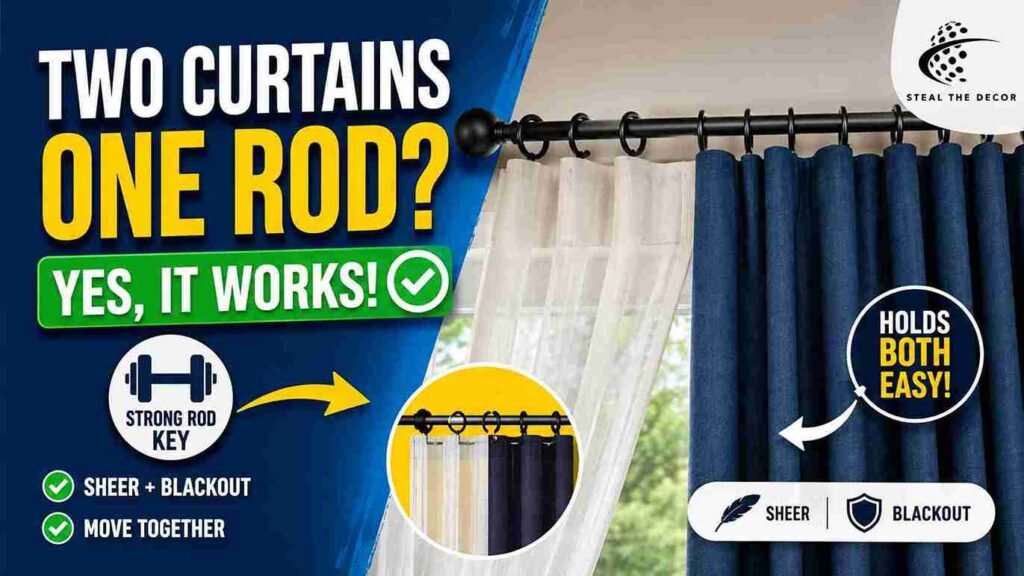
Can You Hang Two Curtains on One Rod?
Yes. But people mean two different things when they ask this. First: two curtain panels side by side on the same rod, usually because one panel doesn’t cover a wide window. Second — the one most renters actually want layering two curtains, sheer plus blackout, so they move as one stack.
A single rod handles both setups fine, as long as the rod, brackets, and rings are rated to hold the combined weight. Lightweight sheers paired with a mid-weight cotton panel? Easy. Heavy blackout curtains paired with a second thick layer put real strain on the hardware that’s where I’ve seen rods bow in the middle, especially past 48 inches wide.
One sturdy rod can absolutely hold two curtain layers. Fabric weight and rod quality decide whether it works well or turns into a 6 a.m. fabric avalanche.
Does Layering Curtains on One Rod Actually Work? (Skeptic Check)
Honestly? Most posts on this topic skip the failure cases. I’m not going to.
In my experience, layering works well with lightweight-to-medium curtains, a rod rated for at least 15–20 pounds, and a center support bracket on anything wider than 60 inches. It does not work when you cram two heavy blackout panels onto a thin tension rod or skip wall anchors and mount straight into drywall.
The rod is usually the failure point. A basic $9 tension rod might handle one sheer panel fine. Two layers, plus rings, plus clips that adds up fast. My first attempt used a hollow rod that bowed about half an inch in the middle within a week, then let the whole stack slide toward one side. Not gonna lie, I was annoyed. Switching to a solid steel rod with a center support bracket and real wall anchors fixed it completely. It’s held for over a year now, zero sagging.
Plaster walls? Nervous about drilling at all? A tension-mounted rod like the ones covered in my tension rod guide for renters can work for very light layered sheers. I wouldn’t trust it with a full blackout panel over a wide window, though.
Bottom line: layering on one rod works reliably once you match the hardware to the fabric weight. The technique was never the problem undersized rods were.
What You’ll Need
Here’s exactly what I used across all four methods, so you’re not guessing at the hardware store:
- A sturdy curtain rod rated for at least 15–20 lbs of combined fabric weight
- Two curtain panels one sheer, one heavier or blackout
- Double curtain rings, clip rings, or layered curtain hooks (pick one method)
- A measuring tape
- A drill or screwdriver (skip this if you’re using a tension rod)
- Wall anchors, if mounting into drywall
- A level, so your rod doesn’t end up crooked like mine did the first time
No drilling allowed at all? Look for removable, adhesive-mounted brackets rated for at least 10 lbs, or a tension rod for lighter layered sheers.
Products I Recommend for Hanging Double Curtains on One Rod
Disclosure: As an Amazon Associate I earn from qualifying purchases. If you buy through a link on this page, I may earn a small commission at no extra cost to you.
I tested layered curtains in my own rental before writing this guide. Anything marked I’d buy it again is exactly what I use in my own setup. The rest are the options I’d pick next, depending on your window and the hanging method you choose.
Best Curtain Rod for Two Layers
This is the most important purchase in this guide. Two panels double the weight on the rod, so skip thin telescoping rods. My own solid steel rod is rated for 20 lbs and still hasn’t sagged after several months. I’d buy it again.
- Look for: solid steel, about 1 inch in diameter, rated for 20 lbs or more. Pick a listing that actually states the weight rating.
- Good options: Kenney, Umbra Cappa, or Ivilon heavy-duty rods
Best Double Curtain Rings
Each hanging method uses different hardware, so buy for the method you chose above. Double curtain rings were the clear winner in my test: smooth movement and no sagging. I’d buy them again.
- Method 1 (double curtain rings): double clip curtain rings, with one clip for each panel
- Method 2 (clip rings): Amazon Basics Curtain Clip Rings or Meriville Clip Rings
- Method 3 (layered hooks): pinch pleat hooks or layered drapery hooks
Best Blackout + Sheer Curtain Combo
- Blackout layer: NICETOWN Blackout Curtains, the blackout panel I hang in my own rental. I’d buy it again.
- Sheer layer: NICETOWN Sheer, MIULEE Sheer, or Deconovo Sheer or voile panels
Best Center Support Bracket
If your window is wider than 60 inches, add a center support so the rod does not sag under two layers of fabric.
- Good options: Kenney or Ivilon center support brackets
- Check first: the bracket must match your rod’s diameter
Best No-Drill Options for Renters
- Kwik-Hang No-Drill Brackets: mount on the window frame, so there are no holes in the wall
- Kenney Kwik Install brackets: twist into the frame and leave only a tiny hole
- Heavy-duty tension rod (Kenney or Umbra ): for light sheers only, not blackout panels. My first attempt used a cheap tension rod with clip rings, and it bowed within a week under blackout plus sheer.
Best Double Curtain Rod (If You Want Independent Layers)
If you want each layer to open and close on its own, a double rod is the easier route.
- Good options: Amazon Basics Double Curtain Rod, or a double rod from Umbra or Ivilon
Tools That Make Install Easier
- Drywall anchors: E-Z Ancor or Toggler
- Measuring tape and level: Stanley tape measure and level
- Garment steamer: releases packaging creases before you hang the panels
- Rod sleeve or felt tape: cuts the scraping noise of rings sliding on metal
Choose the Right Curtains
Sheer and blackout curtains are the most popular layering combination, and there’s a reason for that. The sheer filters daylight and gives you privacy during the day without blocking the room completely. The blackout panel handles nighttime privacy and actually darkens the room when you need it dark. I run a NICETOWN blackout curtain (typically $25–$40 a pair) behind a plain Ecliptic Voile Sheer panel (around $18–$24 a pair) and only pull the blackout layer closed at night.
Match your panel lengths where you can. Two curtains at noticeably different lengths reads as a mistake, not a style choice unless you’re intentionally pairing a shorter sheer with a longer decorative panel for visual interest. Stick to complementary colors too. A patterned blackout panel behind a patterned sheer looks busy, not layered. Want more on how fabric weight interacts with your lighting setup? My guide to picking the right light for a living room gets into that.
Pair a sheer with a solid-color blackout panel, similar length. That’s the combination that looks intentional and layers the most predictably.
Measure the Window and Curtain Rod
Get the sizing right up front and you won’t be redoing the whole install later. Here’s the simple version, in inches:
- Measure your window width frame edge to frame edge.
- Choose a rod that extends past both sides of the frame. A common starting point is 4–6 inches of extension per side, so a 36-inch window might use a 44–48-inch rod. Not a strict rule — trim width, nearby outlets, and furniture placement can shrink or stretch that number.
- Calculate total curtain width. For a fuller, layered look, aim for roughly 1.5–2 times the rod width in combined fabric — a 48-inch rod usually wants panels totaling 72–96 inches across both layers.
- Check the rod’s weight rating before you commit to two layers. Most basic decorative rods are built for one lightweight panel, not two.
Measure the window first. Pick the rod second. Buy the fabric last. That order is what actually prevents mismatched curtains.
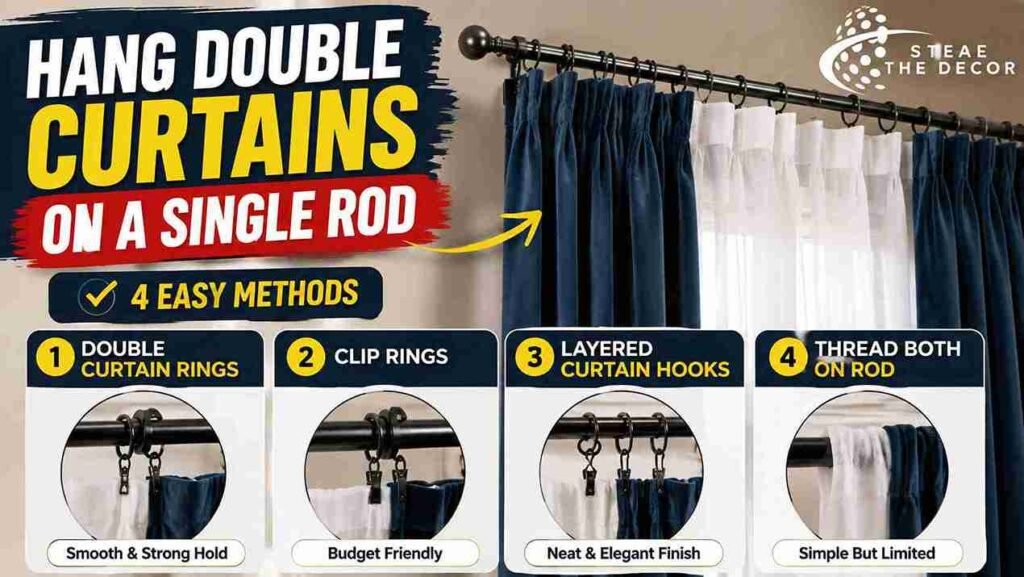
How to Hang Double Curtains on a Single Rod (Step-by-Step)
Method 1: Use Double Curtain Rings
This one held up best in my testing by a wide margin. Double curtain rings have two clip points, one for the sheer, one for the heavier panel, so both layers move as a single unit.
- Attach the sheer panel to the inner clip of each ring, closest to the window glass.
- Attach the blackout or decorative panel to the outer clip, in front of the sheer.
- Slide each ring onto the rod before mounting the rod on its brackets.
- Space the rings evenly. I used one every 4–5 inches on a 48-inch rod, centered over the window.
Method 2: Use Clip Rings
Cheaper, easier to find, but there’s a catch more friction when you open and close the curtains. Clip both fabric layers together at evenly spaced points along the top edge, then slide the joined clip rings onto the rod. Works best with lightweight-to-medium curtains. Two heavier layers this way? I noticed real resistance sliding them compared to true double rings.
Method 3: Use Layered Curtain Hooks
Layered curtain hooks hold two fabric headers at once and give a noticeably neater finish, especially with pleated curtains. The catch and it’s a real one is that this only works well if both panels have compatible headers. Pleat-to-pleat, or hook-compatible tape. Different header styles on each panel? This method gets fiddly fast.
Method 4: Thread Both Panels Onto the Rod
The simplest option. Thread both rod-pocket or grommet panels directly onto the rod sheer first, decorative panel second. Least flexible of the four. The fabric bunches together, movement isn’t independent, and on my test window this version was noticeably harder to open smoothly than any ring-based method. I’d only use it as a temporary fix.
Pro Tips for Renters:
- Add a felt or silicone rod sleeve under metal rings cuts down on the scraping noise when you open and close curtains, which matters more than you’d think at 6 a.m.
- Can’t drill at all? A tension rod plus lightweight sheers is your safest combo. Skip heavy blackout fabric on tension hardware entirely.
- Iron or steam both panels before hanging. Wrinkles show a lot more once two layers are stacked.
- Buy two to four extra rings or clips beyond what you think you need even spacing matters more here than for a single curtain.
- Rod bowing even slightly in the first week? Add a center support bracket right away. Don’t wait for it to get worse.
Single Rod vs. Double Curtain Rod
Want each layer to open and close independently sheer shut for privacy while the blackout panel’s fully open? A true double curtain rod is the better long-term call. Here’s how they compare:
| Feature | Single Rod (Two Layers) | Double Curtain Rod |
|---|---|---|
| Cost | Usually lower ($15–$35) | Usually higher ($30–$70) |
| Installation | Simpler, one set of brackets | Requires dual front/back brackets |
| Best for | Lightweight curtains, smaller windows | Heavy curtains, wide windows |
| Independent movement | Limited layers move together | Much easier each layer slides separately |
| Appearance | Compact, streamlined | More visual separation between layers |
| Flexibility | Moderate | High |
A double curtain rod has separate front and back tracks, so the sheer and heavier panel can be opened or closed on their own schedule. Want the layered look and don’t mind both curtains moving together? Single rod, simpler and cheaper. Want full daily control over light and privacy? Budget for the double rod.
Single rod for style and simplicity. Double rod for control.
Common Mistakes to Avoid
Using a rod that’s too thin for two layers. This is what got me at 6 a.m. A decorative rod rated for one light panel will bow or slide under the weight of two curtains. Check the rating before you buy.
Skipping wall anchors. Drywall alone won’t hold a loaded curtain rod for long, especially with two layers pulling on it every time you open the curtains. Use anchors rated for the rod’s weight, or switch to tension-mounted or adhesive hardware if drilling’s off the table.
Choosing curtains that are the wrong width for the rod. Too narrow and the panels won’t stack right. Too wide and they bunch up, blocking smooth movement. Match fabric width to the rod length using the 1.5–2x fullness ratio from earlier.
Overcrowding the rod with heavy fabric. Two full-weight blackout panels on one rod is usually one layer too many. Both curtains heavy? A double rod, or a single heavier panel, beats stacking.
Forgetting a center support on a wide window. Past about 60 inches, a center bracket earns its keep. I learned this after my rod visibly dipped in the middle within a week of skipping one.
Hanging the layers in the wrong order. Sheer closest to the glass, heavier or blackout panel in front. Reverse it and you kill the whole point of the sheer plus it looks off from outside.
How to Make Layered Curtains Look Fuller
Fullness comes down to extra fabric width relative to the rod, and how evenly it’s spread out. Aim for that 1.5–2x fullness ratio from earlier, and space your rings or clips evenly rather than clustering them uneven spacing is the single biggest reason layered curtains look flat instead of full. Pairing two different textures, a crisp linen-look sheer with a slightly heavier cotton-blend blackout panel, reads as more intentional than two identical fabric weights stacked together.
Can Renters Hang Double Curtains Without Drilling?
Yes, with a real caveat. Tension rods and adhesive, removable brackets can support layered sheers without a single hole in the wall. I’ve run a tension rod for a sheer-plus-lightweight-cotton combo over a 32-inch window for over a year now with zero issues. Where it gets risky is heavy blackout fabric. Most no-drill hardware is rated well below what a drilled bracket can hold, so doubling up heavy curtains on adhesive mounts is where I’d expect trouble. Check the manufacturer’s actual weight rating before assuming a no-drill option can handle two layers. And if you’re also hiding cords from a plug-in light nearby, my no-drill guide to hiding lamp cords has a few tricks that pair well with this setup.
No-drill hardware works fine for light layered curtains. Treat heavier blackout combinations as a drilled-rod job.
What to Check With Your Landlord Before You Start
- Whether your lease specifically restricts drilling or wall modifications
- If wall anchors count as “damage” under your lease terms (this varies)
- Whether you need to patch and repaint holes before move-out
- If there’s an existing curtain rod you’re expected to keep or reinstall
- Whether window treatments are mentioned anywhere on your move-in inspection sheet
Not sure where you stand? HUD’s tenant rights resource is a solid starting point for general renter protections, though your specific lease terms always take priority.
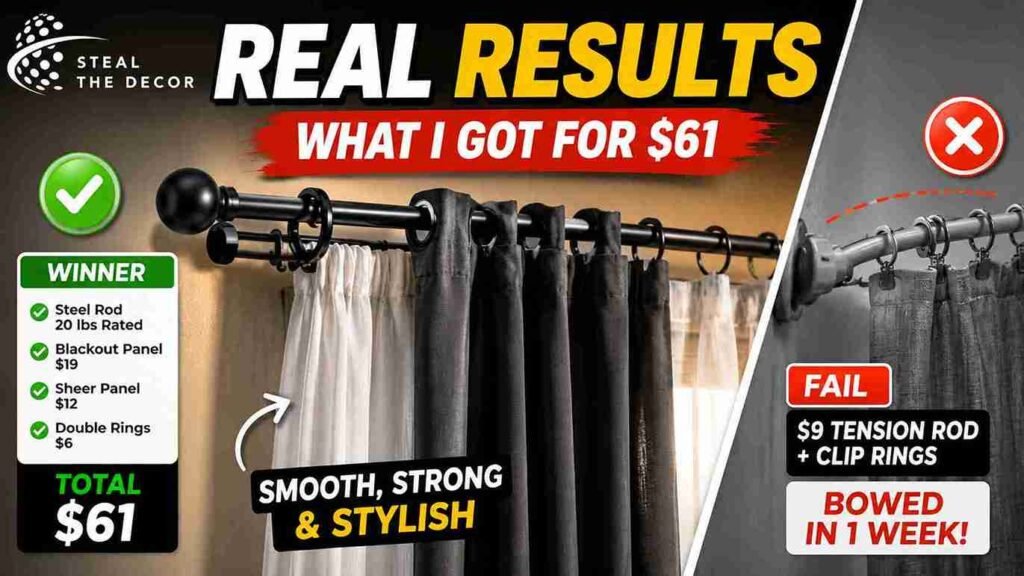
Real Results: What I Got for $61
Here’s the honest breakdown. $24 on a solid steel rod rated for 20 lbs. $19 on a NICETOWN blackout panel. $12 on a sheer voile panel from a clearance rack. $6 on a set of double curtain rings. $61 total. The double-ring method was the clear winner smooth movement, no sagging after several months, and the layered look actually reads as intentional instead of thrown together.
And the failure? My first attempt, a $9 tension rod plus clip rings, bowed within a week under the combined weight. Not a mistake I’d repeat.
Key Takeaways
- A single curtain rod can hold two curtain layers as long as it’s rated for at least 15–20 lbs of combined fabric weight.
- Double curtain rings are the most reliable method for layering a sheer and a blackout panel on one rod without sagging.
- The sheer panel should always sit closest to the window, with the heavier or blackout panel hanging in front.
- Windows wider than about 60 inches typically need a center support bracket to keep the rod from bowing under two layers.
- A true double curtain rod, not a single layered rod, is the better choice if you want each panel to open and close independently.
- Tension rods and adhesive brackets can support lightweight layered sheers without drilling, but aren’t rated for heavy blackout combinations.
- Aim for roughly 1.5–2 times the rod’s width in combined curtain fabric for a full, intentional-looking layered stack.
Conclusion
Layering two curtains on one rod isn’t complicated once the hardware matches the fabric weight. The rod, not the technique, is where most people run into trouble. Short on time? Start with double curtain rings and a properly rated rod — that combination held up best across everything I tested. For more on making rental upgrades that won’t put your deposit at risk, check my guide to decorating a rental without damage. Have you tried layering curtains on one rod in your own place? Tell me what happened below — I read every comment.
FAQ: How to hang double curtains on a single rod
Can I hang blackout curtains and sheers on one rod?
Yes, as long as the rod is rated for the combined fabric weight. Use double curtain rings or layered hooks for the smoothest movement, and add a center support bracket if your window is wider than about 60 inches.
Which curtain goes closest to the window?
The sheer panel goes closest to the glass, with the blackout or decorative curtain hanging in front. This order keeps daytime privacy from the sheer while letting the blackout panel fully darken the room at night.
Can I use two rod-pocket curtains on one rod?
Yes, though rod-pocket panels tend to bunch together and slide less smoothly than curtains attached with rings or clips. It’s a quick, low-cost option — just not the easiest to open and close daily.
How far should a curtain rod extend past the window?
A common starting point is 4–6 inches of extension on each side, though the exact amount depends on your trim, wall space, and how much fabric stack-back you want when the curtains are open.
Do double curtains need to be the same length?
They usually look most polished at matching lengths, though a shorter sill-length sheer paired with a longer floor-length decorative panel can work as a deliberate design choice.
Will this damage my rental’s walls?
Drilled anchors leave small, patchable holes that most leases treat as normal wear. Want a fully damage-free setup? Tension rods or adhesive-mounted brackets rated for your fabric weight skip drilling entirely.
What if the rod starts to sag after I install it?
Add a center support bracket as soon as you notice bowing — don’t wait for it to get worse. Sagging continues after that? The rod’s likely undersized for your fabric weight and needs to be swapped for a sturdier one.