
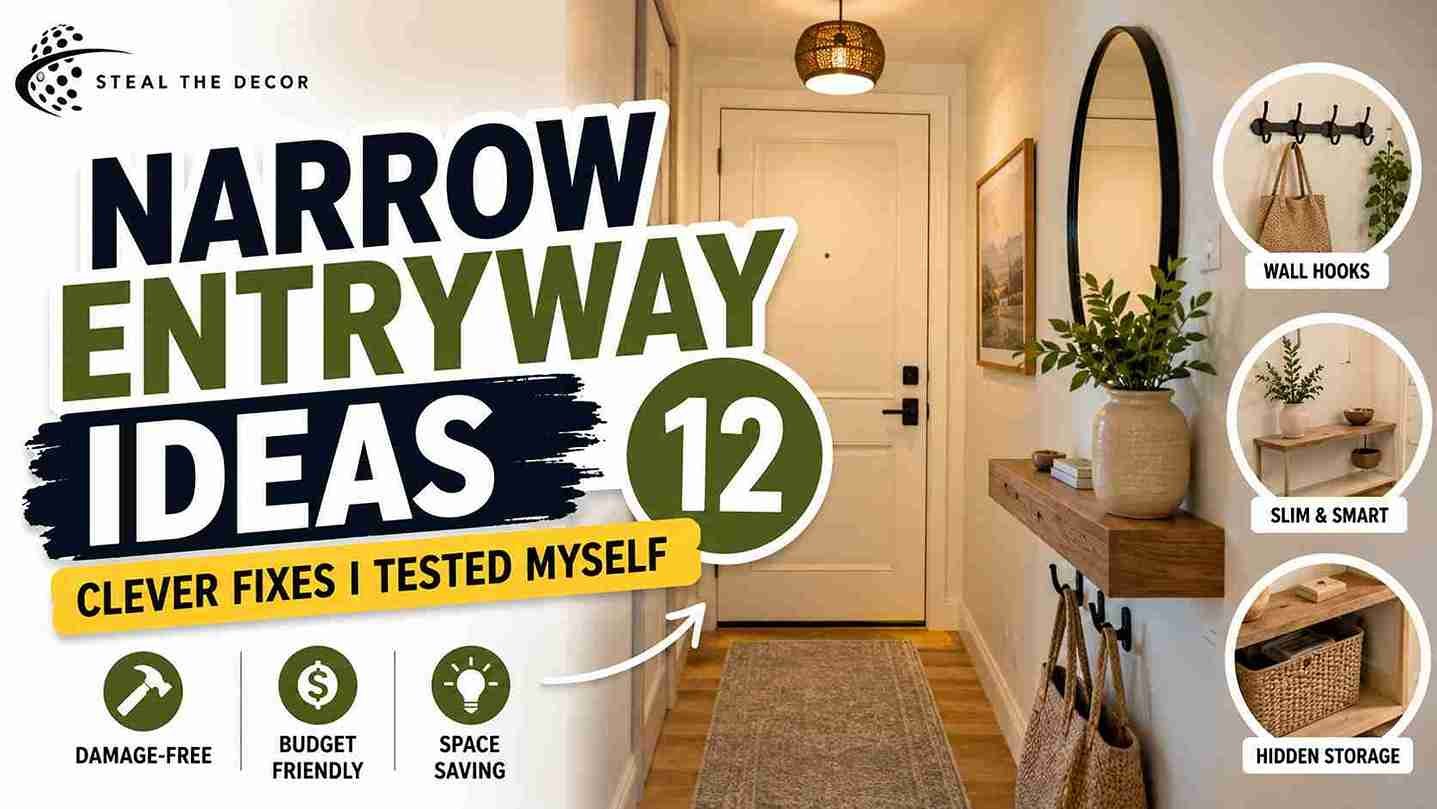
Table of Contents
Thirty-four inches. That was the gap between my front door and the opposite wall, and I learned the number the expensive way — by buying a console table that was 16 inches deep, hauling it up two flights, and then watching my own front door stop dead against it. It went back the next morning.
My place is a one-bedroom rental in a 1970s building. Hallway entrance, a light switch in a spot nobody would choose, and a lease that says no holes, no paint, no fixture swaps. So every one of the narrow entryway ideas below had to clear the same bar: damage-free, reversible, cheap enough that a failure would not ruin my week. Six weeks of testing, 12 approaches, nine keepers, two returns, and one adhesive hook that took a dime-sized chip of paint with it.
Here is what worked, what it cost me down to the dollar, and the two things I would tell you to skip.
Quick Answer: The fastest way to decorate a narrow entryway is to go vertical and shallow — keep every piece under 12 inches deep, mount storage on the wall instead of the floor, and use one full-length mirror to bounce natural light down the hallway. Command Utility Hooks by 3M hold up to 15 pounds and remove cleanly from painted drywall, a slim floating shelf replaces a console table in about four inches of depth, and a low-pile runner rug laid lengthwise stretches the sightline. Total cost for a renter-safe narrow entryway makeover runs roughly $80 to $200 with no drilling.
What Counts as a Narrow Entryway (and Why Renters Get It Wrong)
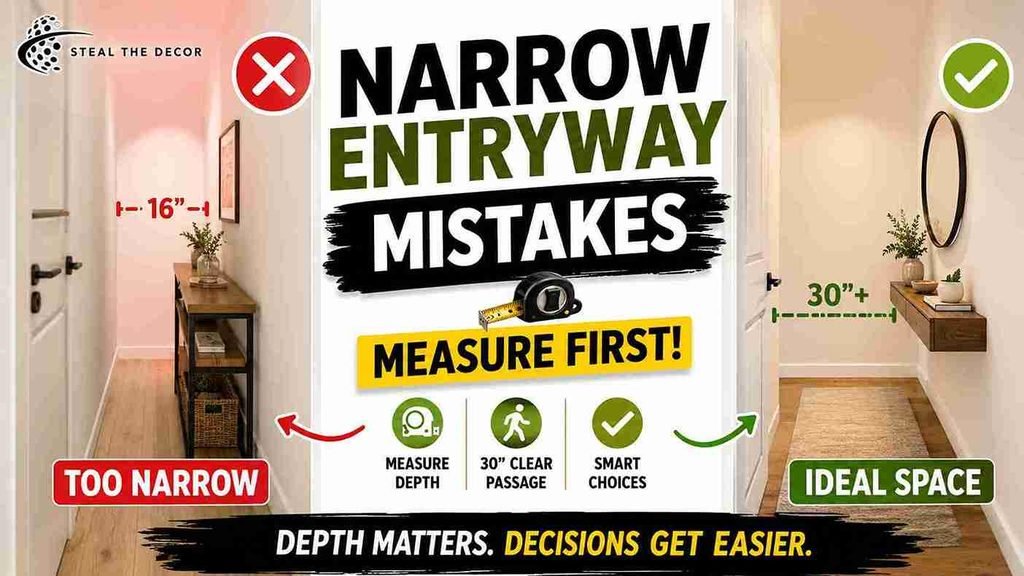
A narrow entryway is any entrance where the depth from wall to opposite wall drops under about 40 inches, leaving less than 30 inches of walking clearance once furniture goes in. That number matters far more than square footage, and it decides every interior choice you make afterward. Standard console tables run 14 to 18 inches deep, and the second you set one in a 34-inch hallway you are down to 16 inches of passage. Narrower than your shoulders with grocery bags, and the whole foyer starts to feel cramped the second you carry anything through it.
Most renters shop by style first and depth second. I did exactly that. The table looked right in the photo and was wrong in the room by four inches, which is the kind of mistake you only make once.
So measure the depth. You are shopping for wall space now, not floor space. Subtract 26 to 30 inches for clearance. Whatever is left is the deepest thing you are allowed to buy — and in my case that left four to eight inches, which quietly rules out most entryway furniture on the market.
But there is an upside. A narrow space forces good decisions, and you end up with a minimalist entryway by default because nothing else fits. No interior designer needed — the room already made half your calls for you, and a stylish small space is usually just an edited one.
Bottom line: measure the depth first, and let that number — not the catalog photo — pick your furniture.
Can You Actually Decorate a Narrow Entryway Without Drilling?
Yes. Roughly 80% of narrow entryway decor goes up with adhesive alone, with three real limits you need to know before you start.
Adhesive strips work on smooth, fully cured painted drywall that is clean and dry. They fail on textured or orange-peel walls, on flat or matte paint that has not cured for at least 30 days, and on anything humid. And if you are in a rental with textured walls — I know. This is the part that keeps tripping you up, and I will come back to it in the steps.
Here is the micro-story. My one paint chip came off a wall left of the door that I now suspect got repainted the week before I moved in. I stood there holding a hook and a flake of paint, doing the math on my deposit. The adhesive held better than the paint underneath it did. Nobody warns you about that failure mode.
Weight limits are real, and they are not suggestions. Command Utility Hooks by 3M are rated up to 15 pounds in the extra-large size, and it is worth checking those ratings against what you actually plan to hang — a rain-soaked winter coat weighs a lot more than the same coat dry. 3M publishes the full Command product weight limits guide, and it takes two minutes to read.
What genuinely needs drilling: floating shelves carrying more than about five pounds, and anything holding a person’s weight. For those, go freestanding or tension-mounted.
Bottom line: adhesive handles almost everything in a narrow hallway, as long as you test one strip on your wall before you trust it with a mirror.
12 Narrow Entryway Ideas That Work in Under 40 Inches
Ranked roughly by impact per dollar. Every one fits in under 12 inches of depth.
- Swap the console table for a floating shelf. A four-inch-deep floating shelf entryway setup gives you a landing spot for keys, mail, and a small plant without eating the walkway. Mine is a 24-inch pine shelf (around $18–$30) holding a ceramic tray, sunglasses, and nothing heavier than a paperback. It reads as intentional, not improvised, and it saves the floor space a console would have eaten.
- Install a row of wall mounted hooks for entryway coats. Three to five hooks at 60 inches high hold bags, coats, and dog leashes, and they clear the floor completely. Use a strip of painter’s tape as a level guide and space them eight to 10 inches apart. A five-hook rail is the cheapest wall organizer you can buy, and wall hooks are the best storage solutions in this entire guide. Honestly? This is the one that surprised me most on the whole list — $19 erased a pile that had been there for months.
- Add a full-length mirror. A narrow entryway with mirror placement facing the door, or perpendicular to your light source, visually doubles the corridor and brightens it at the same time. Mine leans instead of hanging, which sidesteps the weight problem entirely. If you want yours on the wall, our guide to damage-free ways to hang large mirrors is the safest route — and for anything genuinely heavy, read how to hang a heavy mirror without studs first.
- Lay a narrow hallway runner lengthwise. A runner pulls the eye down the hall and makes the space feel longer. Low-pile, four to six inches of bare floor on each side, under 30 inches wide. Budget $35–$90 for a washable one.
- Use a slim shoe cabinet, not a shoe rack. A tilting shoe cabinet sits six to nine inches deep against the wall, versus 12 or more for an open rack, and it hides the mess. The IKEA BISSA and similar tilt-front cabinets are the standard narrow entryway storage ideas pick at $60–$110. Shallow drawers beat open cubbies here, because a closed front hides what an open shoe rack puts on display.
- Hang a vertical gallery wall. Three or four small frames stacked vertically draw the eye upward and add personality without stealing an inch of floor. This is the spot to display family photos if you want the entryway to feel like yours — real visual interest, zero footprint. Our walkthrough on how to hang a gallery wall without nails covers spacing and the adhesive method.
- Add a plug-in sconce or two. Most narrow hallway lighting ideas fail for renters because you cannot hardwire anything. A plug-in wall sconce fixes that — one at each end of the hall at roughly 66 inches high gives you layers instead of one flat overhead glare. A plug-in pendant works too if your ceiling allows it, and warm light builds a welcoming atmosphere far faster than any decor object. No outlet at all? How to light a dark room with no outlets covers the battery-operated options I tested.
- Mount a wall basket for everyday essentials. One shallow wall basket or wire pocket holds mail, keys, and the leash, all tucked away at eye level. Cheapest hidden storage you will ever install, usually under $20, and it is genuine additional storage that costs you no floor at all.
- Put a tray on the shelf. A catch-all tray corrals keys and coins so the surface never reads as visual clutter. Sounds too small to matter. It is the only reason my shelf still looks tidy eight months later.
- Lighten the color palette without paint. You cannot repaint, but removable wallpaper on one end wall creates the illusion of depth and adds color. A pale, cool-toned pattern pushes that wall visually backward and helps the hallway appear larger than the paint color alone ever will. It is also the easiest way to add color without a brush. Start with peel-and-stick wallpaper for renters if you have never applied it, or rental-friendly accent wall ideas if you want the two tone effect without a paintbrush.
- Add one plant at height. A trailing pothos on the shelf or hanging near the door adds warmth and softens a hard corridor, and plants add warmth that no amount of decor objects can fake. Ceiling options live in hanging plants from the ceiling without drilling.
- Hide the cords. Nothing kills a chic entryway faster than a sconce cable running down the wall. Adhesive cord channels or a simple raceway fix it in 10 minutes, and the methods in how to hide lamp cords all work here.
Bottom line: pick three from this list — hooks, a mirror, and a runner — and your narrow entryway will already look deliberate.
Pro Tips for Renters:
- Hang your hooks at 60 inches, not 66. Coat hooks mounted too high make a narrow hallway feel like a locker room, and a wet coat drips down the wall above the baseboard.
- Buy the runner two sizes longer than you think you need. A runner that stops short of the door chops the hall visually, and one that runs the full length reads as a single continuous space.
- Let adhesive strips cure a full hour before you hang anything, and press for 30 seconds first. Most failures I have seen came from impatience, not from the product.
- Photograph the wall before you mount a single thing. If there is already a hairline crack or a soft patch of paint, you want a timestamped photo of it long before your move-out inspection.
- Skip the second piece of furniture. In under 40 inches, one floor-standing item is the ceiling. A narrow bench sounds tempting, and it is the single fastest way to make the space feel cramped no matter how good the piece looks on its own.
Step-by-Step: How to Make a Narrow Hallway Look Wider (No Paint, No Drills)
This is the exact order I worked in. Do it out of order and you will spend money twice, because furniture bought before measuring is furniture you return.
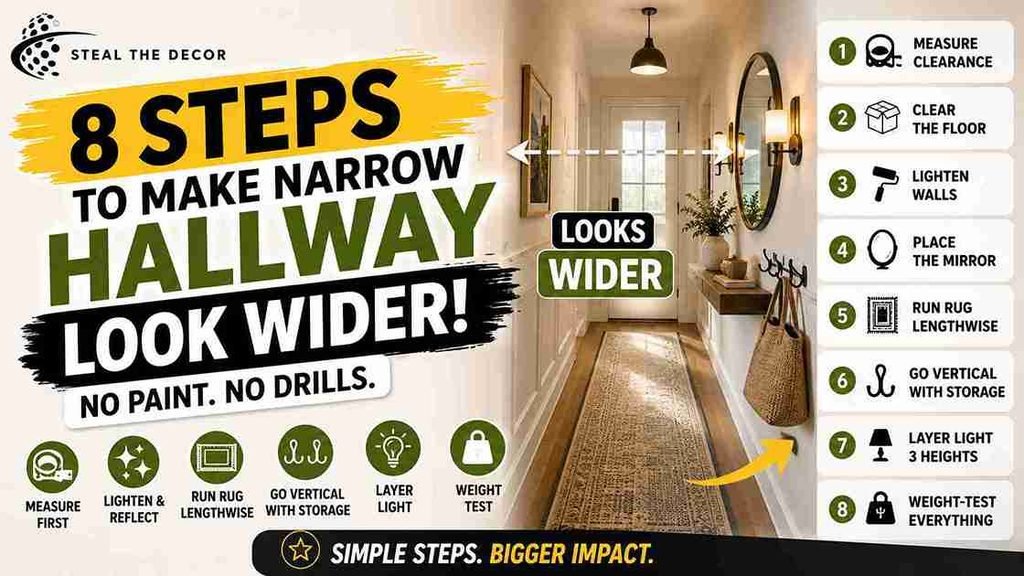
Step 1 — Measure clearance, not square footage. Measure wall to wall at the narrowest point, then subtract 30 inches for walking clearance. Whatever remains is your maximum furniture depth. Write it on your phone and treat it as a hard ceiling while you shop. The classic error here is measuring at the widest point and then discovering a door swing or a radiator pinches the hallway somewhere else.
Step 2 — Clear the floor completely. Take everything out. Shoes, baskets, the umbrella stand, all of it — then live with the empty hallway for two days. You will be surprised how much of it had no reason to be there. Starting from empty also shows you exactly where natural light lands, which decides your mirror placement in Step 4.
Step 3 — Lighten the wall color, renter-style. A pale wall color makes any narrow space feel larger, and removable wallpaper or a peel-and-stick panel on the end wall gets you there without touching the paint. Light, cool tones create the illusion of depth, which is what makes the space feel bigger before you add a single object. Textured walls? Test one sheet in a corner and leave it a week. Adhesion on texture fails slowly rather than immediately, which is what makes it sneaky.
Step 4 — Place the mirror where it catches light. Position a large mirror on the wall perpendicular to your nearest window or door glass, so it throws light down the corridor instead of back at a blank wall. Lean it if it is heavy. Actually — let me walk that back slightly. Lean it even if it is not heavy, because hanging a large mirror on adhesive alone is the riskiest move in this entire project and the one thing here I would not repeat.
Step 5 — Run the rug lengthwise. Lay the runner along the length of the hall, centered, with even bare floor on both sides. A rug laid across the width slices the space into segments and makes it read shorter. Carpeted entryway? The layering rules in our area rug over carpet guide apply, and how to keep a rug on carpet from bunching solves the ripple problem before it starts.
Step 6 — Go vertical with storage. Mount hooks, then the floating shelf, then the wall basket — all on one wall. Keep the opposite wall almost bare, with a single piece of wall art at most. Everything you mount buys you additional storage and helps you save space at floor level, which is the entire trade. And this is where most renters go wrong: loading both walls in a narrow hallway is exactly what turns it into a tunnel.
Step 7 — Layer light at three heights. One light fixture overhead, one sconce at eye level, one low glow near the floor. Warm bulbs around 2700K feel welcoming, and anything above 4000K makes a small entryway feel like a clinic. Get this layer right and the entrance feel changes more than any other single step. The ENERGY STAR guide to light color and mood explains the Kelvin scale if you want your bulbs to match across fixtures.
Step 8 — Weight-test everything before you trust it. Hang each hook, load it with double what you plan to put on it, and walk away for 24 hours. Anything that is going to slip will slip now — instead of at 2 a.m. with your winter coat on it, which is a sound I have heard and would like you to avoid.
Bottom line: measure, empty, lighten, reflect, then load the walls — in that order, every time.
Common Mistakes Renters Make in Narrow Entryways
Buying furniture deeper than the clearance allows. This is the expensive one, and it is the one I made. Anything over 12 inches deep in a sub-40-inch entryway blocks the door swing or forces you to walk sideways. Shop the console table category by depth filter and treat 12 inches as your ceiling. Style and function both lose when the door will not open.
Overloading adhesive hooks past their rating. A hook rated for five pounds holding a backpack, a coat, and a tote is carrying maybe 14. It holds for weeks, then lets go all at once. Count the heaviest realistic load and buy one rating above it.
Laying the rug across the hallway instead of along it. A crosswise rug chops the sightline and makes the hallway feel shorter and busier than it is. Run the runner lengthwise, equal bare floor on both sides.
Relying on one overhead light fixture. A single ceiling fixture flattens a corridor and throws hard shadows down it. Add a plug-in sconce or a battery puck light so you have at least two sources at different heights.
Filling the wall with small decor. Six tiny frames in a narrow hallway read as visual clutter, not a gallery. Fewer, larger statement pieces win — which is the whole case our guide to large-scale wall art for apartments makes.
Ignoring the lease before you start. Some leases ban adhesive products outright, and a few treat anything mounted to a wall as an alteration. Read the alterations clause, then send a one-line email to your landlord confirming what you plan to do.
Bottom line: most narrow entryway failures are depth failures and weight failures, and both are fixable with a tape measure.
Narrow Entryway Furniture and Storage: What I Actually Recommend
These are the categories worth your money, with the prices I paid or saw while testing. Prices move, so read these as ranges rather than promises.
| Product / Method | Price Range | Ease of Use (1–5) | Damage Risk | Best For | My Rating |
|---|---|---|---|---|---|
| Command Utility Hooks by 3M | $8–$16 | 5 | No damage on cured painted drywall | Coats, bags, leashes | 5/5 |
| Slim floating shelf (4–6 in deep) | $18–$40 | 3 | Minor residue if adhesive-mounted | Keys, tray, small plant | 4.5/5 |
| Tilt-front shoe cabinet (IKEA BISSA or similar) | $60–$110 | 3 | No damage, freestanding | Hidden shoe storage | 4.5/5 |
| Low-pile washable runner rug | $35–$90 | 5 | No damage | Making the hall look longer | 5/5 |
| Leaning full-length mirror | $50–$140 | 5 | No damage, freestanding | Bouncing natural light | 5/5 |
| Plug-in wall sconce | $25–$60 | 4 | Minor residue from cord clips | Layered hallway lighting | 4/5 |
Two of these are non-negotiable — the hooks and the runner. Together they cost under $100 and they fix the two things guests actually register: the pile on the floor and the bare corridor.
And if your budget is tight, the shoe cabinet is the one to cut. A basket tucked under the shelf does about 70% of the same job for $20. Trust me on that one before you spend $110.
Bottom line: hooks plus a runner plus a mirror is the core kit, and everything else is refinement.
What to Check With Your Landlord Before You Start
Run this list before anything touches a wall. Ten minutes, and it is the difference between a full deposit and an argument you will lose.
- Read the alterations clause in your lease and note whether adhesive products are named specifically.
- Confirm whether wall-mounted items count as fixtures you have to remove at move-out.
- Ask when the walls were last painted. Anything under 30 days has not cured, and adhesive will pull it.
- Check whether your entryway counts as a shared or common area, which sometimes carries different rules.
- Photograph every wall and the floor before you start, with the date visible.
- Ask in writing. Email counts, and save the reply.
- Confirm who is responsible for the light fixture if you swap a bulb or add a plug-in.
- Look up your state’s rules on normal wear and tear versus damage — HUD’s tenant rights overview is a reasonable starting point before you check your own state statute.
Bottom line: a five-line email to your landlord is cheaper than any repair you might otherwise pay for.
Real Results: What I Spent on My 34-Inch Entryway
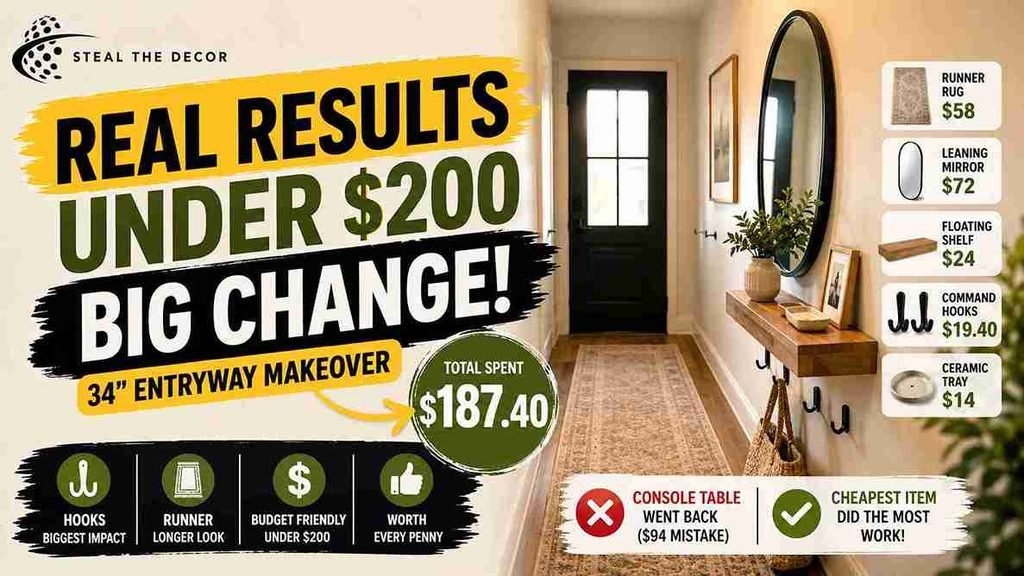
Total: $187.40, spread across six weeks.
The breakdown: runner rug $58, leaning mirror $72, floating shelf $24, Command hooks in two packs $19.40, ceramic tray $14. The plant and the frames I already owned.
What worked instantly? The hooks. Within a day the floor pile was gone, and the entryway feel changed more from that $19 than from anything else in the project. The runner came second — lengthwise, it made the hall read noticeably longer, and it covers the scuffed rental laminate I have been apologizing for since I moved in.
Two things failed. The console table went back, a $94 mistake I caught before it turned permanent. And that adhesive hook took a chip of paint when I repositioned it, which was partly my fault for pulling outward instead of stretching the tab straight down, and partly the fault of paint that was almost certainly too fresh. I bought a $6 touch-up bottle and wrote a note in my move-out folder.
What I would change: buy the mirror first. It did more for how airy the hallway feels than the shelf and the tray put together, and I wasted three weeks fussing with small decor before I got around to it.
Bottom line: under $200 and six weeks turned a corridor into an actual entrance, and the cheapest item did the most work.
Key Takeaways
- A narrow entryway is any entrance under roughly 40 inches deep, which leaves less than 12 inches of usable furniture depth once you subtract 30 inches of walking clearance.
- Command Utility Hooks by 3M are rated up to 15 pounds in the extra-large size and remove cleanly from cured painted drywall, making them the highest-impact damage-free upgrade for a small entryway.
- A floating shelf four to six inches deep replaces a slim console table for entryway use at roughly a third of the depth, and typically costs $18 to $40.
- A low-pile narrow hallway runner laid lengthwise makes a corridor read longer, while the same rug laid crosswise makes it read shorter.
- A leaning full-length mirror placed perpendicular to the nearest window bounces natural light down the hallway with zero wall damage and no weight risk.
- Plug-in wall sconces at 66 inches with warm 2700K bulbs solve narrow hallway lighting ideas for renters who cannot hardwire a light fixture.
- A complete renter-safe narrow entryway makeover, including rug, mirror, shelf, hooks, and tray, costs roughly $80 to $200 with no drilling and no paint.
One Last Thing
Six weeks and $187 later, what sticks with me is how much of this was subtraction rather than addition. The entryway never needed more furniture. It needed the floor cleared, the wall space used, and one mirror in the right spot. That is what makes a corridor feel spacious, and it is what turns a doorway into a great first impression.
So if you do two things off this whole list, hang the hooks and buy the runner. Under $100, and it fixes the part guests actually see.
Taking on the rest of the apartment next? Start with how to decorate a rental without damage — it is the deposit-safe groundwork everything here sits on.
Have you tried any of these narrow entryway ideas in your own rental? Tell me in the comments, especially the failures. Those are the ones that actually help everybody else.
FAQ: Narrow Entryway Ideas for Renters
How do you style a narrow entryway?
Style a narrow entryway by keeping everything under 12 inches deep and moving storage onto the wall. Add wall hooks at 60 inches, one slim shelf with a catch-all tray, a full-length mirror to bounce light, and a lengthwise runner rug. Stick to one floor-standing piece so the walkway stays clear.
How do you decorate a narrow entryway without a console table?
Replace the console with a floating shelf four to six inches deep, mounted at about 32 inches high. It holds keys, mail, and a small plant in a fraction of the depth. Add a wall basket underneath for everyday essentials, plus a hook rail above it for coats.
Should I put a rug in a narrow entryway?
Yes, though orientation matters more than the rug does. A low-pile runner laid lengthwise stretches the sightline and makes the hallway feel longer, while the same rug laid crosswise cuts the space in half. Leave four to six inches of bare floor on each side and pick a washable option.
What are the best colors for a narrow hallway?
Pale, cool-toned colors — soft white, greige, pale blue-grey — make a narrow hallway feel wider because they recede visually. Renters who cannot paint get the same effect from removable wallpaper on the end wall only, which adds depth without committing to a new color throughout.
How do you light a narrow hallway with no wiring?
Use plug-in wall sconces at roughly 66 inches high, one at each end, plus a battery-operated puck light near the floor. Choose warm bulbs around 2700K. Layering two or three sources at different heights kills the shadows that a single overhead fixture always creates in a corridor.
Do adhesive hooks leave damage on rental walls?
On smooth, cured painted drywall, quality adhesive hooks come off cleanly when you stretch the tab straight down instead of pulling outward. They can lift paint on freshly painted walls, matte finishes, or texture. Test one strip somewhere low-visibility and wait 24 hours before you mount anything else.
What do I do if an adhesive hook pulls paint off?
Clean the spot, let it dry, and touch it up with matched paint — most hardware stores will color-match from a chip. Note it in your move-out folder with a photo. Anything larger than a coin, tell your landlord early rather than at inspection.