
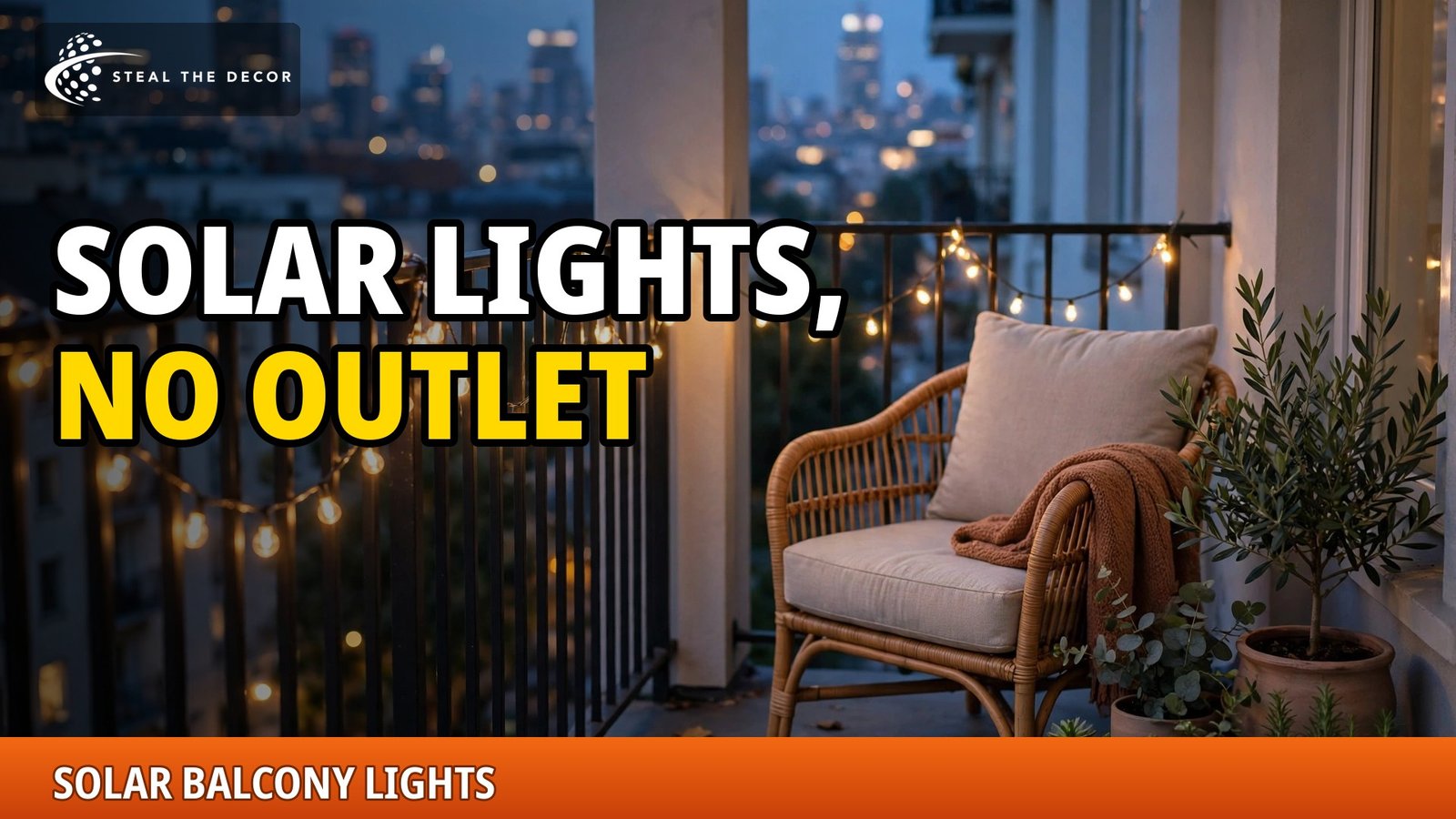
By day, a small balcony can be a pleasant room in a rental. A chair, a plant or two, a coffee in the morning sun. Then the sun goes down and the whole space goes dark. Many balconies have no outdoor outlet, so a plug-in light is not a simple fix, and running a cord through a door is unsafe.
Solar balcony lights solve the outlet problem, but only when the sun plan comes first. This guide to solar powered balcony lights covers five outdoor solar types for small balconies, how to judge sun, brightness, weather rating, and battery life, and how to hang everything without drilling. Every light here runs on outdoor solar power only.
Quick Answer: Check where a solar panel can sit in direct sun before you buy anything. Pick warm white lights near 2700K, start with one main type plus one low light, and hang them with railing clips or adhesive hooks. If your panel spot gets less than four hours of sun, choose a light with a detachable panel you can move into the sun.
Table of Contents
Heads up: some links in this post are Amazon affiliate links. As an Amazon Associate, StealTheDecor earns from qualifying purchases, at no extra cost to you.
Sun First: Will Solar Work on Your Balcony?
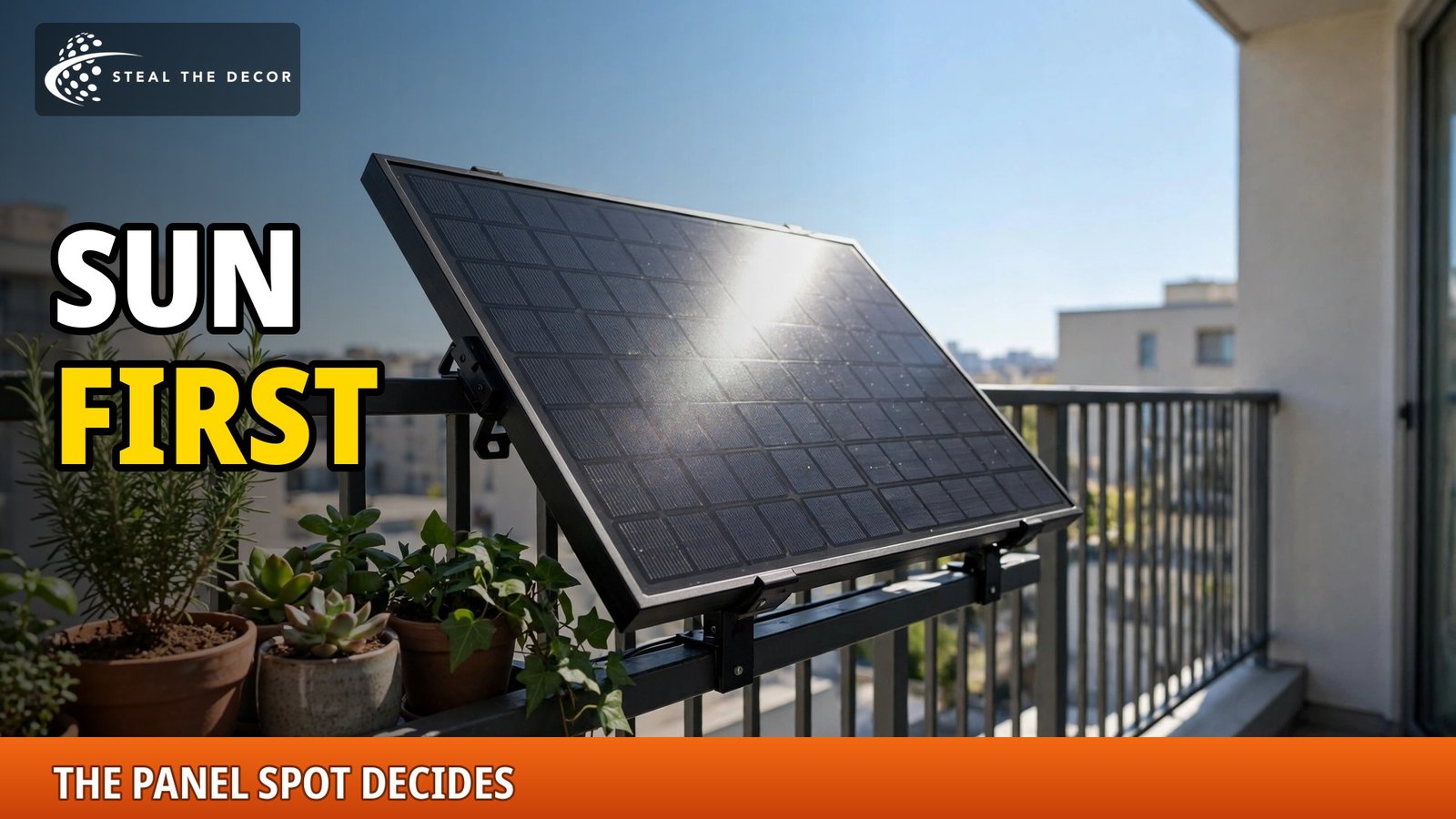
The panel decides everything. A solar light is really two products stuck together: a light and a small charger. If the charger sits in shade all day, the light will fade early no matter how good the bulbs are. Walk out at midday and again in late afternoon, and note which rail, wall, or floor corner actually catches sun, and for how long.
Most solar balcony lights need six to eight hours of direct sun for a full night of light. A balcony that gets four to six hours will still glow for the evening, just for fewer hours. A balcony that gets only one or two hours of weak light through a neighbouring building will disappoint, and no bulb type fixes that.
A detachable panel changes the maths. Some solar string lights let you unclip the panel and place it on a sunny rail or a plant stand while the lights hang in a shady corner. That one feature matters more on a rental balcony than any mode or remote control.
Winter charging drops everywhere. Shorter days, lower sun, and snow or dust on the panel all cut charging hours, so expect shorter runtime in December than in June.
| Your sun situation | Buy this | Skip this |
|---|---|---|
| Six or more hours of direct sun | Any solar type | Nothing |
| Three to five hours of sun | Lights with a detachable panel and a timer | Bright lights left on all night |
| Under three hours, heavy shade | One small lantern with a movable panel | A long string set |
One more check costs nothing: your lease rules. Most leases allow removable lights, but some buildings restrict anything fixed to railings or shared walls. Clips and adhesive hooks come off clean, which protects your deposit. If you are unsure, ask your building manager first.
5 Solar Balcony Lights at a Glance
| Type | Best balcony | Sun need | Honest drawback |
|---|---|---|---|
| Railing string lights | Any small balcony with a rail | Medium to high | Long strings fade early in shade |
| Hanging lanterns | Seating corners and small tables | Medium | One lantern lights a small area only |
| Clip-on motion lights | Doors, steps, and dark corners | Medium to high | Motion mode can annoy neighbours |
| Solar wall sconces | Narrow balconies with a wall | Medium | Adhesive mounts need a clean wall |
| Solar curtain lights | Balconies with a wall or ceiling line | Medium to high | Full walls need more sun |
The 5 Types of Solar Balcony Lights, Honestly Compared
1. Railing Solar String Lights
Solar string lights are the default for a reason. A single strand along a railing turns a dark balcony into a usable evening room, with no wiring and no power bill. Warm white bulbs near 2700K read as candlelight rather than office light. Look for shatterproof bulbs if wind knocks things around, and a timer or remote control so the lights switch off on their own.
The honest drawback is length. A long string needs a bigger panel and more sun than a short one, so a 100-foot set on a shaded balcony will fade before midnight. Measure your railing first, add about ten percent extra for sag, and buy the length that fits that rail. A good railing set with a detachable solar panel is a solid first buy.
2. Hanging Solar Lanterns
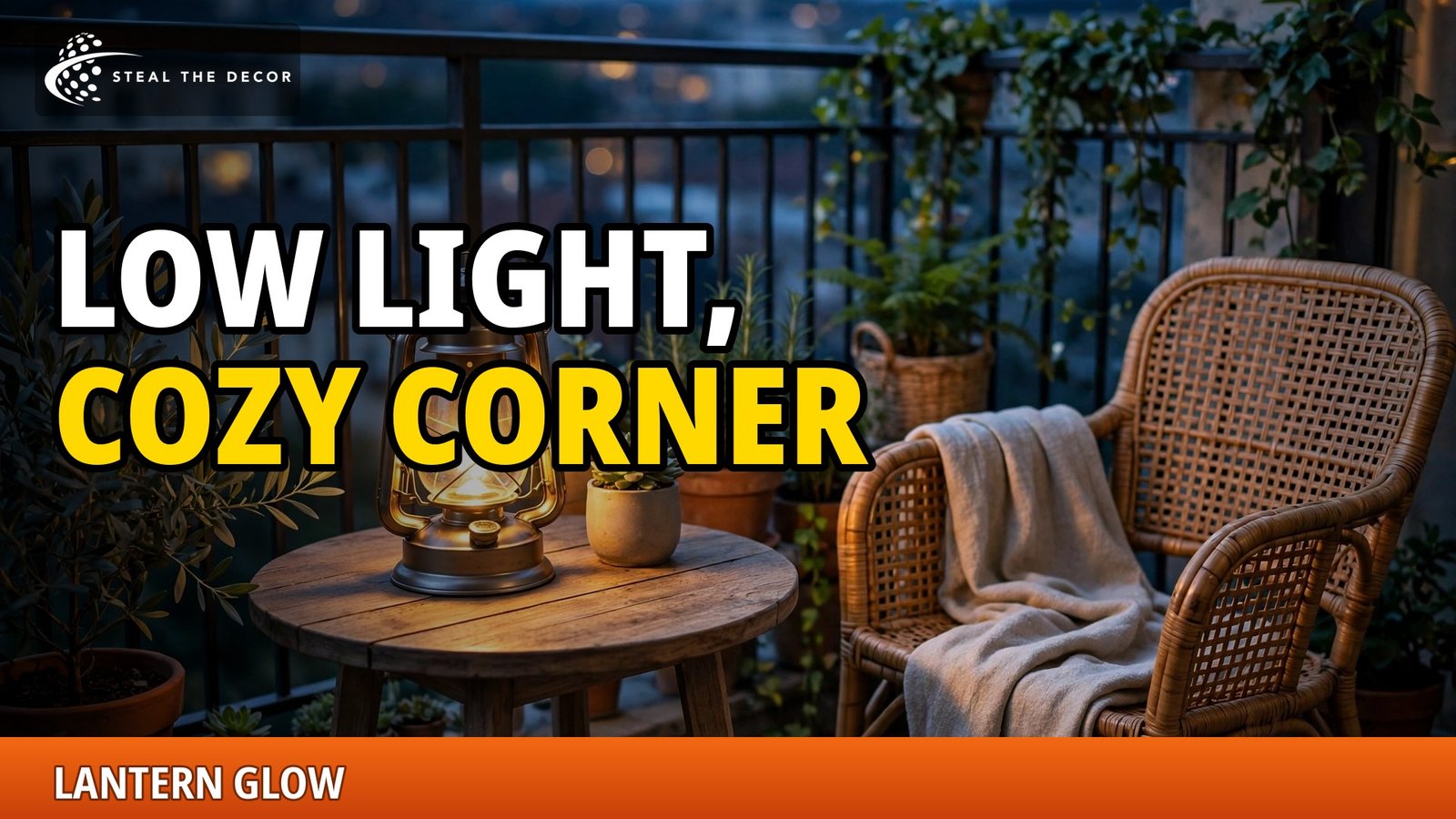
A solar lantern gives low, soft light where you sit, which is exactly what a string overhead cannot do alone. Hang one from a hook or set it on a small table, and the seating corner stops feeling like a corridor. Solar lanterns also work as decor, so they look good in daylight too. Many list an IP65 rating, which means dust-tight and protected against water jets, so rain is not a problem.
The drawback is coverage. One lantern will not light a whole balcony, and two or three small ones beat one large one for even light. Listings that promise up to nine hours after six hours of charging describe a full-sun day, not a cloudy one. A hanging lantern with its own panel is easy to live with.
3. Clip-On Motion Sensor Lights
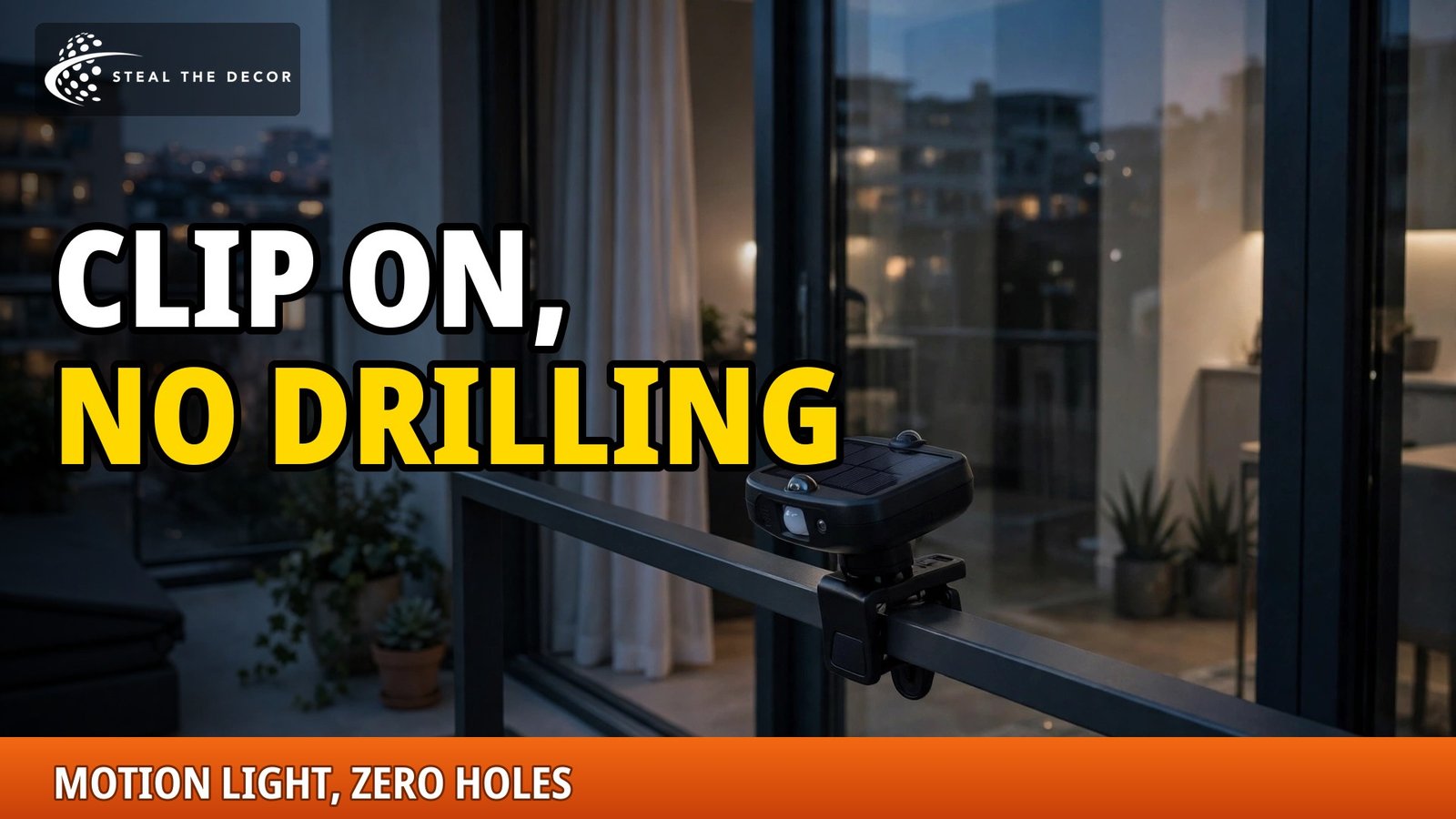
Clip-on lights solve a different job: safety and wayfinding. A motion sensor light clipped to a railing near the balcony door switches on when you step out, so you are not fumbling for a key in the dark. Maker listings describe three modes: always on at low brightness, dim standby that jumps to full brightness on motion, and off until triggered.
The drawback is neighbours. A bright motion light that fires at every passing cat will annoy the people next door and waste the battery. Use the dim standby mode or the off-until-triggered mode, and aim the sensor at your own door, not at the shared walkway. A clip-on light needs no drilling at all.
4. Solar Wall Sconces on Adhesive or Clip Mounts
A solar wall sconce hugs the wall and throws light down or out, which suits a narrow balcony where a string would hang in your face. These lights work well beside a door or over a small seating nook, and they read as a finished fixture rather than a temporary string. Solar exterior lights like these often list a dusk to dawn sensor, so they switch on by themselves at night.
The drawback is the mount. Adhesive mounts need a clean, dry, flat wall, and textured render or peeling paint will defeat them. Test one mount in a hidden spot first, and give the adhesive a full day before you hang the light. If your wall is rough, a railing clip mount or a freestanding lantern is a better bet. A slim solar sconce suits tight spaces, but most sconces ship with screw mounts, so check your lease or ask your landlord before you fix one to the wall.
5. Solar Curtain Lights
Solar curtain lights hang in vertical drops from a top line, so a plain balcony wall becomes a wall of light. They suit renters who want drama without furniture changes, and they pair well with plants: light behind leaves at night looks far better than light on a bare wall. A dimmer helps, since a full wall at full brightness can feel like a shop window.
The drawback is sun appetite. A curtain set has many more bulbs than a single string, so it needs a strong panel and a good sun spot. On a shaded balcony, run a shorter curtain rather than the full width. A curtain set with a remote also doubles as solar powered Christmas decor in winter, so one set can do two jobs if you store it dry between seasons.
Across all five types, one comparison helps. While shopping you will also see garden solar lights, deck solar lights, solar pathway lights, and solar window lights. Most share the same panel, battery, and LED parts as balcony lights, and the real difference is bulb spacing and the mount. A balcony needs rail, wall, hook, or table mounts, so stakes and post caps are out.
Judge each light by panel size, battery type, and mount, and the marketing fades away. A monocrystalline panel charges faster in weak light than a cheaper panel of the same size, which matters on a shaded balcony. That is also why solar lights for yard use and solar garden stakes do not belong on a balcony list: stakes need soil, and a balcony has none. Whatever you buy, wipe the panel once a week and aim the light down into your own space to avoid neighbour glare.
How to Hang Solar Balcony Lights Without Drilling in 8 Steps
Start with the sun spot, not the lights.
- Measure the run. Measure the railing or wall line, add ten percent for sag, and write it down before you shop.
- Find the panel spot. Pick the sunniest rail, wall, or plant stand, checked at midday and late afternoon. The panel lives there, even if the lights hang elsewhere.
- Clean the mounting points. Wipe the rail or wall with a damp cloth and let it dry. Dust is the main reason adhesive hooks fail.
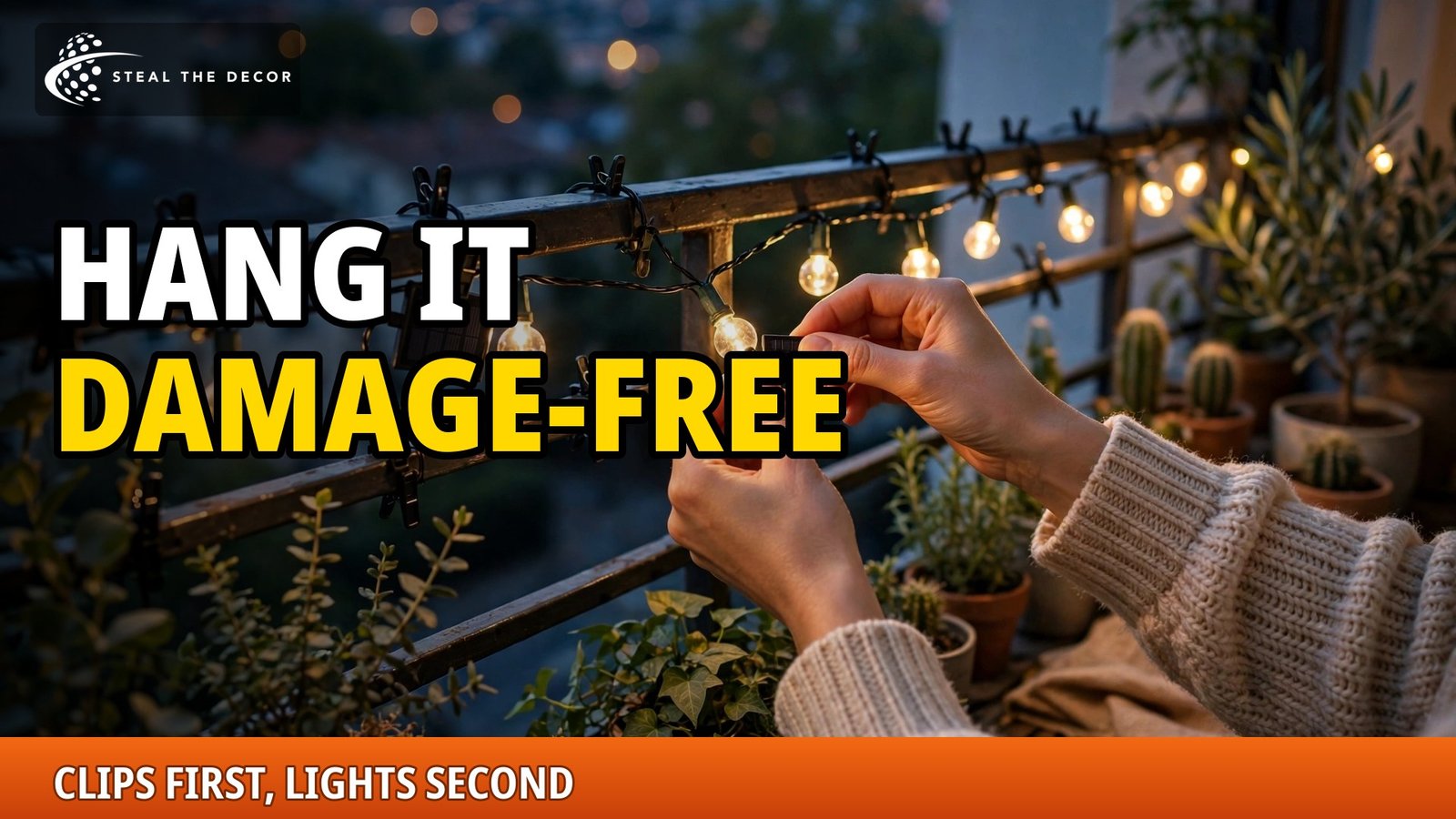
- Place clips or hooks first. Space railing clips or adhesive hooks evenly, and test one hook with a gentle pull first. This is the same idea as learning to hang plants without drilling: the mount goes up before the weight does.
- Wait for adhesive to set. If you used adhesive hooks, wait at least a day before hanging lights on them.
- Hang with slack. Drape strings with a soft sag, not pulled tight. Tight strings snap in wind and pull hooks off.
- Place the panel and switch on. Set the panel at an angle to the sun, switch on, and charge for a full sunny day before judging it. Remove any protective film first.
- Test at dusk. Watch the lights come on, check the glow from your chair, and adjust the panel angle or sensor mode.
Removal is part of the plan, not an afterthought. Peel adhesive strips slowly, straight along the wall, and photograph the wall before and after for your move-out file. Bring lights inside during severe storms, since wind does more damage than rain. A suction cup mount suits glass doors, but check it weekly, since heat and cold loosen suction.
Brightness, Weather, and Battery: Read the Specs Like This
Lumens tell you brightness, but a small balcony needs less than a yard does. A seating corner glows nicely at low lumens, while a clip-on security light lists far more, around 600 lumens on some maker pages, because it must throw light across a wide area. More lumens are not better on a balcony: they cause glare, spill into neighbours’ windows, and drain the battery faster.
Color temperature is the second number that matters. Warm white near 2700K looks like evening light. Cooler whites near 4000K and above look clinical outdoors and clash with wood, plants, and warm cushions. If a listing gives no color temperature, look for the words warm white in the title or spec sheet.
Weather rating comes next. IP65 means the unit is dust-tight and protected against water jets from any direction, which covers rain and garden hoses. It does not mean the light can sit underwater, and it says nothing about wind. A light that survives rain can still blow off a railing, so the mount matters as much as the rating. UV fade is the slow enemy: cheap plastic yellows and cracks after a season or two in strong sun.
Battery chemistry decides lifespan. Budget lights often use nickel-based cells that fade after one to three years, while lithium-ion cells last longer and hold voltage steadier through the night. Industry estimates put budget lights at two to three years and mid-range lights at five to ten years, with the battery failing first in most cases. A light with a replaceable rechargeable battery is worth paying a little more for, since a fresh battery can double the useful life of a good panel and housing.
The same no-outlet thinking applies indoors too, and our guide on how to light a dark room with no outlets covers battery options for inside the flat. Inside, a battery-operated under-cabinet lighting strip can do for a kitchen what a solar lantern does for a balcony. When cords appear, our notes on how to hide lamp cords keep the run tidy. For textured walls, check command hooks for textured walls before trusting a plain adhesive hook.
Solar Balcony Lights Mistakes That Waste the Sun
The most common mistake is buying the lights first and finding the sun spot second. A beautiful string set in a shaded corner will always disappoint, while a modest set on a sunny rail will glow every night. Chasing brightness is the second mistake: a balcony lit like a car park ruins the mood and the battery.
Two more mistakes are easy to avoid. Aiming lights outward annoys neighbours and wastes light on the street, so aim them down. Leaving panels dirty through pollen season cuts charging for no reason.
Frequently Asked Questions
Where can you buy solar balcony lights?
Most big online retailers, home improvement stores, and garden centres stock them. Buy from a seller that lists the panel type, battery type, IP rating, and runtime in plain numbers. A listing that hides those specs is a warning sign, not a bargain.
Are outdoor solar lights any good?
Yes, when the sun spot and the job match. Solar lights glow well for evening seating and doorways on a balcony with decent sun. They are poor task lights for reading fine print all night, and they fade early in deep shade. Judge them as evening mood and safety lights, not as replacements for mains lighting.
What are the best solar lights for a balcony?
Start with a warm white railing string set with a detachable panel, plus one low lantern for the seating corner. That pair covers high and low light and needs only clips and hooks. Add a clip-on motion light only if your door area stays dark.
What are the brightest solar outdoor lights, and do you need them on a balcony?
The brightest outdoor solar lights are usually motion spotlights listing several hundred lumens, built for yards and driveways. You do not need that level on a small balcony, where it causes glare and neighbour complaints. A modest string set and one lantern give a better evening.
Are solar outdoor lights worth it for a renter?
Yes, for most renters, because there is no wiring, no electrician, and nothing fixed to damage. Clips and adhesive hooks remove cleanly, and the lights move with you to the next flat. The value drops only if your balcony gets almost no sun or your building bans railing attachments.
Do solar balcony lights work without direct sun or in winter?
They work weakly without direct sun, since panels charge on daylight but far slower in shade. In winter, shorter days and lower sun cut runtime, and snow or dust on the panel cuts it further. A detachable panel in the best sun spot, plus a timer, gives the best winter result.
How do you hang solar lights on a balcony without drilling?
Use railing clips for strings, adhesive hooks for walls, and suction cups for glass, and hang nothing heavier than the mount is rated for. Clean each mounting point, wait a day for adhesive to set, and drape strings with slack.
Key Takeaways on Solar Balcony Lights
- Check the panel sun spot before you buy, since sun hours decide runtime.
- Warm white near 2700K suits a balcony evening, while cool white looks harsh and clinical outdoors.
- One railing string plus one low lantern beats a single bright spotlight on a small balcony.
- IP65 covers rain, but the mount must also survive wind, so use clips and hooks rated for outdoor use.
- A replaceable battery can double a good light’s life, since the battery usually fails first.
The Evening Balcony, Without an Outlet
Good solar balcony lights turn a dark balcony into one that gets used every evening. Start with the sun check, pick one main solar type that fits your rail or wall, and add a low lantern for the chair. Keep the light warm and aimed at your own space.
If your balcony has almost no sun, do not force a solar set to do a job it cannot do. A battery light inside the flat or a clip-on light with a movable panel will serve you better than a long string fading by nine. Which of these five types fits your balcony sun best?