Table of Contents
I stared at the blank beige wall in my apartment for six months. Six. Months. Every morning, I’d sip my coffee, glance at that sad, space above my couch, and feel this low-grade annoyance I couldn’t shake. The lease said “no paint.” The landlord said, “No permanent changes.” I almost gave up and hung a tapestry as I did in college. Then my friend Jenna mentioned she’d covered her entire studio wall with something called a removable Boho mural. I’d never heard the term before. She showed me a photo on her phone this intricate, sun-faded terracotta mandala sprawling across her accent wall like it had always been there.
It looked painted. Hand-drawn, even. When she said she could peel it off in twenty minutes flat when her lease ended, I ordered my first one that same night. What followed was a journey involving one ruined mural, two arguments with a hairdryer, and a $47 mistake I still think about. I tested six different murals across my apartment over eight months. Some transformed my space. One almost cost me my security deposit. Here’s everything I learned the good, the messy, and the “meh.”
What Is a Removable Boho Mural, Really?
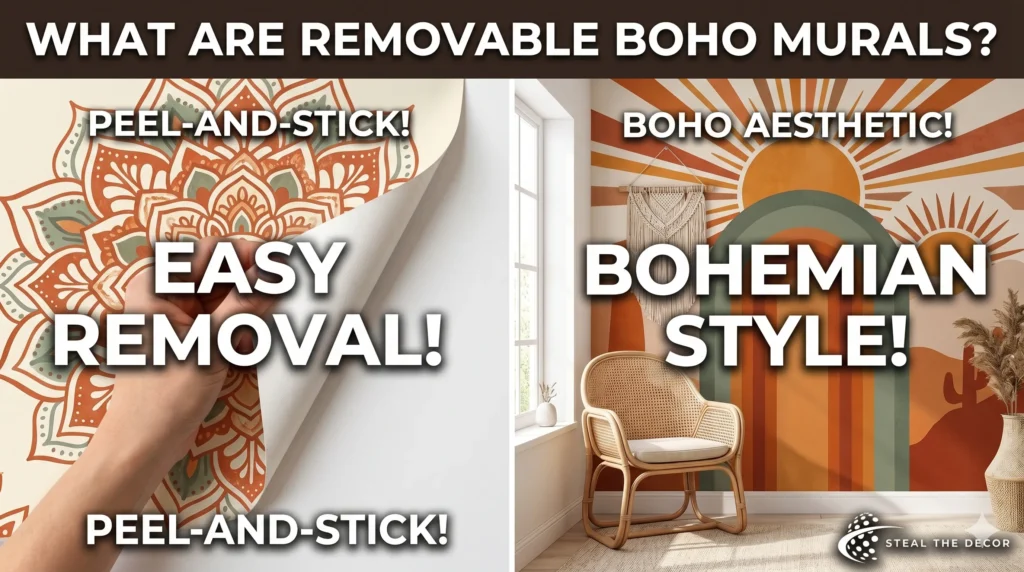
A removable Boho mural is a large-scale wall covering designed with bohemian-inspired patterns think mandalas, desert arches, macrame textures, tribal motifs, sunbursts that adheres to your wall without permanent adhesive. Unlike traditional wallpaper, it peels off cleanly when you’re ready for a change. The “boho” part refers to the aesthetic: layered, earthy, often hand-drawn or vintage-looking designs that pull from Moroccan, Southwestern, and eclectic influences. Most are made from a woven polyester fabric with a low-tack adhesive backing. The material feels closer to a thick matte sticker than actual paper.
These murals sit somewhere between wall decals and full wallpaper. They’re bigger than a decal often covering 4 to 8 feet across but smaller and more targeted than full-room wallpaper. You’re usually buying a single focal panel, sometimes two, meant for an accent wall behind a bed, a couch, or a reading nook. The removable aspect is the real selling point for people like me who rent and can’t commit to anything that requires a steamer and three hours of scraping.
How It’s Different from Peel-and-Stick Wallpaper
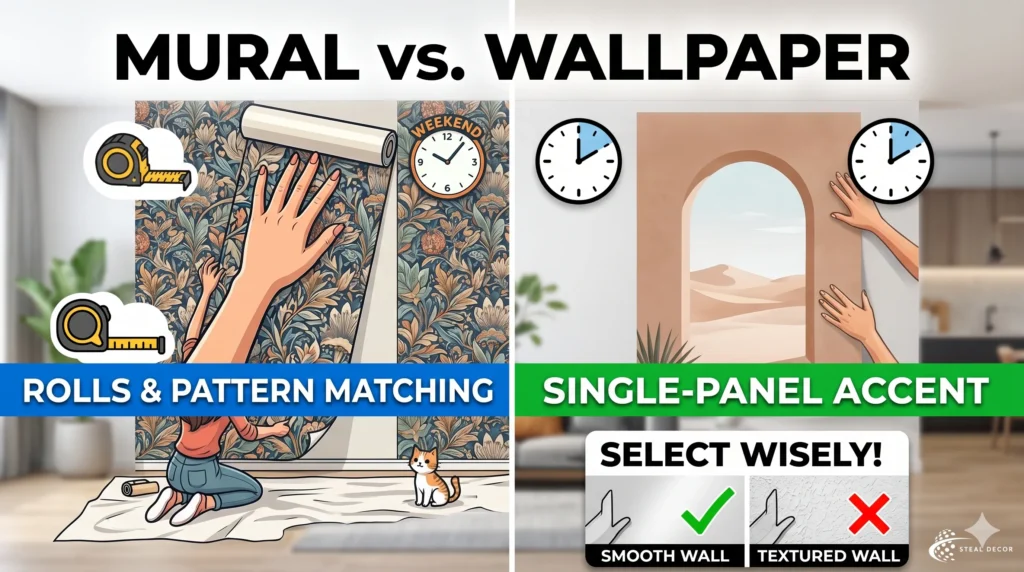
Peel-and-stick wallpaper usually comes in rolls you cut and match like traditional wallpaper, covering entire walls. A boho mural is typically a single scene or pattern no pattern matching, no cutting strips. You just align it and press. The mural format means you’re decorating one wall, not a whole room. Installation takes an hour, not a weekend. That distinction matters when you’re working alone in a 600-square-foot apartment with uneven baseboards and a cat walking across your drop cloth.
Who Should (and Shouldn’t) Buy One
If you rent, you should consider one. If you own but hate commitment, same thing. If your walls are heavily textured think thick knockdown or popcorn skip it. I’ll explain why later, but the short version is: adhesion fails, and you’ll blame yourself. Also, if you’re looking for a pristine, seamless finish with invisible edges, removable murals might annoy you. The seams are subtle, but they exist. I noticed them. My guests didn’t.
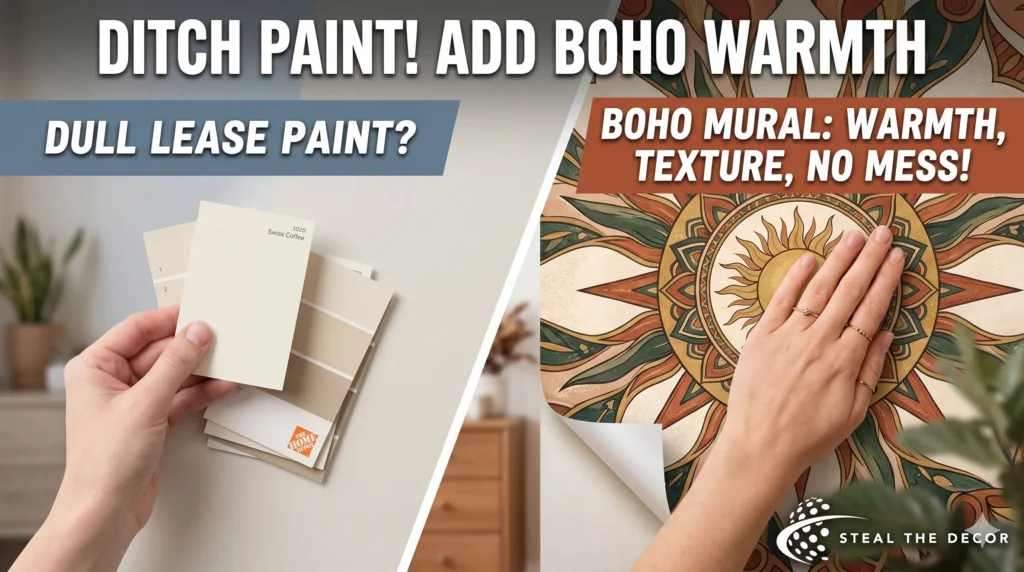
Why I Switched from Paint to Removable Boho Murals
I moved into my current apartment in Portland two years ago. The walls were painted “Swiss Coffee,” which sounds charming but is really just beige with a PR team. I wanted warmth. Texture. Something that made the space feel collected rather than leased. Paint seemed like the obvious answer. I even bought paint swatches from Home Depot last spring. But my lease explicitly banned painting, and honestly, the thought of repainting everything back to beige when I moved out exhausted me before I’d even started.
Then I discovered boho wall decor removable options while scrolling late one night. The idea of temporary wallpaper that doesn’t destroy walls sounded almost too good. I started with a small boho mandala wall decal from Etsy just to test the concept. It was $22 and the size of a large poster. When it arrived, I stuck it above my dresser in twenty minutes. No bubbles. No swearing. It stayed put for three months and peeled off like a Post-it. That small decal convinced me to go bigger. Much bigger.
The $47 Mistake I Made with My First Mural
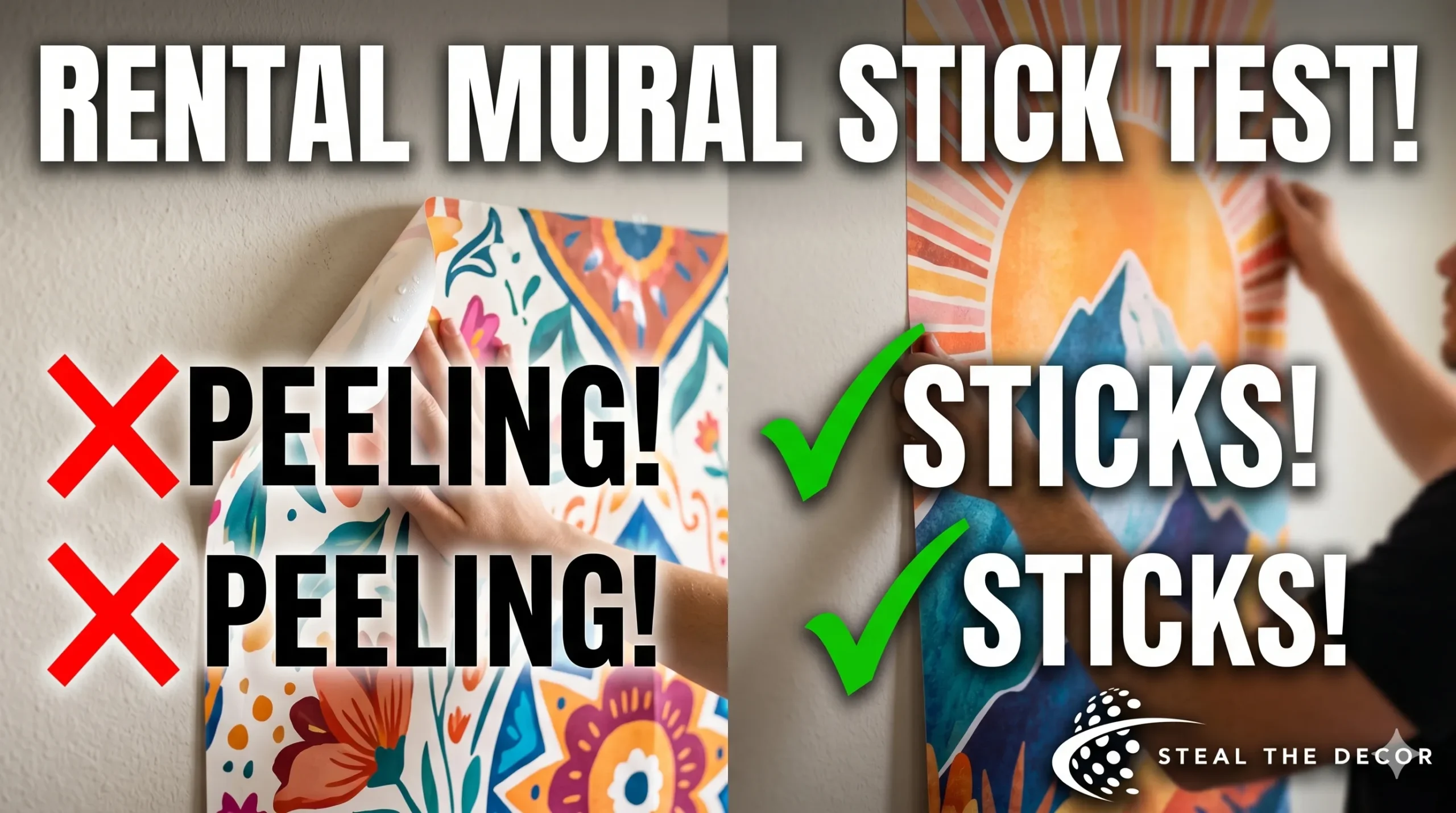
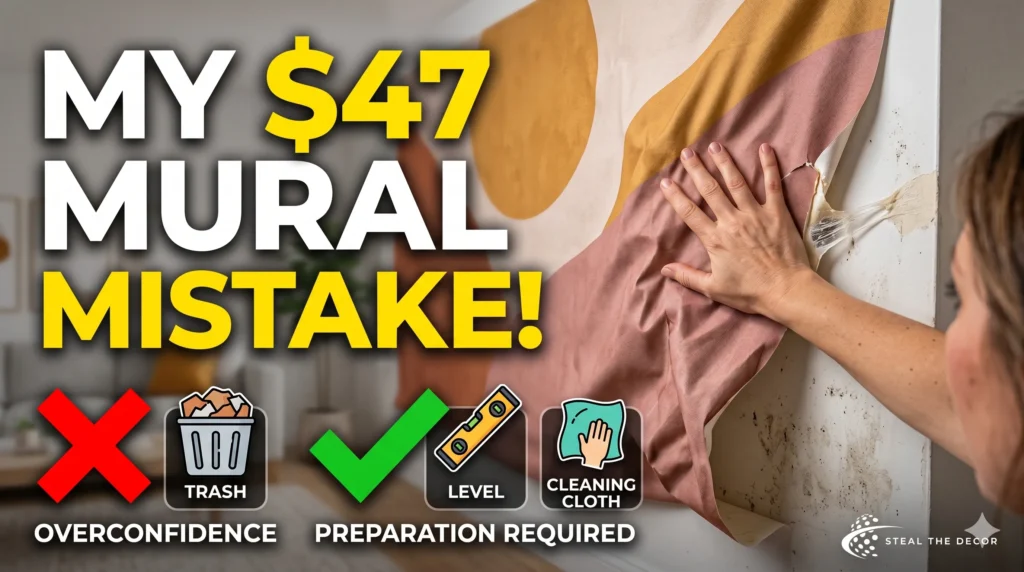
Let me tell you about my first mural purchase. I was overconfident. I’d watched one YouTube tutorial and decided I was an expert. I ordered a vintage boho peel-and-stick mural from Amazon a $47 sunburst design in ochre and dusty rose. The package arrived, I unrolled it, and immediately started sticking it to my living room wall without measuring. I didn’t clean the wall first. I didn’t mark any guidelines. I just peeled the backing and went for it.
Within three minutes, the mural was crooked. Not slightly crooked visibly, aggressively crooked. The bottom edge sloped downward like a tired smile. I tried to peel it back to reposition, but the adhesive stretched and the fabric warped. By the time I got it off the wall, the top corner had torn. That mural went into the trash, and I sat on my floor eating stale Cheez-Its questioning every decision that led me there. The lesson: preparation isn’t optional. You need a clean wall, a level, and patience. I’ll walk you through the right method later, but know that my $47 mistake is the reason you don’t have to make yours.
6 Removable Boho Murals I Tested Honest Reviews
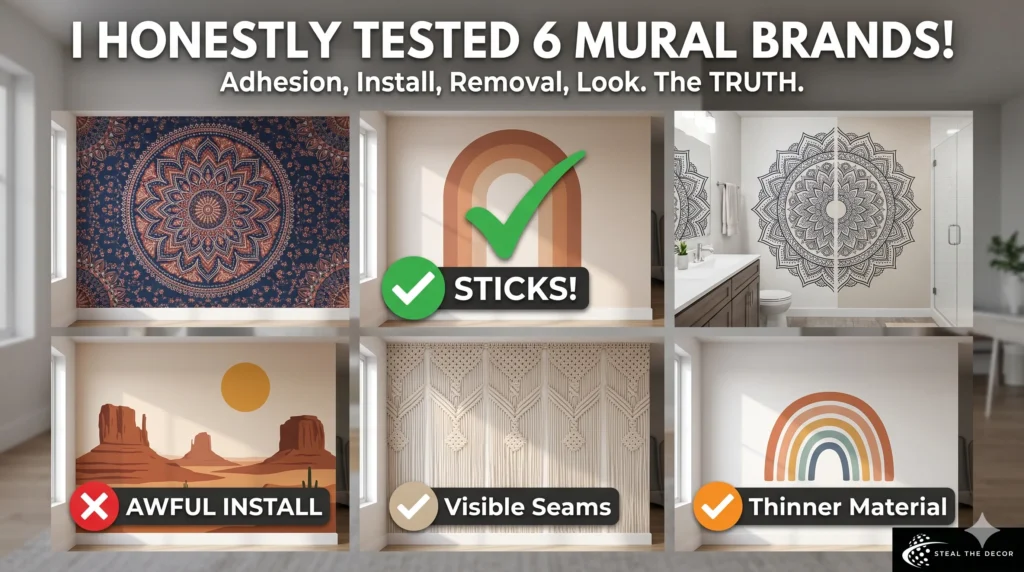
Over the last eight months, I tested six different murals in my apartment. Some went on my bedroom accent wall. Others went behind my desk. One went in my tiny bathroom just to see how it handled humidity. I noted adhesion, ease of install, removal experience, and how each one actually looked in natural light. None of these brands paid me. I bought every single one with my own money.
RoomMates Decor Bohemian Medallion $39.99 at Amazon
This was my redemption purchase after the sunburst disaster. The Roommates Bohemian Medallion comes as a single 6-foot panel featuring an intricate navy and terracotta mandala. I installed it behind my bed, and it took roughly forty minutes solo. The adhesive felt forgiving I could reposition it twice without stretching. What I love: the print quality is sharp, almost screen-printed in appearance. What I don’t love: the edges started lifting slightly after five months near the baseboard. I fixed it with a hairdryer and firm pressure, but it’s worth noting. For $40, though, this is a strong entry point. If you’re browsing boho peel and stick wallpaper on Amazon, this one shows up everywhere for a reason.
MuralsWallpaper Custom Boho Arch $67 at Etsy
This Etsy shop lets you customize the size and colors of a boho arch design a semicircle pattern with layered geometric shapes in desert tones. I ordered mine in 6-foot width with rust, sand, and cream tones. Cost was $67 with free shipping. Installation was trickier because the arch shape needs perfect vertical alignment. I had to use painter’s tape to outline placement first. The material felt thicker than the Roommates mural more like woven canvas. Six months later, it hasn’t budged. No peeling edges. No bubbling. It genuinely looks like I hired someone to paint it. Cons: turnaround time was twelve days, and if you mess up installation, there’s no cheap replacement.
Rocky Mountain Decals Mandala Mural $44.99 at Amazon
This mandala mural from Rocky Mountain Decals is split into two panels that join in the center to form one large design. The seam is intentional it runs down the middle of the mandala and when aligned correctly, it’s nearly invisible. I installed this one in my small bathroom, which was a gamble. Bathrooms get steamy. I waited two weeks before reporting back. So far, no peeling. The adhesive held through multiple hot showers. The design is less intricate than the Roommates one simpler linework, fewer colors but that actually worked better in a small space. My complaint: the installation instructions were confusing. I had to email customer service for clarification. They replied within a day, which was decent.
WallsNeedLove Desert Sun Boho Mural $58
This was the most expensive of the six, and I had high expectations. The design is a soft desert landscape layered mesas, a setting sun, muted pinks and burnt oranges that stretches 7 feet across. It’s gorgeous. Truly. Installation, however, was awful. The adhesive is aggressive. Once it touches the wall, it’s staying there. I couldn’t reposition even slightly without risking a tear.
My alignment was off by maybe half an inch, and I just had to live with it. The finished look is beautiful, but the stress of installing it knocked a point off for me. If you’re experienced with self-adhesive boho mural installation, you might be fine. If you’re a beginner, maybe save this one for your second or third project.
SimpleShapes Macrame Pattern Wall Decal $32 at Etsy
Okay, this one was a surprise. I ordered it on a whim because the macrame pattern looked unique lots of textured, knotted visual lines in cream and charcoal. At $32, it was the cheapest of the six. It arrived in three panels with a matte finish. The adhesive was medium-tack not too sticky, not too loose. Installation took under thirty minutes. The result exceeded my expectations. The pattern catches shadows beautifully in afternoon light. My honest complaint: the seams between the three panels are more visible than I’d like, especially from an angle. Straight-on, they disappear. From the side, you can see faint lines. For $32, I’m not mad about it.
Target’s Pillowfort Boho Rainbow Mural $29.99 at Target
I hesitated to include this because Pillowfort is technically a kids’ line, but the boho rainbow mural in terracotta and cream looked surprisingly elevated in the product photos. At $29.99, I figured it was low risk. It’s smaller only about 4 feet wide and designed for a nursery or kid’s room. I installed it above my desk. Honestly? It’s fine. The colors are nice. The adhesive is light.
But the material feels thinner than everything else I tested, and it shows every wall imperfection underneath. If your wall texture is perfectly smooth, you might get away with it. My walls have a slight orange peel texture, and it was visible through the mural. Not a dealbreaker, but noticeable. This falls firmly in the “meh” category for me I didn’t return it, but I wouldn’t buy it again.
How to Apply a Removable Boho Mural Without Losing Your Mind
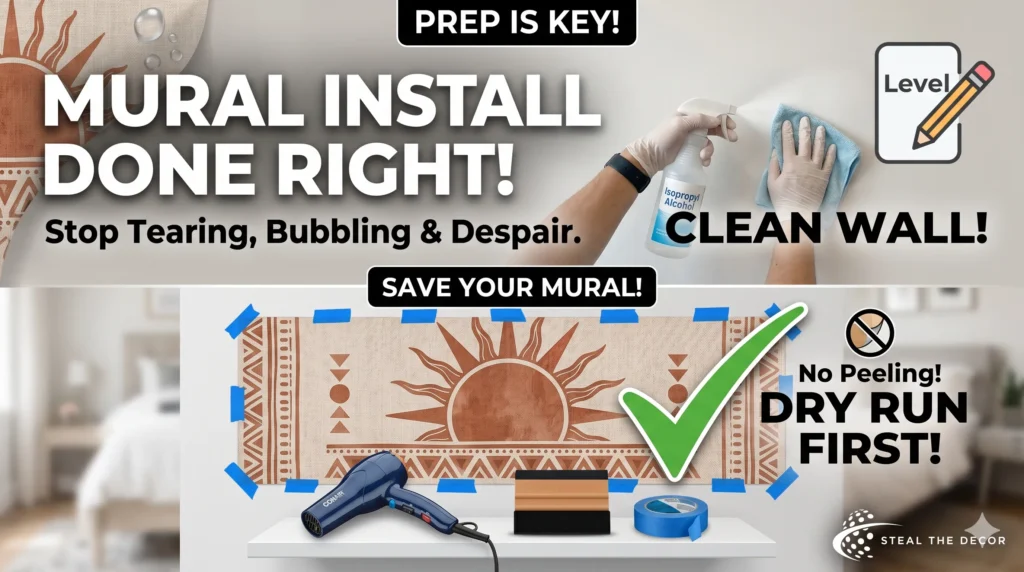
Here’s the method I settled on after my $47 disaster. It works. I’ve installed six murals using these exact steps, and the last four went up without any bubbling, tearing, or existential despair. First, accept that you need about ninety minutes for a standard 6-foot mural if you’re working alone. Second, accept that prep work matters more than the actual sticking.
Clean your wall with isopropyl alcohol or a mild soap solution, then let it dry completely. Any dust, grease, or moisture will compromise adhesion. Grab a level and a pencil. Lightly mark the top edge where you want your mural to sit. Use painter’s tape to do a dry positioning tape the mural to the wall without removing any backing. Step back. Look at it from multiple angles. Adjust until it’s perfect. Only then do you start peeling.
Tools You’ll Actually Need
Forget the little plastic squeegee most kits include. It’s useless on larger murals. What you actually need: a felt-edged squeegee (or a clean microfiber cloth wrapped around a credit card), painter’s tape, a level, a sharp utility knife for trimming edges, and a hairdryer. The hairdryer is non-negotiable. When edges lift or you need to reposition a corner, low heat reactivates the adhesive. I found my Conair dryer on Amazon for $22, and it’s rescued two murals from the trash. Also, if you’re installing on an apartment safe wall mural surface like flat drywall, results will be better.
The Dry Run Trick That Saved My Second Attempt
After my first mural failure, I started doing a full “dry run” with painter’s tape before peeling any backing. Tape the entire mural up. Walk around the room. View it from the doorway, from your bed, from the corner where you charge your phone. A mural that looks centered when you’re standing directly in front of it might look completely off from the actual sightlines in your room. I discovered my bedroom mural needed to shift three inches left because of how the doorframe frames the wall. I never would’ve caught that without the dry run. Three inches might not sound like much, but it was the difference between “that looks nice” and “did you hire someone?”
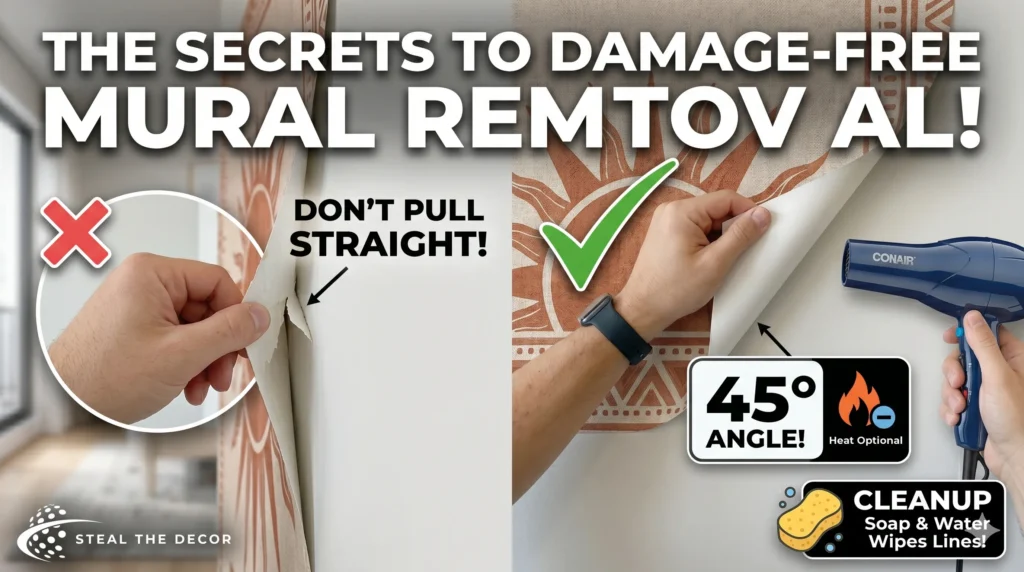
How to Remove It Cleanly What Instructions Don’t Tell You
Most removable mural instructions say “peel slowly from the corner.” That’s the entire removal guide. In reality, removal depends heavily on how long the mural has been up, your wall paint type, and the adhesive formulation. I removed two of my test murals specifically to understand this process.
The RoomMates mural came off cleanly in one piece after four months. No residue. No paint lifting. The Rocky Mountain Decals mural required more patience it had been up longer in a bathroom with humidity, and the adhesive felt stickier. I used low heat from my hairdryer and peeled at a 45-degree angle. That angle matters. Pulling straight outward can stress the paint.
Pulling too flat against the wall can tear the mural. At 45 degrees, the adhesive releases most evenly. It took twenty-five minutes for the full removal. No wall damage on either, but I could see faint adhesive lines where the edges had been. A gentle wipe with warm water and mild soap removed them in under a minute.
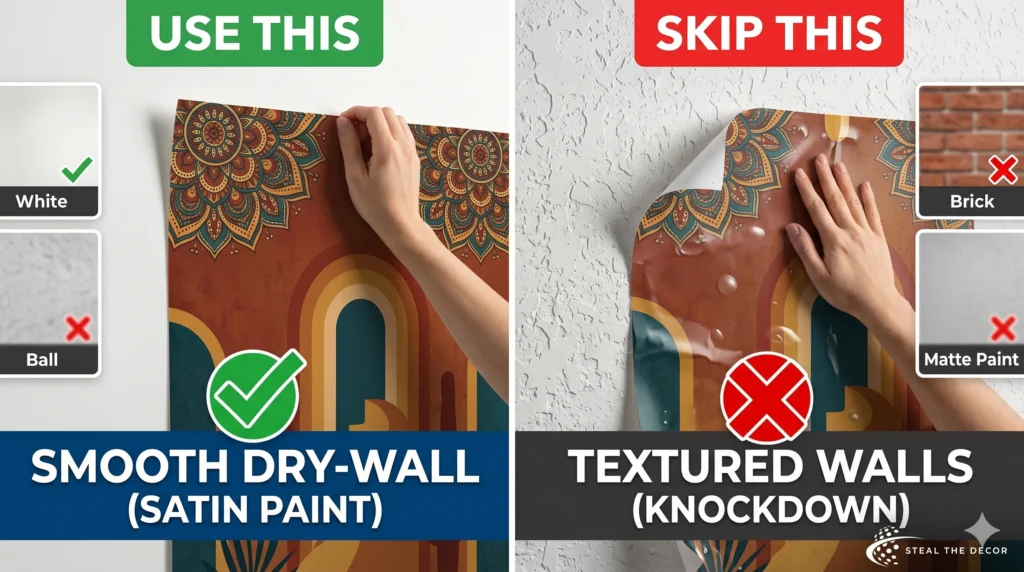
Best Wall Types for Removable Murals (and Walls to Skip)
Flat, smooth drywall with semi-gloss or satin paint is ideal. The smoother the surface, the better the adhesion and the cleaner the removal. My bedroom walls have an eggshell finish, and every mural adhered well. Matte paint is trickier the adhesive can bond too aggressively and pull up paint upon removal. I haven’t personally had this happen, but multiple Etsy sellers warn against it in their product descriptions.
Textured walls are where things fall apart. I mentioned my bathroom has a slight orange peel texture. Some murals handled it fine (Rocky Mountain Decals), others didn’t (Target’s Pillowfort). Heavy knockdown texture or popcorn walls are a hard no. The adhesive can’t make consistent contact across the peaks and valleys, and you’ll end up with bubbling, lifting edges, and frustration. If your rental has textured walls, consider large boho wall art decal options instead smaller decals have less surface area to fail. Brick and unpainted drywall are also problematic. Brick is too porous and uneven. Unpainted drywall absorbs adhesive inconsistently.
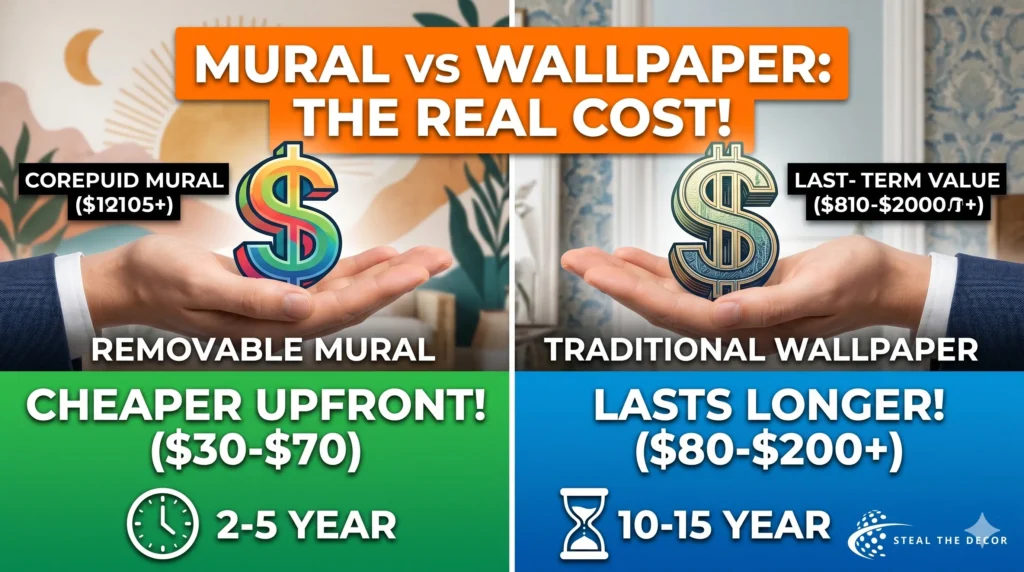
Removable Boho Murals vs. Traditional Wallpaper Real Cost Breakdown
Let’s talk numbers. A single 6-foot removable mural costs between $30 and $70 on average. Traditional wallpaper for one accent wall runs $80 to $200 including paste, tools, and professional installation if you go that route. Removable murals don’t require paste, priming, or professional help. That’s the financial advantage.
However, traditional wallpaper lasts ten to fifteen years. A removable mural lasts roughly two to five years depending on humidity and sun exposure before edges start lifting or colors fade slightly. I compared my removable mural vs traditional wallpaper cost across all six tests and found the removable route was about 60% cheaper upfront but won’t last as long. For renters who move every two to three years, that math works. For homeowners planning to stay long-term, traditional might make more sense. I also looked at how long does removable wallpaper last and found my murals showed their first signs of wear around the five-month mark, though none fully failed within my testing period.

Where to Buy Removable Boho Murals in the US
I sourced all six test murals from four places: Amazon, Etsy, WallsNeedLove, and Target. Amazon has the largest selection of removable wallpaper for renters and peel-and-stick boho wallpaper options, plus fast Prime shipping and easy returns. Etsy wins for uniqueness you’ll find custom sizing, indie designers, and patterns no one else has. Prices run slightly higher, but the quality felt more curated. WallsNeedLove specializes in removable murals, specifically, not just wallpaper.
Their designs skew more artistic, less mass-market. Target carries limited but affordable options, mainly through Pillowfort and Opalhouse. Walmart also stocks Southwest boho wall covering styles online, though I haven’t personally tested those. If you’re hunting boho mural ideas for bedroom inspiration, Instagram and Pinterest are useful for seeing installations in real spaces with natural lighting.
Frequently Asked Questions
Do removable wall murals damage walls?
If your wall paint is in good condition and you remove the mural correctly slow peel at a 45-degree angle with low heat if needed it shouldn’t damage the wall. Flat or matte paint poses more risk because the adhesive bonds more tightly. I removed two murals from eggshell-finished walls and had zero issues. Test a small corner first if you’re unsure.
How long do removable murals last?
Most removable murals last between two and five years. In my testing, the earliest wear sign slight edge lifting appeared around five months on one mural in a humid bathroom. The one in my dry bedroom still looks new after eight months. Sun exposure can fade colors over time, so if your accent wall gets direct afternoon light, expect some gradual softening of the tones.
Can you put removable wallpaper on textured walls?
Light orange peel texture can work, but results vary by product. My Rocky Mountain Decals mural handled it fine. The thinner Target mural showed the texture through the material. Heavy knockdown, popcorn, or skip-trowel textures won’t allow the adhesive to make full contact. If your walls are textured, stick to small bohemian wall decals rather than full murals.
What is the difference between peel-and-stick wallpaper and removable murals?
Peel-and-stick wallpaper comes in rolls meant to cover entire walls with repeating patterns that need matching. A removable mural is a single large panel usually a standalone scene or mandala designed for one accent wall. Murals require no pattern matching, less cutting, and faster installation. Wallpaper is better for full-room coverage; murals are better for a single focal point.
How do you remove peel-and-stick murals?
Start at a top corner. Peel downward at a 45-degree angle using slow, steady pressure. If the adhesive resists, warm the area with a hairdryer on low heat for ten to fifteen seconds. Don’t yank or pull too fast that’s how paint lifts. After removal, wipe the wall with warm water and mild soap to remove any faint adhesive residue. I learned the angle trick from a random Reddit thread, and it worked better than any official instruction.
Are removable murals worth it?
For renters or anyone who wants low-commitment wall decor, yes. My six murals averaged around $45 each. That’s less than a nice dinner for two, and they transformed my apartment in ways I didn’t think possible without paint. Are they perfect? No. The seams show slightly, edges can lift over time, and some brands are genuinely frustrating to install. But the trade-off a space that finally feels like mine, with zero permanent damage is worth every penny to me.
About the Author: My name is Ellis, and I’ve lived in four apartments across three states in the last six years. I’ve lost one security deposit (not mural-related that was a plant-watering incident) and learned more about renter-friendly decor than I ever planned to. I own six different coffee mugs but refuse to get rid of any because each one represents a specific morning mood. My current apartment has a wall mural behind my bed that makes me unreasonably happy every single time I see it even when the edges lift a little and I have to press them back down with my thumb.
2 thoughts on “I Tried 6 Removable Boho Murals in My Rental Here’s What Actually Sticks (and What Doesn’t)”