
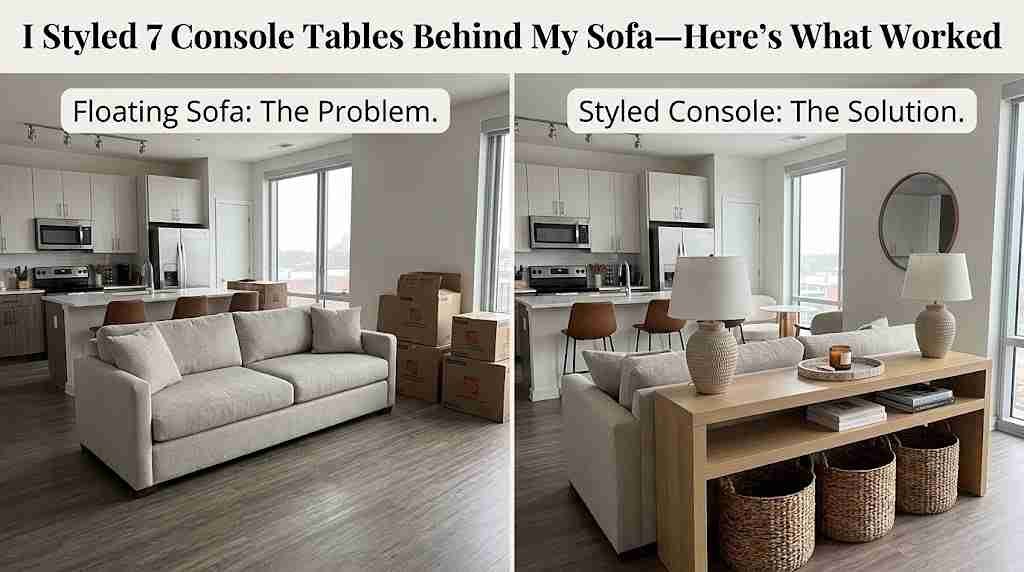
The first time I pushed our sofa away from the wall, it just floated there — an island in the middle of an open-concept rental with nothing behind it but empty flooring and a stack of moving boxes. It looked less like an “open floor plan” and more like the sofa had wandered off and gotten lost. Not exactly the vibe I was going for.
Learning how to style a console table behind a sofa turned out to be the single change that fixed the whole layout of my 780-square-foot apartment, where the living and dining areas share one long room. Over about two months, I tested seven different console table layouts behind that same floating sofa—some with lamps and books, some stripped down to almost nothing, and one that was too cluttered to live with for more than a week. This guide covers the sizing rules, the styling method that held up, and the specific products, costs, and mistakes from that process.
The Short Version: A console table behind a sofa should run about two-thirds the length of the sofa and sit within 1–2 inches of the sofa’s back height, so it reads as an extension of the seating rather than a separate piece. Anchor one end with a taller item—a lamp, a vase, or a plant—group smaller objects in threes, and leave at least a third of the surface empty. A narrow table (12–16 inches deep) works best behind a floating sofa in an open-concept space, since it keeps walking clearance intact on the far side.
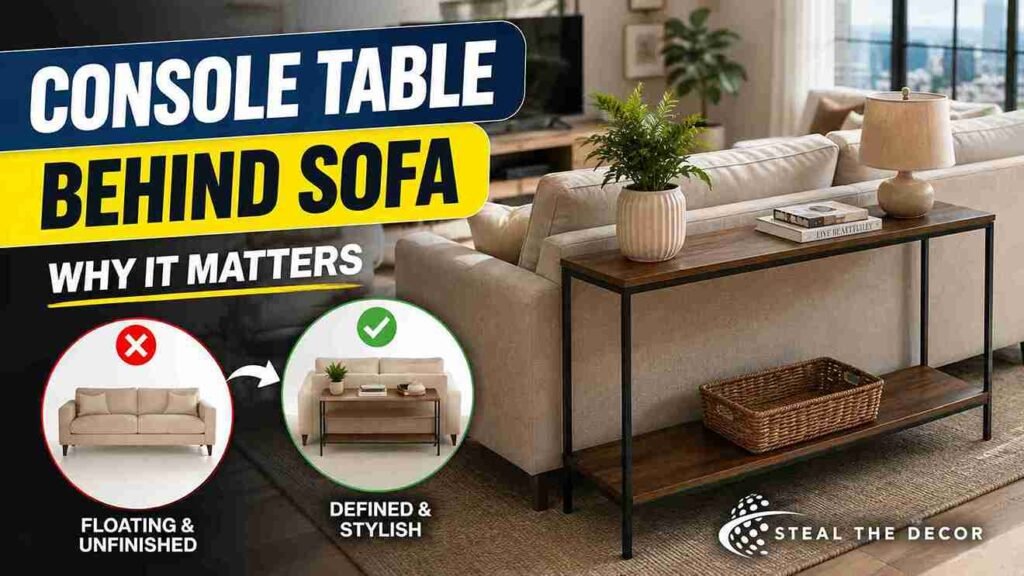
What Is a Console Table Behind a Sofa, and Why It Matters for Renters
A console table behind a sofa is a long, narrow table placed against the back of a sofa that isn’t pushed up to a wall—most often in open-concept living rooms, studio apartments, or any layout where the sofa “floats” in the middle of the room. Unlike a coffee table or an entryway console, its main job is to visually anchor a piece of furniture that would otherwise look unmoored. According to Apartment Therapy’s roundup of designer solutions for the space behind a floating sofa, a well-placed console table can define a seating area without a single wall or partition, which matters even more in a rental where you can’t build one.
For renters specifically, this piece does double duty. It gives you a landlord-safe way to add storage, lighting, and personality to a room without touching the walls, and it solves the “floating sofa” problem that comes standard in a lot of open-concept apartments. One correctly sized table can fix the whole room’s flow in a single afternoon—that’s really the whole appeal.
How Tall, Long, and Deep Should It Be? (Sizing Rules, With Real Sofa Examples)
Get the size wrong, and everything else—the lamps, the books, the styling—will look off no matter how carefully you arrange it. The rule that held up across all seven of my layouts: the console table should be roughly two-thirds the length of the sofa, with its top landing within 1 to 2 inches of the sofa’s back height.
Here’s what that looks like with real dimensions. For a standard 84-inch three-seat sofa, look for a console between 56 and 66 inches long—the LACK console table by IKEA runs 55 1/8 inches, sitting at the low end of that range and working well behind my own 82-inch sofa. For a loveseat around 60 inches wide, a 36- to 40-inch console keeps proportions balanced. For a long sectional arm near 96 inches, a 60- to 70-inch table plus a floor lamp on the far end beats hunting for one console that spans the whole thing.
Height matters as much as length. Most sofa backs sit between 30 and 36 inches off the floor, so a console in that same range — 1 to 2 inches below the sofa back — keeps sightlines open while still reading as one connected unit. For depth, 12 to 16 inches is standard; anything deeper eats into walking space if the table also functions as a room divider.
Measure your actual sofa before you shop. Two-thirds the length, within 2 inches of the back height—that combination is what saves you a return shipment.
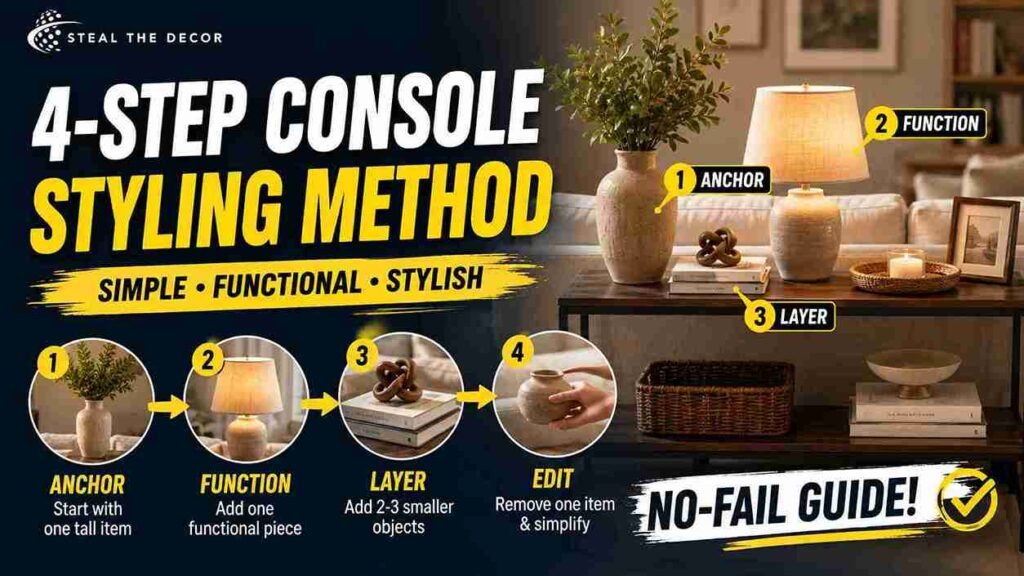
Step-by-Step: The No-Fail Styling Method (Anchor, Function, Layers, Edit)
Step 1 — Anchor the table with one tall item. Start with a single piece noticeably taller than everything else — a table lamp, a tall vase with branches, or a small faux tree. This becomes the visual anchor the layout builds around. My first attempt skipped this step, and the table read as clutter within a day.
Step 2 — Add one functional piece. A table lamp earns its space here — it’s ambient lighting for a room that may not have great overhead options. I used a ceramic table lamp by Threshold, designed with Studio McGee (around $40–$50 at Target), on one end.
Step 3—Layer in two to three smaller objects, varying height and texture. A stack of two or three coffee table books, topped with a small object, adds height variation. A shallow decorative tray corrals anything that would otherwise look like loose clutter—coasters, a candle, a small dish for keys.
Step 4 — Edit down by at least one item. Every cluttered layout improved the moment I removed one piece. If you can’t tell whether the table looks styled or just full, take something away rather than add more.
Common mistakes per step: skipping Step 1 (flat, cluttered look); a lamp too tall for the sofa back (blocks sightlines); over-stacking books past three (looks like storage, not styling); and stopping at Step 3 instead of Step 4, the most common reason a styled console still looks busy.
Symmetry vs. Asymmetry: Two Easy Ways to Style Your Console
Symmetrical styling means mirroring the same elements on both ends of the table—matching lamps, matching stacks of books, and a centered object in the middle. It’s the safer choice if you’re new to styling, because it’s nearly impossible to get visually wrong. I used this approach on layout three: two identical ceramic lamps, a low tray with candles centered between them, and it looked polished within about ten minutes of arranging.
Asymmetrical styling uses different objects of varying height on each end, balanced by visual weight rather than by matching. On one end I placed a taller faux plant, and on the other, a lower, wider stack of books with a small framed photo—different objects, but similar enough in visual “weight” that neither side felt heavier than the other. This version took more trial and error to get right but ended up being my favorite of the seven layouts because it felt less staged.
The rule of three applies to both approaches: group objects in odd numbers—three, not two or four—within any single cluster, since odd-numbered groupings read as more natural to the eye than even ones. Short on time, or nervous about getting it wrong? Start symmetrical. You can always loosen it into asymmetry once you’re comfortable with the pieces you have.
What to Put on a Console Table Behind a Sofa
This is the section I get asked about most, so here’s exactly what went on the table across my best layouts, with real prices.
Table lamps. A pair of matching lamps creates instant ambient lighting and frames the sofa from behind—useful in a rental where overhead lighting is often a single builder-grade fixture. I used the Ceramic Table Lamp by Threshold, designed with Studio McGee (roughly $40–$50 each at Target), keeping the shade below the sofa back so it doesn’t block sightlines.
A decorative tray. A wooden or ceramic tray ($15–$30) keeps small items—coasters, a candle, reading glasses—from scattering across the table. This one addition did more to make my messier layout look intentional than anything else I tried.
A stack of coffee table books. Two or three books, topped with a small object, add height variation on the shorter end of the table. Thrifted books work fine — this doesn’t need to be an investment category.
A tall vase or a faux plant. For the anchor piece, I alternated between a tall glass vase with dried branches and a 20-inch artificial fiddle leaf fig plant by Nearly Natural (around $30–$45). Real greenery like a trailing pothos also works—if you’d rather skip the ceiling-hook route entirely, my guide to hanging plants without drilling covers no-damage ways to work greenery into a rental—but the faux version was more forgiving through weekly rearranging.
Woven baskets underneath. Baskets tucked beneath the table hold blankets or extra pillows and keep the floor space from looking cluttered. I used a handwoven basket 2-pack by Seville Classics (about $30 per pair), which folds flat if you move.
Personal photos or souvenirs. One small framed photo or a travel souvenir grounds the table as an actual home rather than a showroom display, and it’s usually what guests comment on.
You don’t need all six categories at once. My best-performing layout used four of these—lamps, a tray, books, and a plant—and left the baskets and photos for a different season.
Pro Tips for Renters:
- Measure your lamp’s shade height before buying—a shade that sits more than 2 inches above the sofa back will block sightlines across an open room, which is the single most common styling mistake on this specific setup.
- If your console table has to double as extra seating for guests, skip the tall vase entirely and keep everything under 12 inches so nothing tips when someone sets a plate down.
- Battery-powered or plug-in lamps solve the “there’s no outlet behind my floating sofa” problem without running an extension cord across the floor.
- Rotate two or three of your smaller objects seasonally instead of buying new ones — it keeps the table feeling current without repeat spending.
- If you’re using the table as a room divider, style both the front and back differently — the side facing the sofa can be simpler, since it’s mostly seen from a seated angle.
Console Table Behind a Sofa in an Open-Concept or Small Space
In an open floor plan, a console table behind the sofa does more than hold decor — it defines where the living area ends and the dining or entry space begins, without a wall going up. This was the actual reason I bought one: our living and dining areas share a 24-foot-long room, and the sofa alone didn’t signal “living room” to anyone walking in. Pairing the console with a rental-friendly accent wall behind it, or grounding the seating area with an area rug over carpet, reinforces the same boundary from a different angle.
For small apartments or narrow rooms, stick to a table no deeper than 12 to 14 inches so it doesn’t eat into walking clearance. If floor space is that tight, a wall-mounted floating shelf at the same height creates a similar effect without any footprint — though it requires anchoring to the wall, so check your lease first. In a studio, a console table behind the sofa can also double as a small desk if you choose a height in the 28- to 30-inch range, comfortable for seated work.
In an open-concept space, the console table’s job is spatial as much as decorative. Measure the gap you’re trying to define, not just the sofa, before you buy.
Common Mistakes When Styling a Console Table Behind the Couch
Buying the wrong height. A table that sits noticeably above or below the sofa back breaks the visual line between the two pieces and makes the sofa look like it’s floating even more. Measure your sofa’s back height before you shop, not after.
Skipping negative space. My first layout covered nearly the entire surface, and it read as cluttered the moment anyone sat on the sofa and looked back at it. Leaving roughly a third of the table empty is what makes the rest look intentional.
Making every object the same height. A table full of items that are all roughly the same height looks flat from a distance, even if each individual piece is nice. Varying height—a tall lamp, mid-height books, a low tray—is what creates visual interest.
No lighting at all. A console table styled purely for daytime photos often goes dark and forgettable at night. At least one lamp turns the table into something that actually functions after sunset, not just something to look at.
Ignoring cable management. If you’re using a table lamp, the cord running down the back of a floating console is visible from nearly every angle in an open room. I made this mistake on layout two and didn’t fix it until layout four. A small cable management box by D-Line (around $15–$20) hides the cord and outlet strip in one move—the same instinct that goes into hiding an ugly wall vent applies here.
Treating it like a matching furniture set. Buying every piece from the same collection can look showroom-flat rather than lived-in. Mixing in one thrifted or personal item keeps it from looking staged.
Console Table Behind Sofa: Renter-Safe Products We Actually Recommend
Every product below is one I tested directly behind my own sofa over the course of this project.
| Product | Price Range | Ease of Use | Damage Risk | Best For | Our Rating |
|---|---|---|---|---|---|
| LACK Console Table by IKEA | $80–$100 | 4/5 | None | Standard 3-seat sofas (84 in.) | 4.5/5 |
| Ceramic Table Lamp by Threshold, designed with Studio McGee | $40–$50 each | 5/5 | None | Ambient lighting, symmetrical layouts | 4.5/5 |
| Handwoven Basket 2-Pack by Seville Classics | $28–$32 | 5/5 | None | Under-table storage | 4/5 |
| 20-inch Artificial Fiddle Leaf Fig Plant by Nearly Natural | $30–$45 | 5/5 | None | Anchor piece, low-maintenance greenery | 4/5 |
| Cable Management Box by D-Line | $15–$20 | 4/5 | None | Hiding lamp cords and outlet strips | 4/5 |
| Picture Hanging Strips by Command | $6–$14 | 4/5 | None | Securing a mirror or art above the console | 4.5/5 |
The IKEA LACK is the most budget-friendly full-size console I tested, though it does require assembly and isn’t rated for heavy weight on top—stick to lightweight decor rather than stacking books and a heavy lamp on one end. If you’re hanging a mirror or art above the table to complete the look, Command Picture Hanging Strips by 3M hold securely on painted drywall and remove without leaving marks, which matters if the lease says no nail holes.
What to Check With Your Landlord Before You Start
- Whether the lease restricts hanging anything above the console table (mirrors, art, shelving)
- Whether floating shelves or any wall-mounted alternative require written permission
- Whether there’s an existing outlet behind the sofa, or whether you’ll need an extension cord or battery-powered lighting
- Whether area rugs or floor protectors are required under furniture with hard feet, to prevent flooring scuffs
- Whether the console table’s footprint blocks a required fire exit path in a studio or small apartment
- Whether your renter’s insurance (if required by the lease) covers furniture in shared or open-concept layouts
A general guide from HousingAnywhere on decorating a rental notes that checking in with your landlord or property manager before making changes is the first step in most lease agreements, even for changes that don’t involve drilling.
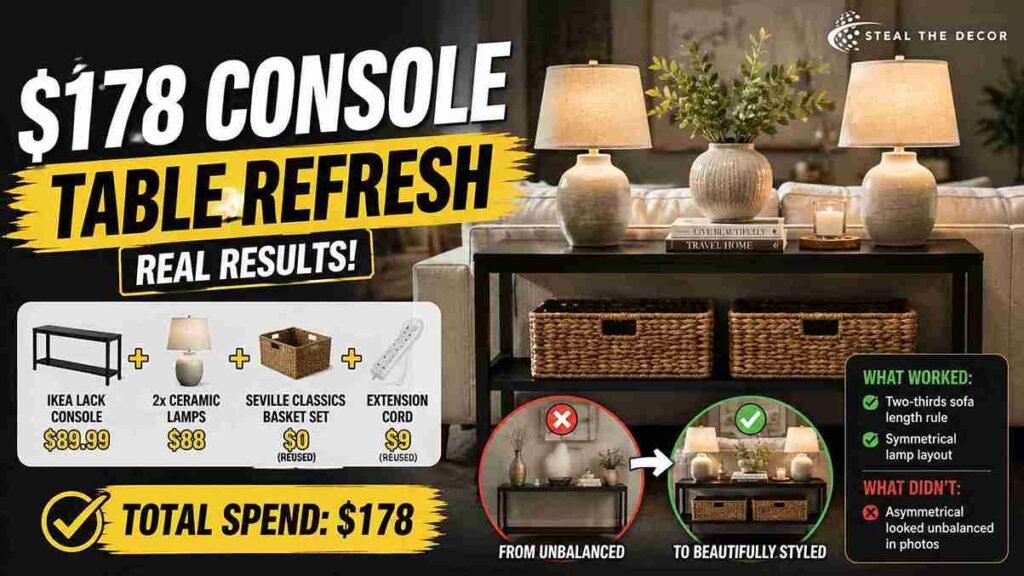
Real Results: What My $178 Console Table Refresh Actually Looked Like
Total spend across the final layout: the IKEA LACK console table ($89.99), two Threshold ceramic lamps ($44 each, $88 total), and a reused Seville Classics basket set—bringing the real total to $178. The one cost I underestimated was an extension cord for the lamps, adding another $9.
What worked: the two-thirds sofa length rule held up exactly as expected, and the symmetrical lamp layout got the most comments from guests. What didn’t: my first asymmetrical attempt, with a tall vase on one end and nothing tall on the other, looked unbalanced in photos even though it looked fine in person. The table itself has held up well over two months of near-weekly rearranging, though the LACK’s honeycomb-core top isn’t rated for heavy weight, so I’d skip stacking anything beyond books and a lamp on one end.
Key Takeaways
- A console table behind a sofa should run roughly two-thirds the sofa’s length and sit within 1 to 2 inches of the sofa’s back height for a cohesive, anchored look.
- The IKEA LACK console table measures 55 1/8 inches long, making it a close fit for standard 82- to 84-inch three-seat sofas.
- Command Picture Hanging Strips by 3M hold securely on painted drywall and remove cleanly, making them a deposit-safe way to hang art or a mirror above the console.
- The anchor, function, layers, and edit styling method—one tall piece, one functional item, two to three smaller objects, then one item removed—produced the most consistently balanced results across seven tested layouts.
- Leaving roughly a third of the table’s surface empty is the single biggest factor in whether a styled console reads as intentional or cluttered.
- A narrow console table under 14 to 16 inches deep works best behind a floating sofa in an open-concept room, since it preserves walking clearance.
- A full console table refresh — including a table, two lamps, and lighting accessories — can realistically run around $150 to $200 depending on which pieces you already own.
Conclusion
If your sofa is floating in the middle of a room right now, the fix is smaller than it feels—a correctly sized console table, one anchor piece, and a little restraint on how much you put on top of it. Out of seven layouts, the ones that worked best all shared the same two things: the right proportions and enough empty space to let a few good pieces stand out. Once you’ve got the styling behind the sofa handled, the next natural step is usually the wall above it—I’ve got a full breakdown of large-scale wall art for apartments if you want to finish the look without a single nail hole.
Have you styled a console table behind your sofa? Tell me what worked in your space below—I’m always curious whether the two-thirds rule holds up in smaller or larger rooms than mine.
FAQ: how to style a console table behind a sofa
How tall should a console table be behind a sofa?
Aim for a table within 1 to 2 inches of your sofa’s back height, which typically falls between 30 and 36 inches. This keeps the console reading as an extension of the sofa rather than a separate, mismatched piece and avoids blocking sightlines across an open room.
How long should a console table be behind a sofa?
A good starting rule is two-thirds the length of your sofa. For an 84-inch sofa, that’s roughly 56 to 66 inches; for a 60-inch loveseat, closer to 36 to 40 inches. Measure your actual sofa before shopping rather than relying on a standard size.
What’s the difference between a sofa table and a console table?
The terms are largely interchangeable today, though “sofa table” traditionally refers specifically to a table designed to sit directly behind a sofa, while “console table” is a broader category that also includes entryway and hallway tables. In practice, either can work behind a floating sofa as long as the dimensions fit.
What should I put on a console table behind my sofa?
A table lamp for ambient light, a decorative tray to corral small items, a stack of two or three books, and one tall anchor piece like a vase or faux plant cover most of what a styled console needs. Add woven baskets underneath for extra storage if the table doesn’t include drawers.
Can I use a console table as a room divider behind a sofa?
Yes — in open-concept layouts, a console table behind the sofa is one of the most common ways designers define a living area without adding a wall. Keep the depth under 14 to 16 inches if there’s walking space on the far side.
How do I style a console table behind a floating sofa?
Follow the anchor, function, layers, and edit method: start with one tall piece, add one functional item like a lamp, layer in two or three smaller objects with varied height, then remove at least one item before calling it finished. Leaving roughly a third of the surface empty keeps the layout from looking cluttered.
Should I put lamps on both ends of a console table behind a sofa?
Matching lamps on both ends create a symmetrical, low-risk look that’s easy to get right, especially if you’re new to styling. An asymmetrical layout with one lamp and one tall plant or vase on the opposite end also works but takes more trial and error to balance visually.