
Nothing on this page is sponsored, and there are no affiliate links. Every product named below is something I bought with my own money and used on my own couch.
Nobody tells you how to clean a faux leather sofa without cracking it until after you’ve already ruined one. Two months after moving into my apartment, a thin grey line showed up along the left arm of the sofa that came with the place. I’d been hitting the thing with all-purpose spray twice a week and calling it maintenance. The line looked like a scratch. It wasn’t. When I ran a fingernail across it, a flake of coating lifted off and stuck to my thumb like a fish scale and that was the moment I understood the “leather” couch wasn’t leather at all and that I’d spent two months slowly sanding it to death.
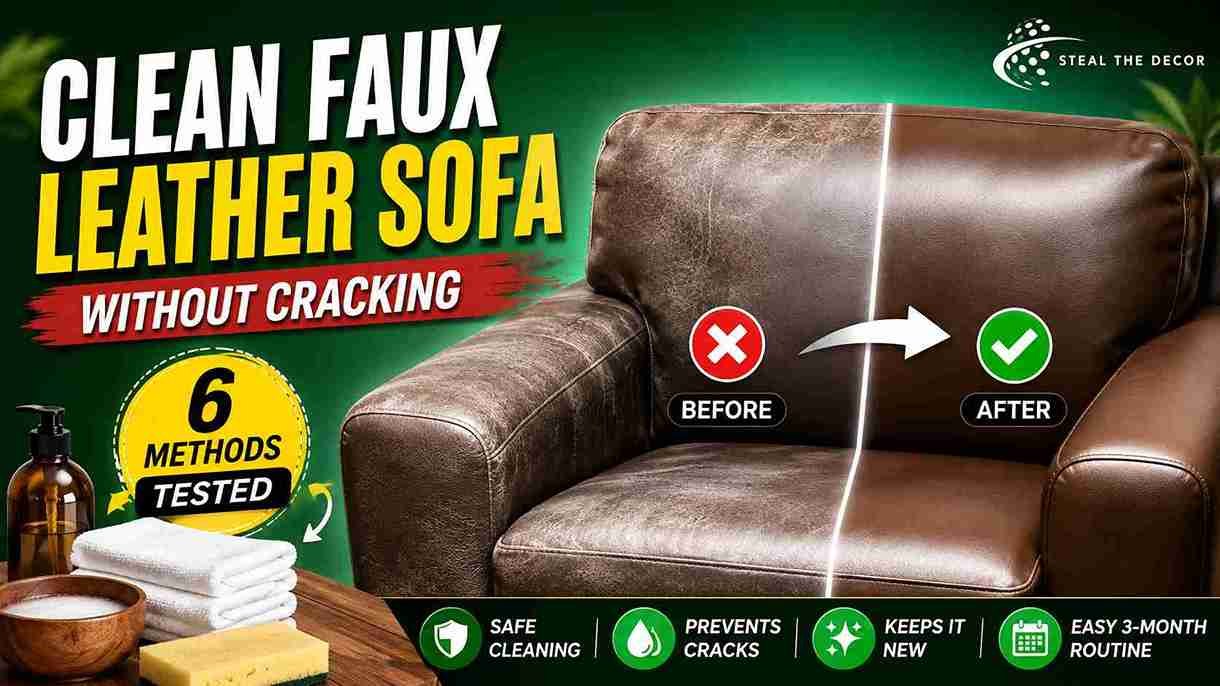
The sofa is landlord-owned. Which means any damage comes straight out of my deposit, so I stopped guessing. Over five weeks I tested six different cleaning methods on six different sections of the same couch, photographing every panel before and after so I couldn’t lie to myself about the results. One worked cleanly. One left a dull patch that’s still sitting there. Below is what happened to each one, what it cost, and the proper care routine I now use every three months to keep it looking new.
The Short Version: To clean a faux leather sofa without cracking it, mix two to three drops of a mild pH-neutral dish soap (Dawn Free & Clear or Dr. Bronner’s Pure-Castile) into a bowl of warm water, dip a microfiber cloth, and wring it until it’s barely damp never wet. Wipe one small section at a time, follow immediately with a plain-water cloth to lift soap residue, then dry with a second microfiber cloth right away. Finish with a thin coat of a vinyl-and-plastic-safe conditioner such as Leather Honey or Weiman Leather Cleaner & Conditioner every three to four months. Skip alcohol, bleach, acetone, Magic Erasers, and heat drying; those are what actually cause the cracking.
What Faux Leather Actually Is (And Why It Cracks When You Clean It)
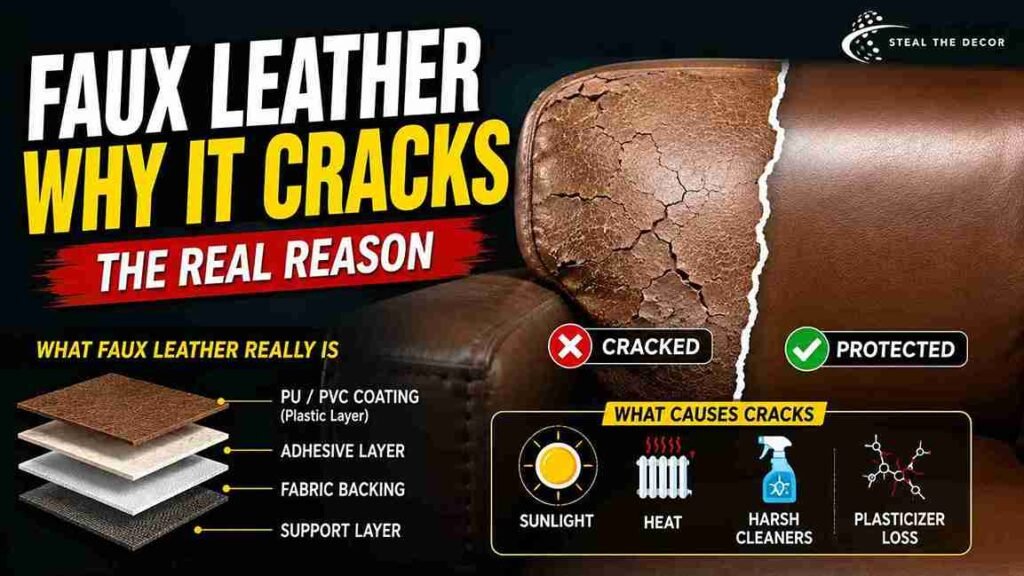
Faux leather isn’t a fabric that’s been treated. It’s a thin plastic coating bonded to a woven fabric backing usually polyurethane (PU) or polyvinyl chloride (PVC), sometimes sold as vegan leather, synthetic leather, or imitation leather. Artificial leather manufacturers build it up in layers, and the layer your hand touches is maybe a fraction of a millimeter thick. On a tag or a spec sheet the material used might be listed as fake leather, PU upholstery, or bonded leather. All faux leather furniture, same build. Different marketing. So whether you’re searching how to clean imitation leather sofa covers or how to clean fake leather furniture the advice below applies.
That structure explains the whole problem. Real leather is a porous hide that drinks in conditioner and stays supple, which is why good leather furniture softens as it ages. Faux leather can’t absorb anything, because plastic isn’t porous; no product you apply will penetrate the fabric backing or feed the surface of the material like real leather. What keeps the PU layer flexible is a set of chemical plasticizers mixed in at the factory, and those plasticizers slowly migrate out over the years. Heat speeds that up. So does sunlight. So do solvents, faster than either.
Then the flexibility drops past a certain point, and the coating can no longer bend with the fabric backing underneath it. Every time you sit down, the surface flexes and the brittle topcoat splits. Those splits start as hairline lines on the highest-stress spots (arms, front seat edges, and the seam near the cushion) before they widen into flakes. That’s delamination, and it’s why faux leather sofa cracking after cleaning is such a common complaint. The cleaner didn’t scratch anything. It stripped or dissolved plasticizer, and normal sitting finished the job three weeks later, long after you’d forgotten what you’d sprayed on it. Every harsh cleaning product trades a little appearance and durability for a slightly cleaner panel today.
Two things wreck faux leather faster than anything else in a rental: radiator heat and direct sunlight through an unshaded window. Mine sits four feet from a west-facing window. That’s almost certainly why the left arm went first.
Bottom line: you’re not cleaning leather; you’re cleaning a plastic skin, and everything harsh you use today shows up as a crack six weeks from now.
Does Gentle Cleaning Actually Save a Faux Leather Sofa? An Honest Answer
Gentle cleaning genuinely extends the life of faux leather. It cannot reverse damage that’s already happened. I want to be blunt about that, because most articles on this topic imply otherwise and then sell you a leather repair kit. Maintaining faux leather is prevention work, not restoration work. Every guide on how to clean fake leather sofa panels should start with that caveat.
Here’s the honest split. Gentle cleaning works if the topcoat is still intact meaning the surface looks dull, sticky, or grubby, but you can’t lift any material with a fingernail. Strip the body oils and skin residue off a surface like that, restore a bit of flexibility, and you measurably slow the next stage of failure. My right arm and both back panels went onto the soap-and-water method in week one. They look identical today.
Gentle cleaning does not work when the coating has already separated from the backing. Once you can see fabric mesh through a crack or flakes come away in your hand, no cleaner or conditioner or oil on earth closes that gap. Conditioner darkens the edges a little. Makes it less obvious from across the room. That’s the entire improvement, and I tested it specifically on the failing left arm same crack, same length, five weeks later.
But there’s a third case nobody mentions. Some peeling faux leather isn’t cracked at all. It’s a cheap surface film delaminating in sheets, and it shows up on bonded or bicast leather sofas that aren’t even three years old yet. If yours peels in strips rather than flaking in specks, cleaning has nothing to do with the outcome. That’s a manufacturing failure. Cover the piece and move on.
Bottom line: cleaning is prevention, not repair; start before you see the first crack, because after that you’re only managing appearance.
I Tried 6 Ways to Clean My Faux Leather Sofa Here’s What Worked
Six methods. Six sections of the same couch. Five weeks of checking back, because the damage from bad cleaning is almost never visible on the day you do it. I checked every panel again at two weeks and four weeks, and that delay is exactly what makes this stuff so easy to get wrong.
1. Warm water and mild dish soap Worked (the winner) Two to three drops of Dawn Free & Clear in a bowl of warm water. Dip a clean microfiber cloth in the soapy water, wring it out hard, and gently wipe the surface one panel at a time. Cost me nothing extra; the soap was already under my sink, and a six-pack of microfibre cloths runs about $8–$14.
It lifted three months of body oil and a coffee splash off the seat panel with zero colour change, zero dulling, zero texture shift at four weeks. This is the safe way to clean faux leather sofa surfaces, and it’s what I use now. If you’re wondering how to clean fake leather couches in general this is the method to start with. Stick to mild, non-abrasive tools and this handles almost everything. The one rule that actually matters is wringing that cloth until it’s barely damp, because a soaked cloth pushes water into the seams where it reaches the fabric backing.
2. 50/50 white vinegar and water Use with caution A homemade cleaner for faux leather sofa panels that half the internet swears by. Honestly? It works better than I expected. It dissolves that sticky, tacky film that builds up on faux leather (the one that makes your forearm peel off the arm rest in summer) and it lifted a dried soda spill and two stubborn stains near the seam that nothing else touched.
But vinegar is acidic, and left sitting on the surface it keeps working. I put it on a small test square, wiped it with plain water inside 60 seconds, and saw no damage at four weeks. Sticky patches only. Never a full-sofa wash. Always chase it with plain water. About $4 for a gallon of white distilled vinegar.
3. Baby wipes Depends entirely on the brand Convenient, and fine for a crumb or a fingerprint. The problem is that plenty of wipes carry alcohol, fragrance, or preservatives that behave like mild solvents on PU. I used fragrance-free, alcohol-free WaterWipes on one back cushion and saw no effect at four weeks but I wouldn’t have risked those on the arm. If the pack doesn’t say alcohol-free on the label, treat it as unsafe. Roughly $5–$9 per pack.
4. Dedicated vinyl and plastic cleaner Worked; best for deep cleaning I used Weiman Leather Cleaner & Conditioner (around $8–$15) on the seat panel that takes the most abuse. It cleaned about as well as soap and water. Where it pulled ahead was feel the surface came out more supple and lost that dry squeak. For a quarterly deep clean it earns its place, and it makes the panel easier to maintain between washes. For regular cleaning a dedicated cleaning product is overkill, and using it too often is its own kind of overdoing it.
5. Rubbing alcohol on an ink mark This is the one that failed A pen leaked on the front edge of the seat. Every ink-removal guide on the internet says isopropyl alcohol, so I put some on a cotton pad and held it against the mark for maybe four seconds. Four. The ink came off. So did the sheen. I remember lifting the pad and just staring at it, waiting for the surface to bounce back the way water does when it dries and it never did.
There’s now a matte patch the size of a business card that catches the light differently from every other inch of that sofa, and no amount of conditioner has evened it out. The alcohol dissolved the topcoat’s finish layer. Cost of the mistake: $3 for the alcohol, plus a permanent dull spot on a couch I don’t own. If I could go back, I’d have left the ink alone and thrown a blanket over it.
6. Magic Eraser Do not do this It shows up in every list of sofa cleaning hacks so I tested it on the hidden back panel precisely because I suspected it would go badly. A melamine foam pad like Mr. Clean Magic Eraser is a micro-abrasive. It works by sanding. On faux leather it takes the topcoat off along with the stain, and the spot it touched feels rougher than the surrounding surface and has started to look chalky. This is the fastest route to faux leather sofa peeling after cleaning that I know of.
Actually let me walk back something from method two. I said vinegar is safe with a water rinse, and that held true on my sofa. But my couch is PU. On some PVC coatings the acid dulls the finish even with a rinse, so patch test it like you would anything else here.
Bottom line: mild soap and barely damp microfiber wins on every panel, and every failure I had came from something that dissolved or abraded the surface rather than washing it.
Pro Tips for Renters:
- Keep the sofa at least two feet from radiators, heating vents, and direct afternoon sun. Heat pulls plasticizer out of PU faster than any cleaner you own, and it’s why one arm always cracks before the other.
- Blot spills inside about 60 seconds. Faux leather doesn’t absorb liquid, but sugary drinks dry into a film that then needs a stronger cleaner and the stronger cleaner is the thing that does the actual damage.
- Rotate and flip your seat cushions monthly ideally right after your monthly couch cushion cleaning. Cracking starts where flex repeats in the same spot, so spreading that wear across four surfaces instead of one buys you real time. Same logic applies to faux leather bar stools and dining chairs, where the seat dies long before the frame shows anything and it’s the core of how to clean faux leather chairs without cracking them.
- Use two cloths. Always one for cleaning, one for drying. Air-drying with soap residue on the surface leaves a faint film that grabs dust faster than before you started, and drying properly is what makes a panel look new again rather than merely damp.
- Never use a hairdryer, a radiator, or an open window in full sun to speed up drying. Heat is the exact thing you’re protecting the sofa from.
Step-by-Step: How to Clean a Faux Leather Sofa Without Cracking It
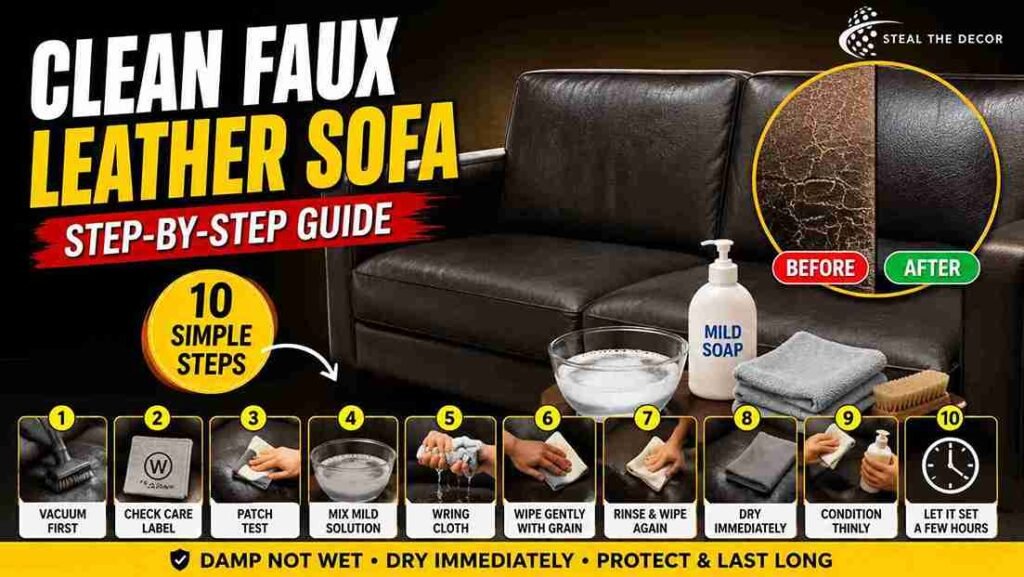
This is how to clean a faux leather couch the full way in order. Takes about 35 minutes for a three-seater. Don’t skip the patch test; it’s the step that separates a clean sofa from a dull patch you have to explain at move-out.
Step 1 Vacuum first, with a brush attachment. Run a soft brush attachment along every seam, into the cushion crevices, and under the cushions themselves. Grit trapped in a seam turns into sandpaper the second you start wiping. Common mistake: using a hard plastic nozzle, which scratches the coating on contact.
Step 2 Find the care label and read the cleaning code. Look under the seat cushions, along the base, or under the frame. A “W” code means water-based cleaners are fine, S means solvent only (a dry cleaning solvent rather than water); “WS” means either; and “X” means vacuum or light brushing only. Most faux leather is W or WS. If your tag says X, stop reading and clean by vacuuming alone.
Step 3 Test on a hidden area first. The back of the sofa or the underside of a cushion is ideal. Apply your solution, wipe it off, then wait a full 10 minutes and check for color lift, dulling, or a texture change. Common mistake: checking after 30 seconds. Most reactions aren’t immediate.
Step 4 Mix the solution. Mix a few drops of mild pH-neutral dish soap into roughly two cups of warm water in a bowl warm, never hot. More soap doesn’t clean better. It just leaves residue you then have to remove, and this same mild soap solution is the safest option for PU, PVC, and vegan leather alike.
Step 5 Wring the cloth until it’s barely damp. If you can squeeze a drop out of it, it’s too wet. Water that reaches the fabric backing through a seam or an existing crack causes swelling and a permanent ring, and this one step prevents most water damage on faux leather sofa panels.
Step 6 Wipe one small section at a time with the grain. Work in roughly one-foot squares, straight strokes, following the direction of the embossed texture. Common mistake: scrubbing in circles on a stain, which polishes the topcoat unevenly and leaves a shiny halo you’ll notice every time the light hits it.
Step 7 Rinse the cloth and go over the panel again. Use a second clean cloth, dampened with plain water only, over the same section. Soap left behind stays slightly tacky and pulls dust back within a day.
Step 8 Dry immediately with a dry microfiber cloth. Don’t let it air-dry. Don’t use heat of any kind. This is sofa cleaning without steam on purpose steam cleaners push hot moisture into the seams which is exactly what PU can’t handle. Buff gently until the surface is dry to the touch.
Step 9 Condition thinly, then buff. Put the conditioner on the cloth rather than the sofa, spread it in a thin even layer, and buff off the excess after about five minutes. A heavy coat can’t soak in (there’s nowhere for it to go) so it sits on top and transfers straight onto your clothes.
Step 10 Let it sit for a few hours before anyone sits down. Flexing a freshly conditioned surface before it sets is how you end up with streaks along the seat edge.
Bottom line: damp not wet; section by section; dry immediately. Those three rules do more for your sofa than any product on the shelf.
6 Cleaning Mistakes That Crack a Faux Leather Couch
Here’s what trips most people up. I made two of these myself, and the evidence is still sitting on my left arm rest.
Mistake 1: Soaking the surface. Faux leather looks waterproof, so a dripping sponge feels safe. Water finds the seams, the stitch holes, and any hairline crack that’s already there, then reaches the fabric backing underneath where it swells the fibres and lifts the coating from below. Wring the cloth until it’s barely damp. Every single time.
Mistake 2: Reaching for alcohol, acetone, or bleach. These dissolve the finish rather than lifting dirt off it. My ink experiment left a permanent matte patch in under five seconds of contact. If a mark won’t come off with mild soap, cover it and accept it; I promise that’s the cheaper outcome.
Mistake 3: Using a Magic Eraser or any abrasive pad. Melamine foam sands the topcoat away. So do scouring pads, stiff brushes, and paper towels used with any pressure behind them. Microfiber only.
Mistake 4: Using a heavy real-leather conditioner. Oil- and wax-heavy products built for hide (the kind you’d use on leather shoes boots and other leather items) are loaded with oils, waxes, and lanolin designed to be absorbed. Plastic absorbs nothing, so those oils sit on the surface, stay greasy, collect dust, and can soften certain PVC coatings outright. Choose a conditioner that specifically names vinyl, synthetic, or faux leather on the label or use a light one like Leather Honey very sparingly. Faux leather cleaning and care is not the same as leather cleaning and care and mixing them up is how sofas end up greasy.
Mistake 5: Drying with heat. A hairdryer, a radiator, or a sunny window drives out plasticizer and does in 20 minutes what a year of normal use would do. Dry with a cloth, indoors, away from the window.
Mistake 6: Cleaning far too often. And this is the one nobody expects. Every wipe removes a little surface material, so weekly full cleaning strips the topcoat gradually and dries the panel out. Dust weekly, do light cleaning once a month, and deep clean and condition once a quarter.
Bottom line: nearly every cracked faux leather sofa I’ve seen was cleaned too hard, too often, or with something that belonged under the kitchen sink.
Renter-Safe Faux Leather Cleaners and Conditioners I’d Actually Buy
Choose the right product, and a faux leather piece stays durable and stylish far longer than the label suggests. Four products here, plus the free option, all tested on the same couch. Prices move constantly, so treat these as ranges rather than quotes. For how to clean faux leather furniture beyond the sofa the same products cover chairs headboards and ottomans.
Dawn Free & Clear Dish Soap (about $4–$7) is the base of the whole routine and the cheapest thing on this list. Diluted to two or three drops per two cups of warm water, it’s the best cleaner for faux leather sofa maintenance for most renters. Pros: pH-neutral, fragrance-free, already in your kitchen. Cons: it does nothing for suppleness, so it needs a conditioner working alongside it every quarter.
Weiman Leather Cleaner & Conditioner (about $8–$15) is what I reach for on the quarterly deep clean. Cleans and conditions in one pass, and the surface stops squeaking. Pros: safe on PU and PVC, one-step application, hard to mess up. Cons: the conditioning effect is modest, and overuse leaves a slight film.
Leather Honey Leather Conditioner (about $20–$28) is the conditioning step, applied thinly. It’s marketed for real leather but works as a surface treatment on synthetics when you’re stingy with it. Apply this conditioner every three to four months, or at an absolute minimum twice a year. Pros: A little goes a very long way, one bottle lasts years. Cons: Go heavy on faux leather, and it stays greasy; this is a rice-grain-per-panel product, and I learned that the sticky way.
Chemical Guys Leather Cleaner (about $10–$18) is the pick if you’ve got an actual stain rather than general grime. Stronger than soap and water without being solvent-based. Pros: handles set-in marks. Cons: strong enough that skipping the patch test is asking for it, and it’s more product than most people need.
| Product / Method | Price Range | Ease of Use (1–5) | Damage Risk | Best For | Our Rating |
|---|---|---|---|---|---|
| Mild dish soap + warm water (Dawn Free & Clear) | $4–$7 | 5/5 | None | Monthly routine cleaning | 5/5 |
| Weiman Leather Cleaner & Conditioner | $8–$15 | 5/5 | None | Quarterly deep clean | 4.5/5 |
| Leather Honey Conditioner | $20–$28 | 4/5 | Low residue if over-applied | Preventing dryness and cracking | 4/5 |
| Chemical Guys Leather Cleaner | $10–$18 | 3/5 | Low | Set-in stains only | 3.5/5 |
| 50/50 white vinegar + water | $4 per gallon | 3/5 | Low | Sticky, tacky patches only | 3/5 |
| Rubbing alcohol / Magic Eraser | $3–$6 | 1/5 | High (permanent surface damage) | Nothing; avoid entirely | 0/5 |
And if you’re building out a rental living room on a budget, the same logic runs through everything else in the room cheap fixes that reverse cleanly beat expensive ones that don’t, which is the whole idea behind my guide to decorating a rental without damage.
Bottom line: $10 of dish soap and microfiber cloths covers 90% of this, and the conditioner is the only upgrade genuinely worth buying.
Before You Clean a Landlord-Owned Sofa: What to Check First
If the sofa came with the apartment, you’re cleaning someone else’s property and the cost of getting it wrong gets deducted rather than absorbed. Run this checklist before you touch it.
- Photograph the sofa’s current condition, including close-ups of every existing crack, scuff, and stain, with a timestamp. This is your single best protection at move-out.
- Read your lease for a furnishings clause. Plenty of furnished rentals spell out who’s responsible for cleaning the furniture that came with the place and what counts as damage.
- Find the manufacturer’s care tag and follow the cleaning code rather than a generic method you found online. A code X tag overrules everything in this article, including me.
- Ask your landlord in writing before using any solvent-based product, dedicated leather cleaners included. An email creates a record. A text thread counts too.
- Check what your state treats as normal wear and tear. Landlords generally can’t deduct for ordinary deterioration, only for damage beyond it. Nolo’s breakdown of what landlords can deduct for cleaning and repairs is the clearest plain-English version I’ve found, and their renter’s guide to getting your deposit back covers what to do when it goes sideways. Some states publish their own, like the Texas State Law Library’s security deposit guide.
- Never attempt a DIY recolor, dye, or paint on a landlord’s sofa without written consent, no matter how good the before-and-after photos look on Instagram.
- Report pre-existing damage in writing within your first week, so a crack that was already there doesn’t quietly become yours.
Bottom line: five minutes of photographs and one email cost you nothing and can save your entire deposit.
Real Results: What I Spent and What My Sofa Looks Like Now
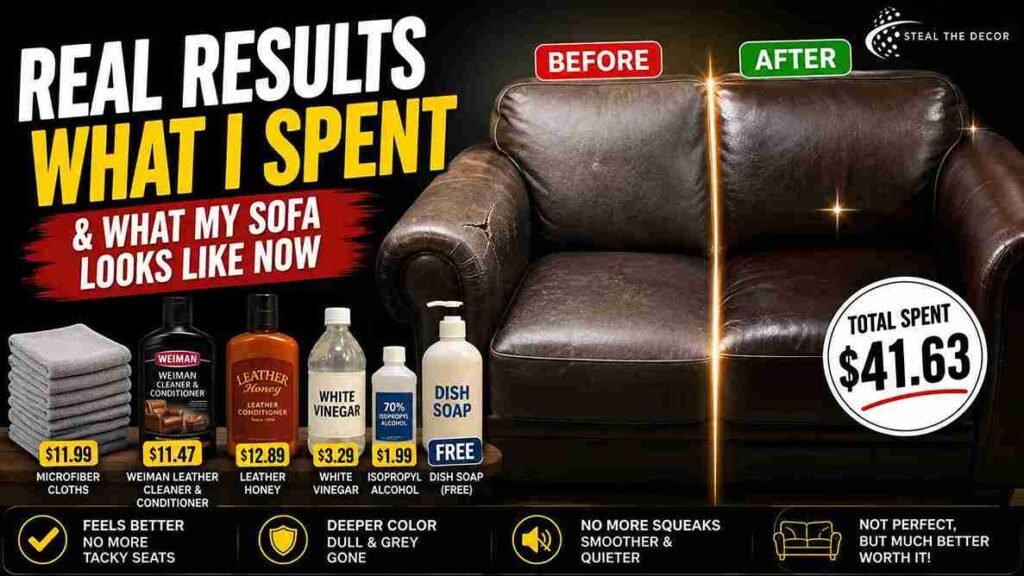
Total outlay across five weeks: $41.63. Microfiber cloth six-pack, $11.99. Weiman Leather Cleaner & Conditioner, $11.47. Leather Honey, $12.89 for the small bottle. White vinegar, $3.29. Isopropyl alcohol, $1.99 the only line item I regret.
The dish soap was free. And honestly, it did most of the work.
What improved: the seat panels stopped going tacky in warm weather, which was the thing I actually hated about this couch. That dull, dusty grey cast across the back cushions is gone and the colour reads noticeably deeper. The surface squeak that used to happen every time somebody shifted their weight has almost completely stopped, and I’d credit the conditioner for that more than the cleaning.
What didn’t improve (and I want to be clear here, because this is the part most posts skip) the original crack on the left arm is exactly the size it was in week one. Conditioner darkened the edges enough that you have to be within about three feet to spot it. It is not repaired.
It never will be. And the matte patch from the alcohol is still sitting there too, permanently, in the most visible position on the entire sofa the front seat edge, right where the afternoon light lands. There’s a folded throw over it. My landlord hasn’t said a word, and I flagged the arm crack in writing the week I found it so at least there won’t be any surprises at move-out. Better outcome than a four-second experiment deserved.
Bottom line: $42 bought me a sofa that looks and feels considerably better, and one permanent reminder that solvents don’t hand out second chances.
Key Takeaways
- Faux leather is a polyurethane or PVC coating bonded to a fabric backing, so it cannot absorb conditioner the way real leather does and has to be treated as a plastic surface rather than a hide.
- The safest cleaner for a faux leather sofa is two to three drops of a pH-neutral dish soap such as Dawn Free & Clear diluted in two cups of warm water, applied with a microfiber cloth wrung until barely damp.
- Cracking in faux leather is delamination caused by plasticizer loss, which makes isopropyl alcohol, acetone, bleach, abrasive melamine pads like Mr. Clean Magic Eraser, and heat drying the primary causes of damage not dirt.
- Existing cracks in faux leather cannot be reversed by any cleaner or conditioner, so gentle cleaning is a prevention strategy that slows further failure while conditioner only darkens crack edges to make them less visible.
- A vinyl-safe conditioner such as Weiman Leather Cleaner & Conditioner or Leather Honey applied thinly every three to four months keeps the topcoat flexible, and monthly light cleaning with weekly dusting is the correct frequency.
- Renters with landlord-owned faux leather sofas should photograph existing damage at move-in, check the W, S, WS, or X cleaning code on the care tag, and confirm in writing before using any solvent-based product, since most states bar landlords from deducting for normal wear and tear but not for tenant-caused damage.
- Regular cleaning with mild soap plus quarterly conditioning is what will keep your faux leather looking its best and serves it best for years to come, while harsh cleaners shorten its life.
- A complete faux leather sofa cleaning kit (microfiber cloths, mild dish soap, and one conditioner) costs roughly $25 to $40, against $400 to $900 to replace a mid-range faux leather sofa.
Also read: How to Fix a Wobbly Wooden Chair Leg at Home (4 Tested Fixes)
Wrapping Up
If you take one thing from five weeks of me experimenting on furniture I don’t own, make it this: barely damp cloth, mild soap, dry immediately, and condition quarterly. That’s the whole answer to how to clean faux leather couch panels and those are the only tips on how to care for a faux leather sofa that you need to maintain your faux leather for the long run.
The other thing worth sitting with is that prevention is the only lever you actually have here. Start the gentle routine while your couch still looks fine, keep it clear of the radiator and the afternoon sun, and you may never need to read something like this again.
So have you cleaned a faux leather sofa in your rental? Did something work that I missed, or did a “safe” method wreck yours the way alcohol wrecked mine? Tell me in the comments. I read all of them.
And if you’re staring down a living room that still feels like a beige box, start with decorating a rental without damage or the guide to styling a blank wall behind a TV. Both are things you can do this weekend and undo on move-out day.
Faux Leather Sofa Cleaning: Frequently Asked Questions
Can I use vinegar on a faux leather sofa?
Yes, but only diluted 50/50 with water, only on sticky or tacky patches, and only followed straight away by a plain-water wipe. Vinegar is acidic and keeps working if you leave it sitting, which dulls the topcoat over time. It’s a spot treatment. Never a full-sofa wash.
Is a baby wipe safe for a faux leather sofa?
Only if the pack says alcohol-free and fragrance-free. Standard baby wipes often carry alcohol and preservatives that act like mild solvents on polyurethane, dissolving the finish layer through repeated use. Alcohol-free wipes such as WaterWipes are fine for crumbs and fingerprints, but they’re no substitute for a proper clean.
How do I clean a sticky faux leather sofa?
Stickiness is body oil and plasticizer residue sitting on the surface, not dirt down in the material. Wipe with a barely damp microfiber cloth and two drops of mild dish soap, follow with a plain-water cloth, then dry immediately. For stubborn tackiness, a 50/50 vinegar and water spot treatment plus a water rinse usually clears it.
Can you condition faux leather like real leather?
Not the same way. Real leather absorbs conditioner into the hide. Faux leather is plastic and absorbs nothing, so the product sits on top. Use a thin coat of something that names vinyl or synthetic leather on the label, buff off the excess, and apply it every three to four months rather than monthly.
How often should I clean a faux leather sofa?
Dust or dry-wipe weekly, do a proper damp clean monthly, and deep clean plus condition once every three to four months; twice a year is the bare minimum to prevent cracking. Cleaning more often than this strips the topcoat gradually and dries the surface out, causing the exact damage you’re trying to avoid.
What do I do about water damage or a water ring?
Dab the area dry immediately with a clean cloth, then dry the whole panel evenly rather than just the wet spot, because uneven drying is what creates the ring outline in the first place. If a ring has already set, a light even wipe across the full panel followed by conditioner usually blends it in. Never apply heat.
Can peeling faux leather be repaired?
Not restored. Only covered. Peeling means the coating has separated from the fabric backing, and nothing rebonds it. Vinyl repair compounds can fill small flaked areas but rarely match the texture, so on a landlord-owned sofa, a fitted cover or a throw is the safer, more deposit-friendly call.
How to clean faux leather?
Dust it then wipe with a microfiber cloth dipped in warm water with two or three drops of pH-neutral dish soap and wrung until barely damp. Follow with a plain-water cloth and dry immediately. Condition thinly every three to four months and skip alcohol bleach and Magic Erasers.
How to clean pleather couch?
Pleather is just another name for PU or PVC faux leather so the same routine works. For how to clean fake leather couch cushions specifically vacuum the seams first wipe one cushion at a time with a barely damp soapy cloth rinse-wipe and dry before anyone sits down.
How do I clean faux leather sofa?
Check the care tag code first (W or WS means water is fine) patch test on the back then work in one-foot sections soapy damp cloth plain-water cloth dry cloth. The full 10-step routine above takes about 35 minutes for a three-seater.
How to clean fake leather?
Treat it like a plastic surface not a hide. Mild soap and water lifts most grime a 50/50 vinegar and water spot treatment handles sticky film and a vinyl-safe cleaner like Weiman covers the quarterly deep clean. Avoid solvents and abrasive pads entirely.
How to clean pleather?
Wipe it with a soft cloth and a mild soap solution rinse with a damp cloth and dry it straight away. Pleather jackets bags and chairs all respond to the same gentle method; the one thing they never tolerate is heat drying.
2 thoughts on “How to Clean a Faux Leather Sofa Without Cracking It: 6 Methods Tested”