

Table of Contents
The dowel slid an inch to the left the first time I brushed past my own curtains. I stood there in my socks at 7 a.m., wondering if I’d just wasted an entire Saturday. That was attempt one. My lease says no drilling anywhere near the window frame, so when my bedroom window sat bare for three weeks, I went looking for a workaround instead of asking my landlord for an exception I knew wasn’t coming.
How to hang curtains with Command hooks and a dowel turned out to be the answer — but not on the first try. It took two failed attempts and one dumb measurement mistake before I got it right. I tested three hook placements, two dowel thicknesses, and four curtain styles over two weekends in my own apartment, and honestly, I was skeptical the whole time that adhesive strips could hold anything more than a picture frame. This guide is everything I wish someone had told me before I started.
⚡ The Short Version: Yes, you can hang curtains with Command hooks and a wooden dowel — a pair of Command™ Curtain Rod Hooks by 3M holds up to 10 pounds and fits rod diameters between 0.5″ and 0.75″, enough for one to two lightweight panels on a ¾-inch dowel. Add a center hook on windows wider than 48 inches, clean the wall with rubbing alcohol first, and wait the full hour before hanging any weight.
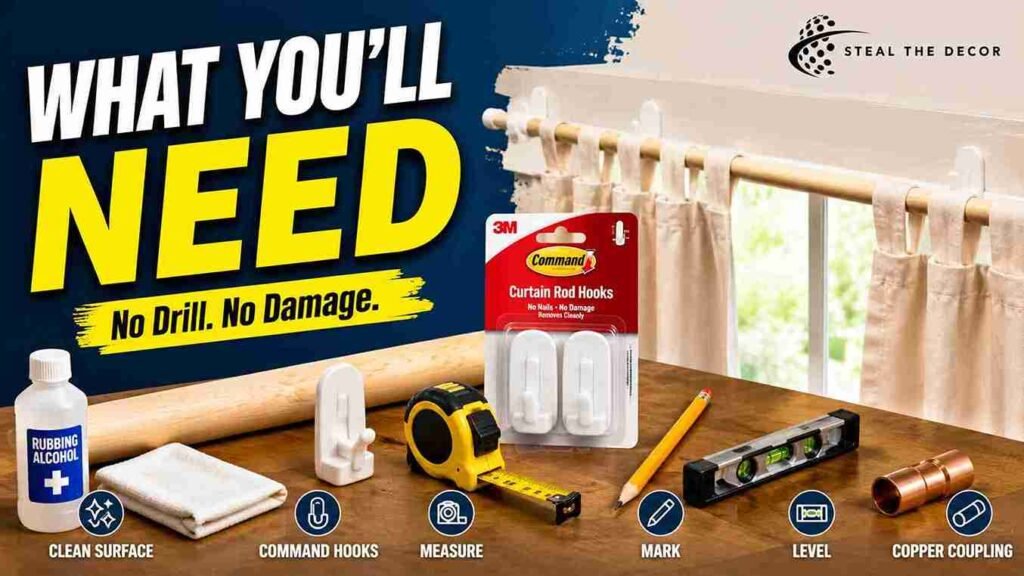
What You’ll Need
Gather a wooden dowel (¾” diameter, a few inches wider than your window), a pack of Command™ Curtain Rod Hooks by 3M ($8–$12), rubbing alcohol, a lint-free cloth, a pencil, a level, and a measuring tape. For windows wider than one dowel length, grab a copper coupling ($3–$5) to join two pieces. No drill, no anchors, no trip to the fastener aisle.
I also picked up curtain rings after my rod-pocket curtains snagged — more on that disaster below — and if your cord situation near the window is as messy as mine was, it’s worth a quick fix with this guide to hiding lamp cords while you’re already mid-project. And if you’re tackling other no-drill wins in the same room, this pairs naturally with a rental-friendly accent wall, a gallery wall without nails, or even hanging plants without drilling near the same window. Bottom line: this whole list runs under $40, and every piece of it is reusable somewhere else later.
How to Choose the Right Dowel
A ¾-inch wooden dowel is the sweet spot — thick enough not to bow, thin enough to actually seat in a standard Command hook cradle. Anything under ⅝ inch flexes noticeably. Anything over 1 inch might not fit the hook at all. Not great either direction.
Measure your window and add 6–8 inches total so curtains can stack fully open without blocking the glass. Over 48 inches? Buy two dowels and a copper coupling to join them at the center — which, conveniently, is also exactly where you’ll want a third hook. I stained mine to match a thrifted nightstand, borrowing the same finishing approach I’d used framing a cheap poster without a frame.
If you want the dowel itself to feel like a design statement rather than a workaround, it’s worth studying how a well-styled grid gallery wall with adhesive strips or a piece of large-scale wall art balances function and looks in the same room. Bottom line: size the dowel up, not down — a too-thin rod is the number one cause of sagging, and I learned that the annoying way.
Can Command Hooks Actually Hold a Dowel Curtain Rod?
Yes — within their stated limits. Command™ Curtain Rod Hooks by 3M are rated for up to 10 pounds per pair on a clean, painted wall, per the official Command installation instructions. That covers a lightweight cotton or sheer panel just fine. It does not cover a pair of blackout curtains, which can weigh 3–5 pounds each before the dowel’s own weight gets added on top.
My setup held perfectly for six weeks with two linen-blend panels and only began to droop slightly in month two — a sign I was near the limit, not comfortably under it. The same weight-limit logic applies to damage-free ways to hang large mirrors: adhesive hardware is only as strong as its rating, no matter what you’re hanging from it. Skip this method entirely on freshly painted (under 30 days), textured, or wallpapered walls — the adhesive won’t cure properly, full stop. Bottom line: this is genuinely deposit-safe for light-to-medium curtains, not a substitute for a mounted rod under heavy drapery.
How Many Command Hooks Do You Need?
For a window under 36 inches with sheer curtains, two end hooks do the job. For a medium window with light cotton panels, use two hooks and watch for any dip after 24 hours. Past 48 inches? A center hook isn’t optional — it’s mandatory.
| Curtain Setup | Recommended Support |
|---|---|
| Small window + sheer curtain | 2 end hooks |
| Medium window + light cotton curtains | 2–3 hooks |
| Wide window (48″+) | 2 end hooks + 1 center hook |
| Heavy blackout curtains | Skip Command hooks — use a stronger bracket |
Your total load includes the dowel itself — a ¾-inch dowel alone weighs close to a pound before curtains ever touch it, the same way styling a blank wall behind a TV means accounting for cable weight, not just the shelf itself. Not gonna lie — I under-hooked a 52-inch window on my first try and watched it sag within a day. Added the center hook. Fixed it instantly. Bottom line: when in doubt, add a hook.
Pro Tips for Renters:
- Test the adhesive on a hidden patch of wall first — some builder-grade paint takes Command Strips differently than standard latex, and you won’t find out until it’s too late.
- Buy one extra hook pack, even if the math says you don’t need it. You’ll need it.
- Mark hook positions with painter’s tape before pencil — it’s removable if your level was off.
- Let the dowel sit unweighted for a day before adding heavier curtains.
- If you’re re-thinking the wall behind the curtains too, this method pairs well with peel-and-stick wallpaper for renters as a same-weekend project.
How to Measure Your Window
Measure the window’s actual width, then add 3–4 inches per side so curtains clear the glass when open. This is the single most common mistake renters make — myself included, on attempt one. Decide length next: 4–6 inches above the frame for a classic look, or closer to the ceiling for something taller and more dramatic. Mark both end-hook positions with an actual level, not by eye. A rod off by a quarter inch over 48 inches will look crooked once curtains hang, and you will notice it every single day.
This same measure-twice habit is exactly what makes a project like an area rug over carpet or hanging a heavy mirror without studs go smoothly instead of needing a redo. Bottom line: measure the window, then measure your marked hook positions a second time — before you peel a single liner.
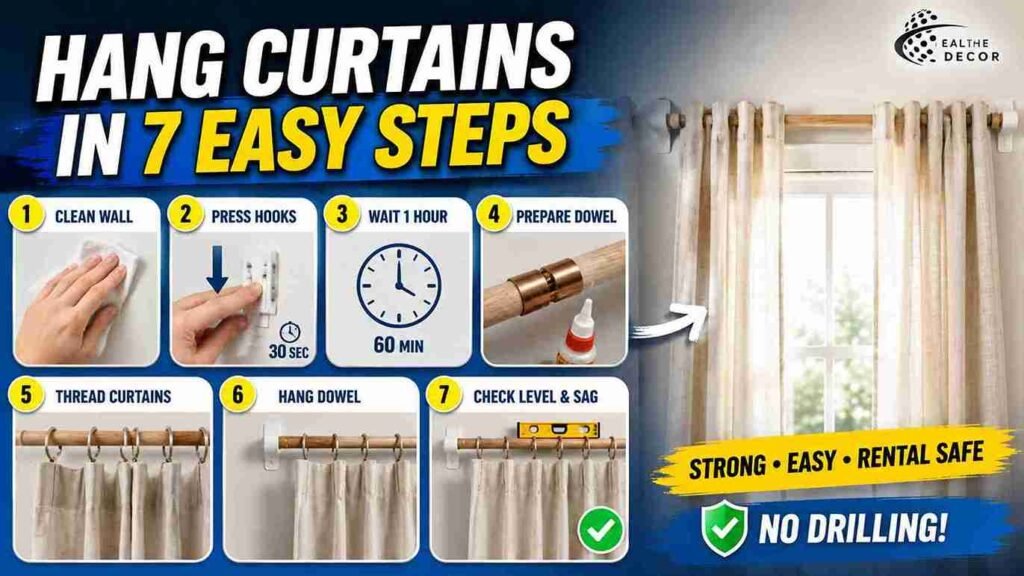
Step by Step: Hanging the Curtains
Step 1: Clean the wall. Wipe the marked area with rubbing alcohol and let it dry fully. Skip this, and you’ll have a peeling hook within a week. Guaranteed.
Step 2: Position and press the hooks. Remove the liner, press each hook firmly, and hold for 30 seconds.
Step 3: Wait a full hour. The adhesive needs real time to bond before it can bear any weight — set a timer and walk away. Actually walk away.
Step 4: Prepare your dowel. If you’re joining two dowels with a copper coupling, add a little wood glue and let it set for 20–30 minutes.
Step 5: Thread your curtains. Slide panels or curtain rings onto the dowel before hanging it — far easier on a table than mid-air, trust me on that one.
Step 6: Hang the dowel. Lift the threaded dowel into the hook cradles, one end at a time, then adjust spacing.
Step 7: Check for level and sag. Step back and look from across the room. A visible dip means it’s time to add a center hook — don’t wait it out.
This “wait, then test, then adjust” order is the same sequence I now use for smaller projects, including hanging a tapestry without damage the following month, and it’s worth applying to a rental bathroom refresh like vinyl floor stickers too. Bottom line: the whole process takes about 90 minutes, and 60 of those minutes are just you waiting for adhesive to cure.
Best Curtains for a Dowel Rod
Back-tab curtains are the easiest match — the loops sit flush against the dowel and slide smoothly across the hooks. Hidden-tab curtains work nearly as well and hide the dowel entirely when closed. Rod-pocket curtains are the trickiest one on this list. The seam catches directly on the hook cradle — which is exactly what happened to me before I switched to clip rings. Grommet curtains can work if the grommet fits the dowel snugly. Sheer curtains are the lightest and safest option for weight capacity, hands down.
Skip blackout curtains for this method entirely — too much sustained weight over time. Curtain fabric choice matters here the same way it does when picking between a best aesthetic removable wallpaper for a small bedroom and heavier options like rental-friendly wall paneling — lighter materials simply hold up better on adhesive hardware. Bottom line: back-tab or hidden-tab curtains in a lightweight fabric are your safest match.
Products We Actually Recommend
Command™ Curtain Rod Hooks by 3M ($8–$12) are the backbone of this whole project — purpose-built for slim rods. An unfinished poplar wood dowel ($5–$9) takes stain or paint evenly. A copper pipe coupling ($3–$5) from the plumbing aisle is sturdier than most plastic dowel connectors sold for crafts. A set of clip curtain rings ($10–$15) solves rod-pocket snagging instantly. If you’d rather skip the DIY dowel altogether, a pre-made no-drill curtain rod bracket ($15–$25) is a solid alternative — the same category of hardware that makes Command hooks for kitchen organization so useful beyond just curtains.
| Product / Method | Price Range | Ease of Use (1–5) | Damage Risk | Best For | Our Rating |
|---|---|---|---|---|---|
| Command™ Curtain Rod Hooks by 3M | $8–$12 | ⭐⭐⭐⭐⭐ | ✅ None | Lightweight dowel rods | 5/5 |
| Poplar wood dowel (unfinished) | $5–$9 | ⭐⭐⭐⭐⭐ | ✅ None | Custom-length rods | 5/5 |
| Copper pipe coupling | $3–$5 | ⭐⭐⭐⭐ | ✅ None | Joining two dowels on wide windows | 4/5 |
| Clip curtain rings (set of 7) | $10–$15 | ⭐⭐⭐⭐ | ✅ None | Rod-pocket curtains that snag | 4/5 |
| No-drill curtain rod bracket | $15–$25 | ⭐⭐⭐⭐ | ⚠️ Minor residue on removal | Renters who want a pre-made rod | 4/5 |
Bottom line: total project cost lands well under $40 if you already own curtains.
Common Mistakes People Make
Skipping the one-hour wait time. My very first mistake. I hung curtains within ten minutes and watched one slide down the wall by dinnertime. Should’ve known better.
Using a dowel that’s too thin. Anything under ⅝ inch bows visibly across a window wider than 36 inches.
Skipping the center hook on wide windows. It feels unnecessary—until the rod dips, and now you’re re-marking a hook you could’ve installed the first time around.
Choosing rod-pocket curtains without testing fit. The seam catches on the hook cradle and makes curtains hard to slide.
Hanging on a fresh or textured wall. The same caution applies whether you’re installing hooks or trying a faux brick wall treatment — under-cured paint and textured surfaces both reduce adhesive contact, dramatically.
Overloading with blackout curtains. Two hooks rated for 10 pounds combined will still strain under blackout fabric plus a dowel’s weight over time.
Troubleshooting: Sagging, Slipping, and Peeling
Sagging in the middle almost always means one fix: add a center hook. It solved my own issue in five minutes flat. A peeling hook usually means the wall wasn’t cleaned thoroughly, or the cure hour got skipped — remove it, re-clean, and start fresh rather than re-pressing a partially failed strip. Curtains that won’t slide smoothly? Nine times out of ten it’s rod-pocket curtains catching on the hook cradle — clip rings fix this instantly.
If a hook falls entirely, use a fresh adhesive strip rather than reusing the old one, and try a slightly different section of wall. This same “diagnose before you redo” approach saved me a repeat trip when I first tried to hide ugly wall vents near this same window and got the fit wrong on the first attempt too. Old habits, apparently.
How to Remove Command Hooks Without Damaging the Wall
Slide the hook off its adhesive base first, then gently stretch the strip tab straight down along the wall — not outward — for at least 15 inches to release it cleanly, per Command’s official guidance. Pulling the hook straight off instead of stretching the strip is the most common way people end up with paint damage. Don’t rush this part.
If you’re clearing the wall to try something new afterward, this is also the moment to remove wallpaper without damaging paint or swap in a fresh removable kitchen backsplash elsewhere in the space while you’re already in project mode. Bottom line: stretch, don’t pull, and the wall looks untouched.
Alternatives to Command Hooks and a Dowel
If your curtains are heavier than this method supports, a tension rod wedges inside the window frame with no adhesive at all. A magnetic curtain rod works well on metal window frames. No-drill curtain rod brackets with stronger adhesive (rated 20–30 pounds) handle heavier fabric without complaint.
For a decorative twist without hardware, borrow the layered look from washi tape faux wall frames, or lean into texture with a removable wall decal treatment around the window instead of fabric altogether. And if you’re chasing a similar no-drill fabric look elsewhere in your rental, it’s worth reading how fabric worked as wallpaper in a different room of my apartment. Bottom line: match the alternative to your actual curtain weight, not the prettiest option in the aisle.
What to Check With Your Landlord First
Confirm your lease doesn’t have a blanket “no adhesive products” clause — some do, regardless of how removable the product claims to be. Check for building rules on window treatments visible from outside. Photograph your walls before you start, for a clear before-and-after record. Keep the Command hook packaging in case you need the weight rating later.
For general renter protections in the US, the HUD tenant rights resource is a solid starting point if a lease clause feels unclear. Bottom line: a five-minute lease check now is cheaper than a deposit dispute later.

Real Results: What I Got for $38.50
Here’s the actual breakdown: one ¾-inch poplar dowel ($7.20), one pack of Command curtain rod hooks ($9.98), a second pack for the center hook ($9.98), a copper coupling ($3.79), and a seven-pack of clip curtain rings ($7.55) after my rod-pocket curtains kept snagging — total, $38.50.
And the honest failure: my first attempt sagged within 24 hours because I skipped the center hook, and one end hook peeled because I rushed the wait time. Not my finest morning. The fix took under 20 minutes. Six weeks later, the rod is still level, and the hooks show zero sign of peeling.
If you’re on a budget streak, this pairs well with the ideas in a rental kitchen makeover on a budget or brightening the room further with a dark room lighting fix once the curtains are up, and you can actually see what the space needs. Bottom line: under $40 and about 90 minutes of active work got me a curtain rod that’s held for six weeks and counting.
Key Takeaways
- Command™ Curtain Rod Hooks by 3M hold up to 10 pounds per pair and fit rod diameters of 0.5″ to 0.75″, making them a deposit-safe option for lightweight curtain rods in rental apartments.
- A ¾-inch wooden dowel is the ideal thickness for most rental windows, balancing rigidity with a diameter that fits standard curtain rod hooks.
- Windows wider than 48 inches need a center hook in addition to two end hooks to prevent sagging.
- Back-tab and hidden-tab curtains glide most smoothly on a dowel rod, while rod-pocket curtains are most likely to snag.
- Cleaning the wall with rubbing alcohol and waiting a full hour before hanging weight is the single most important step for adhesive hook longevity.
- Removing Command hooks by stretching the adhesive strip straight down the wall — rather than pulling it off directly — prevents paint damage at move-out.
- A complete Command hook and dowel curtain rod project typically costs between $35 and $45 and takes about 90 minutes, most of which is adhesive cure time.
Final Thoughts
A bare window is one of those small rental frustrations that’s easy to put off — until you’re staring at it for the fifth week running. Two things worth remembering: size your dowel correctly and don’t skip the one-hour wait, and add a center hook on any window wider than 48 inches before you find out the hard way that you needed one.
Have you tried a Command hook curtain rod in your own rental? I’d love to know what worked and what didn’t for you — drop it in the comments below. If you’re on a roll with no-drill wins, this pairs nicely with a removable boho mural, peel-and-stick wood planks, temporary interlocking flooring, or simply decorating a rental room by room without damage.
I’ve also covered keeping a rug from bunching on carpet, cleaning a vintage rug, the best kelvin for a living room, covering a boob light without replacing it, and hanging plug-in pendant lights from the ceiling if lighting is next on your list. All the products I tested and recommend are linked above — I’ve tried every single one myself, sagging attempts included.
FAQ: How to hang curtains with command hooks and a dowel
Can Command hooks hold a wooden dowel?
Yes — Command™ Curtain Rod Hooks by 3M are designed for slim rods between 0.5″ and 0.75″ in diameter and hold up to 10 pounds per pair on a clean, painted wall. A ¾-inch wooden dowel with lightweight curtains fits comfortably within that range.
How much weight can Command curtain hooks hold?
Up to 10 pounds per pair when installed correctly on smooth painted drywall. That covers one to two lightweight or sheer curtain panels plus the dowel itself — but not heavy blackout fabric.
How many hooks do I need for curtains?
Two end hooks for windows under 48 inches with lightweight curtains. Add a center hook for anything wider, or for curtains on the heavier end of what the hooks can support.
Can I use blackout curtains with a Command hook dowel rod?
It’s not recommended. Blackout fabric plus a dowel’s weight can exceed the hooks’ rated capacity over time, leading to sagging or peeling.
Will Command hooks damage painted walls?
No — when removed correctly, they leave painted walls residue-free. Stretch the adhesive strip straight down the wall to release it rather than pulling the hook off directly.
How do I remove Command hooks without damaging the wall?
Slide the hook off its base, then stretch the adhesive strip tab down along the wall for at least 15 inches until it releases. Pulling straight off is the most common cause of paint damage.
Is a dowel curtain rod better than a standard curtain rod?
For renters who can’t drill, yes — it’s fully removable and damage-free. It’s not stronger than a drilled installation, but it’s the safer choice for a rental.